
Many SEO professionals understand how to build Private Blog Networks (PBNs), but many are less familiar with what makes a network easier to recognize. A PBN can include quality domains, relevant content, and a well-planned backlink strategy, yet repeated similarities across websites can create identifiable signals known as PBN Footprints. Recognizing and reducing these signals is an important part of managing any long-term PBN strategy.
PBN Footprints are the technical, editorial, and behavioral similarities that can connect multiple websites within the same network. They may include repeated hosting environments, similar website designs, ownership details, content patterns, anchor text usage, or linking behavior. While a single similarity does not automatically indicate a footprint, multiple recurring signals can make websites appear more closely related.
Understanding PBN Footprints is about more than avoiding common mistakes. It also helps website owners build networks that are better organized, easier to manage, and more consistent with long-term SEO practices. Identifying potential footprints early allows you to make better decisions when building, maintaining, or expanding a Private Blog Network.
In this guide, you’ll learn what PBN Footprints are, why they matter, how search engines evaluate website patterns, the most common types of footprints, how to identify and prevent them, the tools that can help audit your network, and the best practices for maintaining a more sustainable PBN strategy.
What Are PBN Footprints?
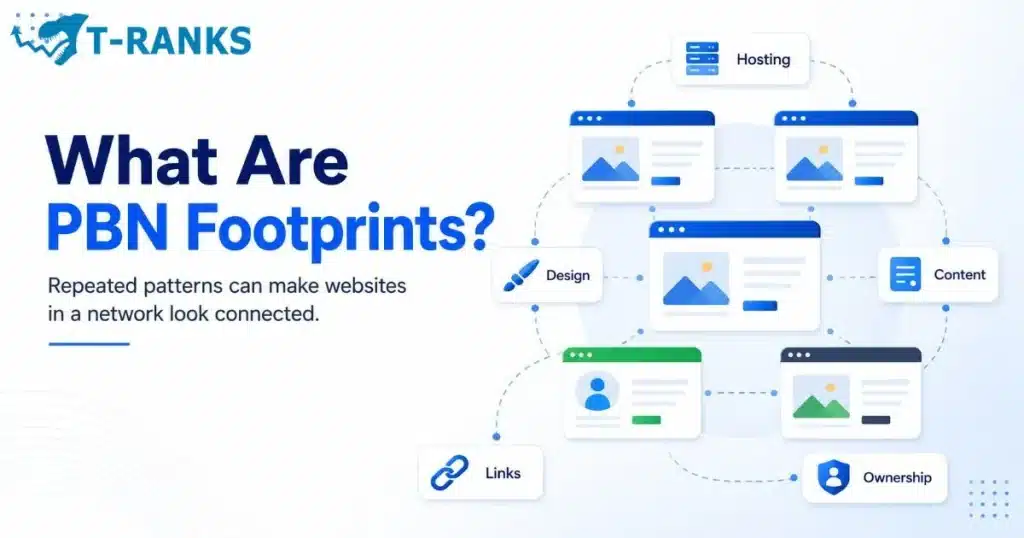
PBN Footprints are the identifiable patterns or similarities that can connect multiple websites within a Private Blog Network (PBN). These patterns may be created through shared hosting environments, similar website designs, ownership details, content structures, anchor text usage, or other repeated characteristics that make websites appear related instead of independent.
A PBN is designed to operate as a collection of separate websites, but when those websites repeatedly share the same technical or editorial characteristics, they begin to leave recognizable signals. While a single similarity is not usually enough to identify a network, multiple recurring patterns can make the relationship between websites more apparent.
This is why experienced SEO professionals pay close attention to PBN Footprints when building or managing a network. The goal is not simply to create backlinks but to ensure each website appears natural, well-maintained, and independent. Factors such as unique content, relevant topics, varied website designs, and thoughtful network management all contribute to reducing unnecessary similarities across websites.
Understanding PBN Footprints is an important part of long-term PBN management. Identifying these patterns early allows website owners to improve their networks before expanding them further. The following sections explain why PBN Footprints matter, how they are evaluated, and the best practices for identifying and reducing them.
Why Do PBN Footprints Matter for SEO?
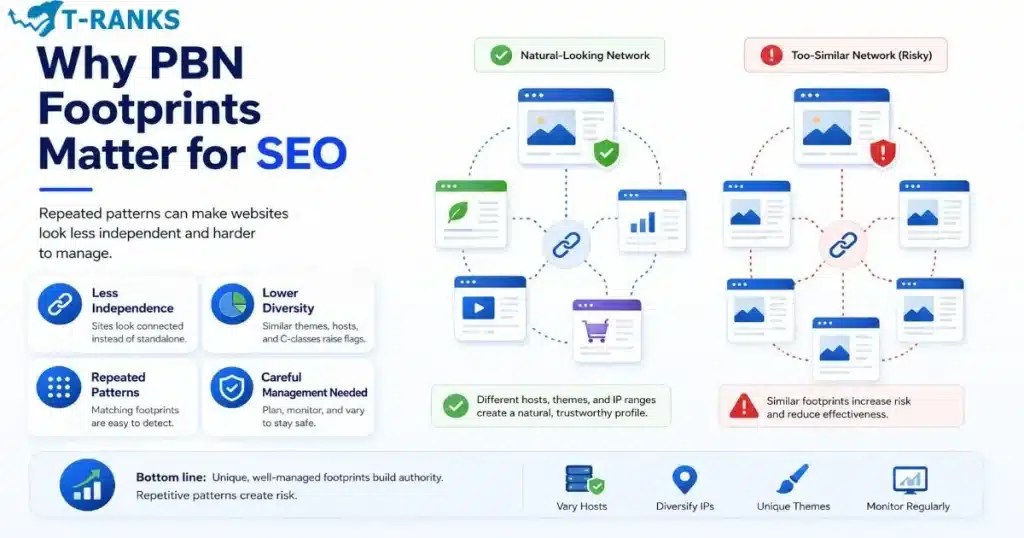
PBN Footprints matter because repeated technical, editorial, and linking patterns can make websites within a Private Blog Network (PBN) appear less independent. Understanding and reducing these similarities helps website owners build more natural-looking networks and manage them more effectively over the long term.
Building a successful PBN involves much more than acquiring quality domains and creating backlinks. Every website should operate as an independent property with its own design, content, publishing schedule, and overall management. When too many characteristics are repeated across multiple websites, those similarities can gradually create recognizable PBN Footprints.
PBN Footprints matter because they can:
- Make websites within a network appear more closely related.
- Reduce the natural diversity of a PBN.
- Create repeated technical, editorial, and linking patterns.
- Increase the importance of careful network management.
It is also important to understand that a single shared hosting provider, WordPress theme, plugin, or content style does not automatically create a footprint. Many legitimate websites naturally use similar technologies and publishing practices. What generally matters is the overall combination of recurring patterns across an entire network rather than one characteristic on its own.
For this reason, experienced SEO professionals focus on building networks that emphasize quality, diversity, and natural variation instead of following identical processes for every website. Preventing unnecessary similarities from the beginning is often easier than trying to correct them after a network has expanded.
How Search Engines Evaluate PBN Footprints
Search engines evaluate PBN Footprints by assessing multiple website signals rather than relying on a single characteristic. Instead of looking for one specific footprint, they evaluate the overall relationship between websites to determine whether they appear to operate independently or as part of the same network.
Understanding this process is important because no single technical or editorial similarity automatically identifies a Private Blog Network (PBN). Many legitimate websites naturally share hosting providers, content management systems, plugins, or design elements. It is usually the combination of recurring patterns across multiple websites that provides a clearer picture of how those websites are related.
Technical Signals
Search engines may evaluate technical characteristics that appear across multiple websites. These can include hosting environments, DNS configurations, website infrastructure, and other recurring technical similarities. On their own, these signals are not enough to identify a PBN, but repeated patterns across an entire network may contribute to the overall evaluation.
Content and Editorial Signals
Content quality and editorial consistency also play an important role. Websites with repetitive content structures, thin articles, identical publishing styles, or limited topical value may appear less independent when those similarities occur repeatedly across a network. Original, well-maintained, and topic-relevant content helps each website establish its own identity.
Linking Patterns
Linking behavior is another area that may be evaluated. Repeated anchor text, predictable outbound linking, or highly similar linking structures across multiple websites can create recurring patterns. Maintaining natural anchor text variation and linking practices helps build a more balanced backlink profile.
Overall Website Relationships
Rather than relying on one footprint, search engines evaluate the overall relationship between websites. Technical configurations, editorial quality, content relevance, publishing behavior, and linking patterns are all considered together to build a broader understanding of how websites are connected.
For this reason, experienced SEO professionals focus on creating websites that operate independently instead of repeating identical processes across an entire network. Prioritizing quality, topical relevance, natural variation, and ongoing website management helps reduce unnecessary similarities while supporting a more sustainable SEO strategy.
Common Types of PBN Footprints
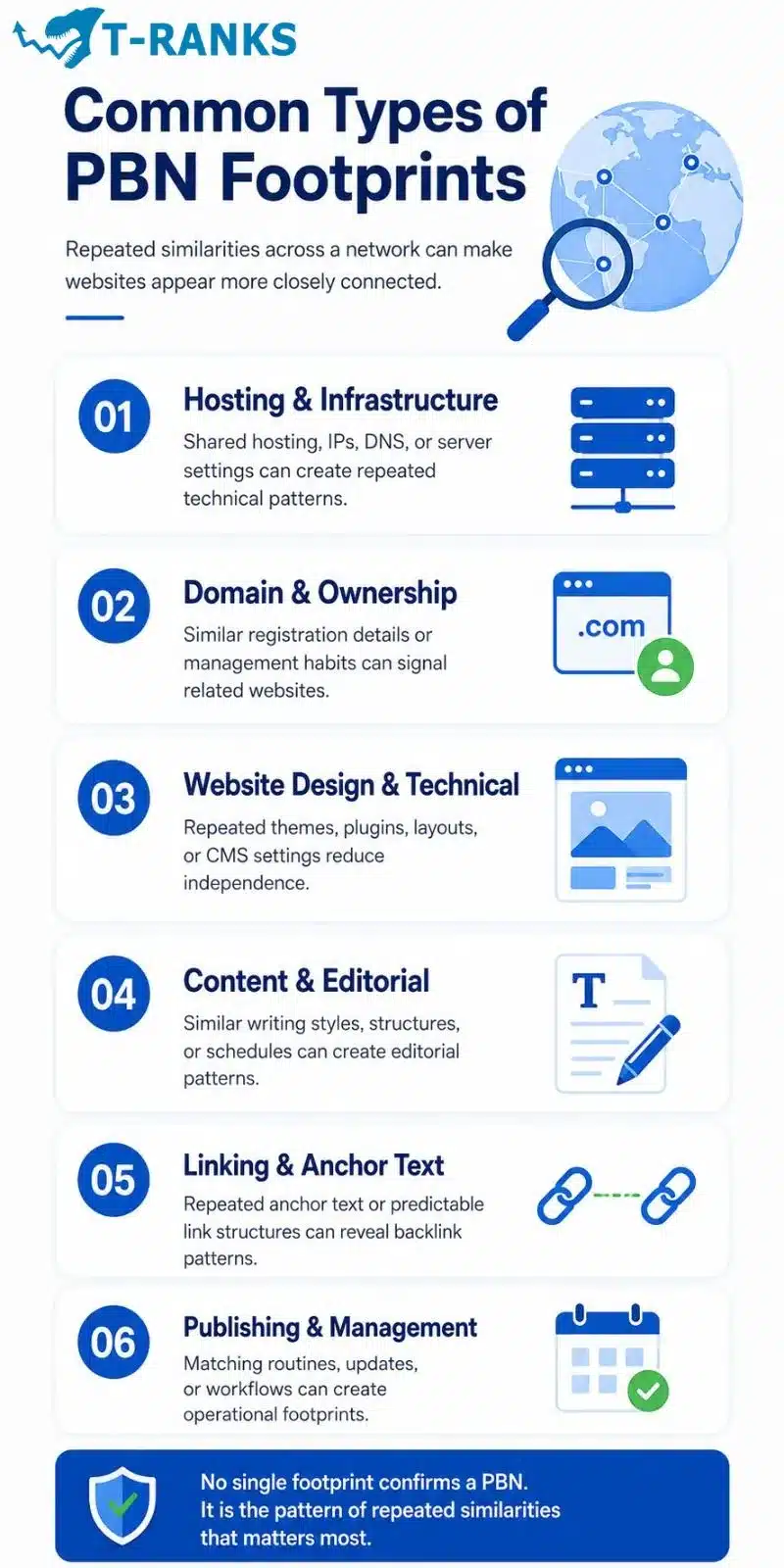
PBN Footprints can appear in different areas of a Private Blog Network, including its technical setup, website management, content, and linking practices. While no single footprint automatically identifies a PBN, repeated similarities across multiple websites can gradually make a network appear more closely connected.
Understanding these footprint categories helps website owners recognize where recurring patterns may develop and manage their networks more effectively.
The most common PBN Footprints include:
- Hosting and infrastructure similarities
- Domain registration and ownership patterns
- Website design and technical configurations
- Content and editorial similarities
- Linking and anchor text patterns
- Publishing and management practices
1. Hosting and Infrastructure Footprints
Hosting and infrastructure footprints occur when multiple websites repeatedly share similar technical environments. These similarities may involve hosting providers, IP addresses, DNS configurations, or server settings. Although legitimate websites often share infrastructure, repeated technical patterns across an entire network can reduce its overall diversity.
2. Domain and Ownership Footprints
Domain and ownership footprints relate to how websites are registered and managed. Similar registration dates, ownership information, domain management practices, or registration patterns may create recurring signals when they consistently appear across multiple websites. Managing each domain independently helps reduce unnecessary similarities.
3. Website Design and Technical Footprints
Website design and technical footprints develop when websites repeatedly use identical themes, layouts, plugins, CMS settings, navigation structures, or visual elements. Similar technologies are common across the web, but using the same design approach throughout an entire network can make websites appear less independent.
4. Content and Editorial Footprints
Content and editorial footprints appear when multiple websites publish similar writing styles, content structures, publishing schedules, or low-value pages. Creating original, topic-focused, and regularly updated content helps each website establish its own editorial identity while reducing repeated content patterns.
5. Linking and Anchor Text Footprints
Linking and anchor text footprints are created through repeated linking behavior across a network. Consistently using the same anchor text, predictable outbound linking patterns, or similar link structures may create recurring signals. Maintaining varied anchor text and natural linking practices helps support a more balanced backlink profile.
6. Publishing and Management Footprints
Publishing and management footprints develop through repeated administrative processes. Similar publishing schedules, update routines, maintenance practices, or website management workflows can create operational patterns across multiple websites. Treating each website as an independent property helps reduce these similarities and encourages greater diversity throughout the network.
No single footprint automatically identifies a Private Blog Network. Instead, PBN Footprints are better understood as a combination of recurring technical, editorial, and linking similarities that appear across multiple websites. Evaluating these categories together provides a more complete understanding of how a network is managed and where improvements may be needed.
How to Identify PBN Footprints
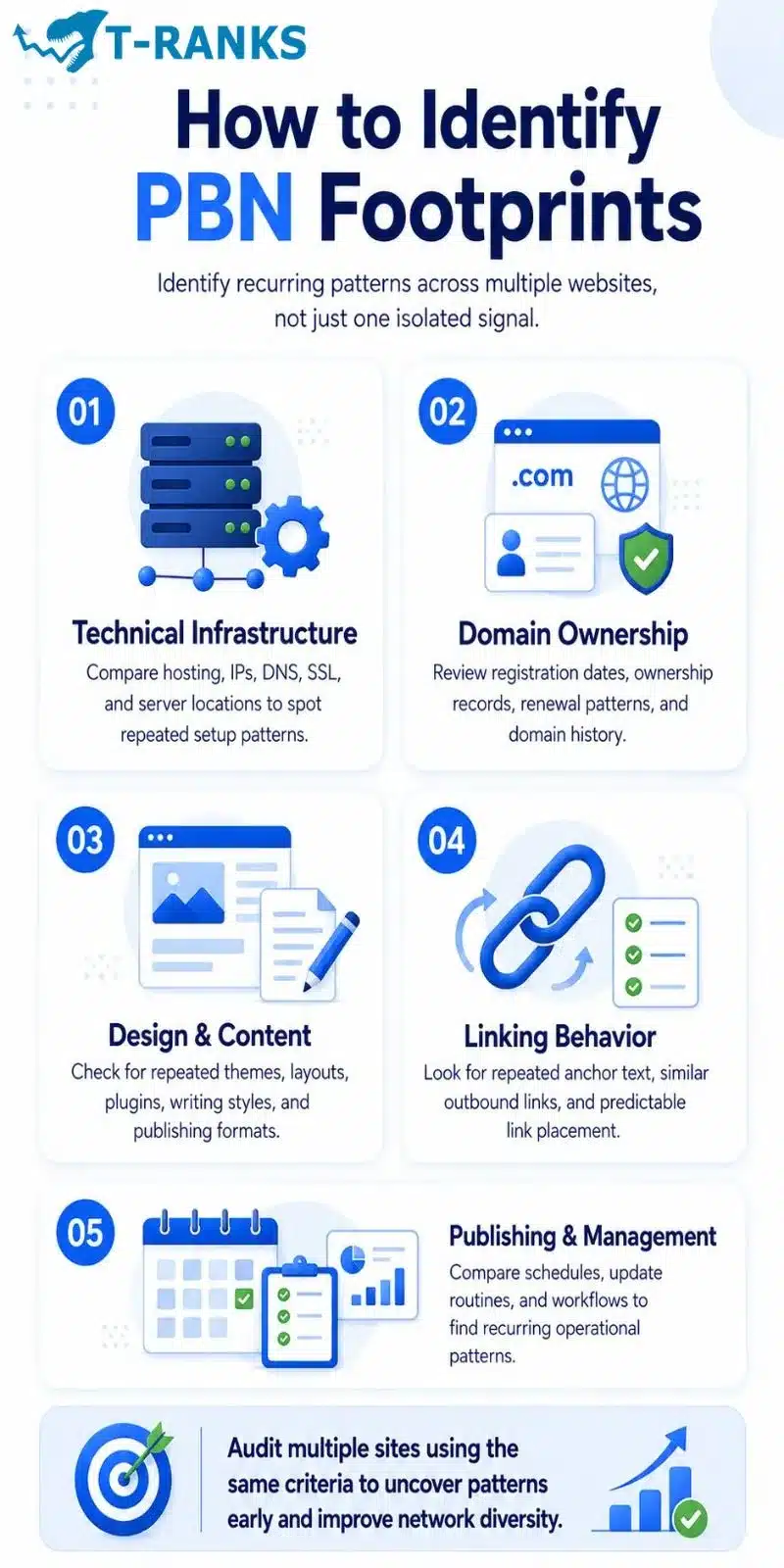
Identifying PBN Footprints is about recognizing recurring patterns across an entire network rather than looking for one isolated issue. A single shared hosting provider, website theme, or plugin is not usually enough to identify a footprint. Instead, you should evaluate multiple websites together and look for repeated similarities that reduce the network’s overall diversity.
The review process becomes much easier when you examine each website using the same criteria. Comparing technical settings, content, design, linking behavior, and publishing practices across the network helps reveal patterns that may not be obvious when reviewing a single website.
When auditing a Private Blog Network, review these key areas:
- Technical infrastructure
- Domain registration and ownership
- Website design and technical setup
- Content and editorial quality
- Linking and anchor text usage
- Publishing and management practices
1. Review the Technical Infrastructure
Start by comparing the technical setup of every website in the network. Look at hosting providers, IP addresses, DNS configurations, SSL certificates, and server locations. While many legitimate websites naturally share some technical elements, repeated infrastructure patterns across multiple websites are worth investigating further.
2. Review Domain Registration and Ownership
Next, review how domains are registered and managed. Compare registration dates, ownership records, domain history, renewal patterns, and other administrative details. Consistent ownership or registration practices across many websites may indicate recurring management patterns.
3. Review Website Design and Content
Carefully compare the appearance and content of each website. Repeated themes, layouts, plugins, navigation structures, writing styles, or publishing formats can gradually create recognizable similarities. Every website should have its own design, editorial approach, and topical focus.
4. Review Linking Behavior
Look at how websites link to other pages both internally and externally. Repeated anchor text, similar outbound linking patterns, or predictable link placement across multiple websites may indicate recurring linking practices. A natural backlink profile usually includes greater variation.
5. Review Publishing and Website Management
Finally, examine how each website is maintained over time. Compare publishing schedules, update frequency, maintenance routines, and administrative workflows. Websites that follow identical management patterns over long periods may gradually develop operational footprints.
Identifying PBN Footprints is not about proving that a network exists based on one similarity. The objective is to connect recurring patterns across multiple websites and evaluate whether they reduce the overall independence of the network. Regular audits make it easier to recognize these patterns early and improve the quality and diversity of the network over time.
Best Practices to Avoid PBN Footprints
The most effective way to avoid PBN Footprints is to build and manage every website as an independent, high-quality property rather than as another site within a network. Instead of trying to hide individual footprints, focus on reducing repeated technical, editorial, and operational similarities across your websites. A network built around quality, diversity, and long-term management naturally creates fewer recurring patterns than one built around shortcuts.
There is no single technique that completely prevents PBN Footprints. Effective footprint management comes from consistently applying good practices across every website. The objective is to create websites that have their own purpose, content, design, and publishing strategy instead of following identical processes throughout the network.
To reduce unnecessary PBN Footprints, focus on these best practices:
- Build every website as an independent property.
- Diversify technical infrastructure where appropriate.
- Publish original, topic-focused content.
- Maintain natural linking practices.
- Manage and update websites individually.
- Audit the network regularly.
1. Build Every Website as an Independent Property
Every website should serve its own purpose instead of existing only to support another site. Give each website its own audience, branding, content strategy, publishing schedule, and editorial direction. The more independent each property becomes, the fewer recurring patterns develop across the network.
2. Diversify Your Technical Infrastructure
Avoid relying on identical technical configurations for every website. Where appropriate, vary hosting environments, DNS settings, website themes, plugins, CMS configurations, and other infrastructure elements. The objective is not to make every website completely different but to avoid unnecessary repetition across the network.
3. Publish Original, High-Quality Content
Content should provide genuine value to readers rather than exist only to support backlinks. Create original, topic-relevant articles that match each website’s niche and maintain a consistent publishing schedule. Strong editorial quality helps every website establish its own identity while reducing repeated content patterns.
4. Use Natural Linking Practices
Links should support the surrounding content and provide value to readers. Maintain a balanced mix of anchor text, avoid repetitive linking structures, and ensure outbound links appear naturally within relevant content. A varied and contextual linking strategy creates a healthier backlink profile over time.
5. Manage Every Website Individually
Treat each website as its own project rather than managing the entire network with identical processes. Content updates, maintenance schedules, design improvements, and administrative tasks should reflect the unique needs of each website instead of following one standardized routine.
6. Audit Your Network Regularly
Footprint prevention is an ongoing process rather than a one-time setup. Regularly review technical infrastructure, content quality, linking behavior, website management practices, and overall network diversity. Periodic audits make it easier to identify recurring patterns early and address them before they spread across multiple websites.
Building a Private Blog Network is not simply about reducing footprints. It is about creating websites that remain useful, well-maintained, and genuinely independent over time. When quality, diversity, and thoughtful management become the foundation of your strategy, reducing PBN Footprints becomes a natural outcome rather than a separate task.
Common Mistakes That Create PBN Footprints
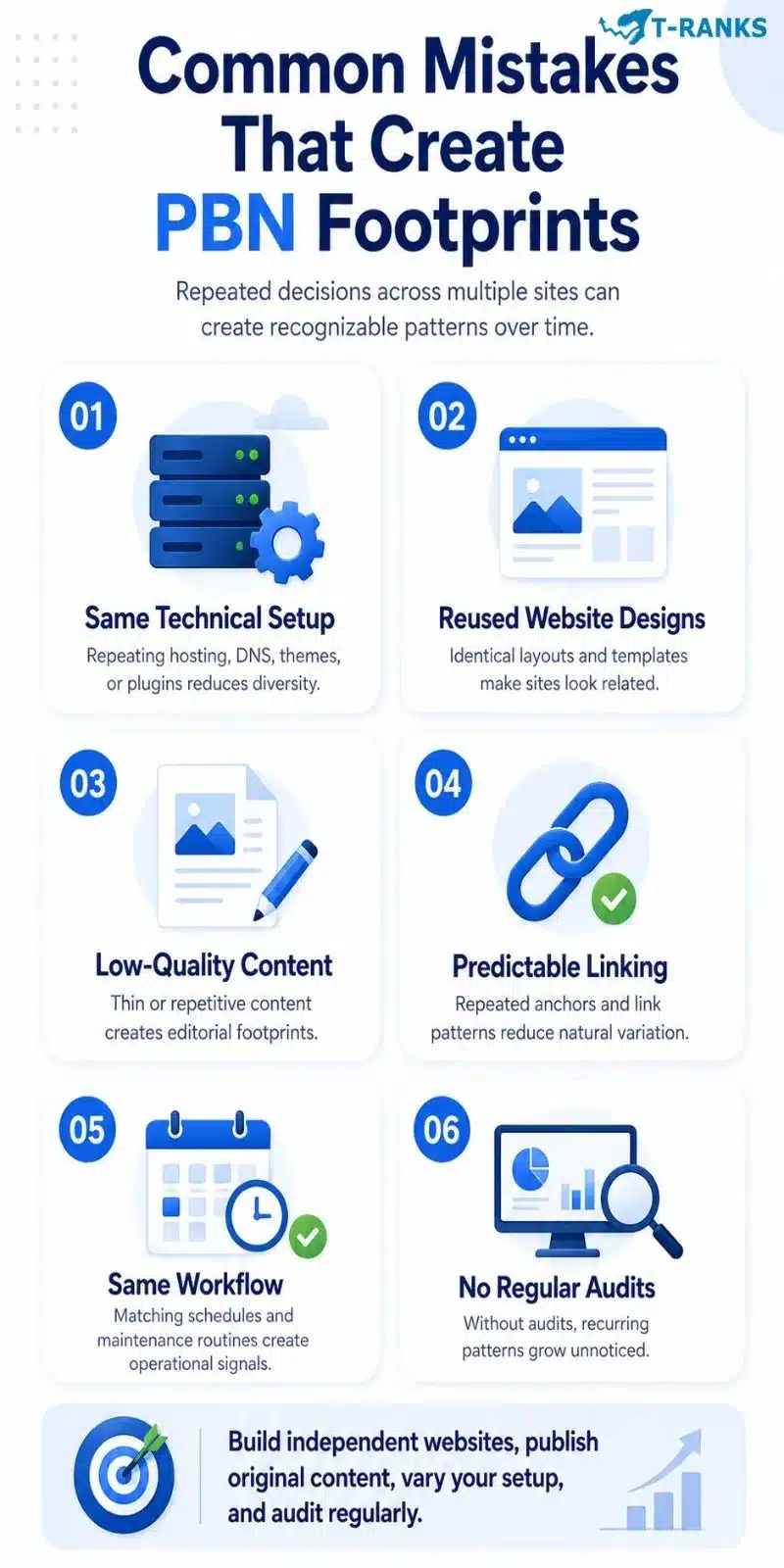
Most PBN Footprints are not created by one major mistake. They usually develop when the same technical, editorial, and management decisions are repeated across multiple websites over time.
A successful Private Blog Network should look like a collection of independent websites, not a collection of websites managed with identical processes. When every site shares the same setup, content style, publishing routine, or linking strategy, recurring similarities naturally begin to appear across the network.
The most common mistakes include:
- Repeating the same technical setup across multiple websites
- Reusing identical website designs and configurations
- Publishing repetitive or low-quality content
- Using predictable linking practices
- Managing every website with the same workflow
- Skipping regular network audits
1. Repeating the Same Technical Setup
Using the same hosting environment, DNS configuration, CMS settings, themes, or plugins across every website may simplify management, but it also reduces technical diversity. While shared technologies are common across the web, repeating the same setup throughout an entire network can create recurring technical patterns.
2. Reusing Website Designs and Configurations
Every website should have its own visual identity. Reusing the same layouts, navigation, templates, or design elements across multiple websites makes them appear more closely related. Independent websites naturally evolve with different structures, branding, and user experiences.
3. Publishing Repetitive or Low-Quality Content
Content that exists only to support backlinks often lacks originality and long-term value. Repeating similar article structures, writing styles, or publishing formats across multiple websites can gradually create editorial similarities. Original, well-maintained, and niche-relevant content helps every website build its own authority.
4. Using Predictable Linking Practices
A backlink profile should grow naturally over time. Repeated anchor text, identical link placement, or consistently linking to the same destinations creates linking patterns that reduce diversity across the network. Contextual, relevant, and varied linking practices create a healthier backlink profile.
5. Managing Every Website the Same Way
Managing every website with the same publishing schedule, maintenance routine, and administrative workflow creates operational similarities. Treating each website as an independent project allows it to develop its own publishing history and long-term identity.
6. Skipping Regular Network Audits
Many PBN Footprints develop gradually rather than all at once. Without regular reviews, recurring technical, editorial, and linking patterns may continue to grow unnoticed. Periodic audits help identify these issues early and support continuous improvements across the network.
Most PBN Footprints are the result of many small, repeated decisions rather than one obvious mistake. Building independent websites, maintaining high editorial standards, and reviewing your network consistently helps reduce recurring similarities while supporting a stronger and more sustainable long-term SEO strategy.
Tools That Help Identify PBN Footprints
Reviewing a small network manually is often manageable, but as a Private Blog Network grows, identifying recurring patterns becomes more difficult. SEO tools help organize data, compare websites, and highlight similarities that may otherwise go unnoticed. They should be viewed as part of the audit process rather than as standalone solutions.
No single tool can determine whether a website is part of a PBN. Instead, different tools provide different types of information, helping you evaluate technical setups, backlink profiles, content quality, and overall website relationships more efficiently.
The most useful tool categories include:
- Backlink analysis tools
- Technical SEO crawlers
- Domain and ownership lookup tools
- Hosting and DNS lookup tools
- Content analysis tools
- Website monitoring tools
1. Backlink Analysis Tools
Backlink analysis tools help you review referring domains, anchor text distribution, outbound links, and overall backlink patterns. They are useful for identifying repeated linking behavior and understanding how websites connect to one another.
Popular examples include Ahrefs, Semrush, and Majestic.
2. Technical SEO Crawlers
Technical SEO crawlers analyze website structure and technical configurations. They help identify crawl issues, duplicate pages, internal linking structures, metadata, redirects, and other technical elements that may reveal recurring website patterns.
Popular examples include Screaming Frog SEO Spider and Sitebulb.
3. Domain and Ownership Lookup Tools
Domain lookup tools provide information about domain history, registration details, ownership records, and historical changes. Reviewing this information helps identify recurring administrative patterns across multiple websites.
4. Hosting and DNS Lookup Tools
Hosting and DNS tools allow you to compare IP addresses, nameservers, hosting providers, and DNS records. These insights help you understand whether technical infrastructure is unnecessarily repeated across a network.
5. Content Analysis Tools
Content analysis tools help evaluate originality, duplicate content, topical relevance, and editorial consistency. They make it easier to identify repeated writing patterns or content structures that may reduce the uniqueness of individual websites.
6. Website Monitoring Tools
Website monitoring tools track uptime, content changes, technical updates, and website health over time. Regular monitoring helps identify unexpected changes while supporting ongoing network maintenance.
SEO tools provide valuable insights, but they should support—not replace—manual reviews. The most effective audits combine technical data with careful analysis, allowing you to identify recurring PBN Footprints while considering the broader context of each website.
Do PBN Footprints Always Lead to SEO Problems?
Not always. A single PBN Footprint does not automatically lead to SEO problems. Search engines evaluate the overall relationship between websites rather than one shared characteristic. Recurring technical, editorial, and linking patterns are generally more meaningful than an isolated similarity.
Many website owners assume that sharing the same hosting provider, CMS, or WordPress plugin automatically creates a dangerous footprint. In reality, these technologies are widely used across millions of legitimate websites. What matters is whether multiple recurring patterns suggest that websites are operating as part of a manipulative link-building strategy.
Examples of common similarities that do not automatically create a PBN Footprint include:
- Using the same content management system (CMS)
- Choosing a popular hosting provider
- Installing widely used WordPress plugins
- Publishing content in the same niche
- Following common website layouts
The goal is not to eliminate every shared characteristic. Instead, focus on building independent websites that publish original content, follow natural linking practices, and provide value to users. A network built around quality and diversity is less likely to develop recurring patterns than one managed with identical processes.
Conclusion
In conclusion, understanding PBN Footprints is not about trying to eliminate every shared characteristic across a Private Blog Network. It is about recognizing recurring technical, editorial, and linking patterns that can reduce the independence of your websites over time. Learning how to identify these patterns, avoid common mistakes, perform regular audits, and manage every website individually helps create a more organized and sustainable network.
A well-managed Private Blog Network is built on quality, originality, and long-term website management rather than repeated processes or short-term SEO tactics. Focusing on independent websites, natural content, diverse technical setups, and balanced linking practices creates a stronger foundation for long-term growth while reducing unnecessary similarities across your network.
Whether you’re building a new Private Blog Network or improving an existing one, treating every website as a valuable standalone property is one of the most effective ways to reduce PBN Footprints and support a more consistent SEO strategy.
Looking for professionally managed PBN backlinks with a strong focus on quality, topical relevance, and long-term sustainability? Explore T-RANKS to discover carefully built backlink solutions designed to support smarter and more strategic SEO campaigns.
FAQ About PBN Footprints
1. What are PBN Footprints?
PBN Footprints are recurring technical, editorial, or linking patterns that can connect multiple websites within a Private Blog Network. These similarities may involve hosting, content, website design, or backlink behavior and can make websites appear more closely related.
2. Can Google detect PBN Footprints?
Google can evaluate recurring patterns that may indicate a Private Blog Network, but it does not rely on one footprint alone. Search engines assess multiple technical, content, and linking signals together rather than a single shared characteristic.
3. Does sharing the same hosting provider create a PBN Footprint?
No, using the same hosting provider alone does not automatically create a PBN Footprint. Many legitimate websites share hosting providers, and recurring patterns across multiple websites are generally more important than one technical similarity.
4. What is the most common PBN Footprint?
Repeated technical setups and predictable linking patterns are among the most common PBN Footprints. Identical hosting environments, website designs, anchor text, or publishing workflows can create recurring similarities across a network.
5. How can I identify PBN Footprints?
Identify PBN Footprints by reviewing technical infrastructure, website design, content quality, linking behavior, and publishing practices across your network. Comparing multiple websites together makes recurring patterns easier to recognize than reviewing one website at a time.
6. How can I reduce PBN Footprints?
Reduce PBN Footprints by treating every website as an independent property. Publish original content, diversify technical configurations where appropriate, maintain natural linking practices, and perform regular network audits.
7. Do PBN Footprints always lead to Google penalties?
No, PBN Footprints do not automatically lead to Google penalties. SEO risk generally increases when multiple recurring patterns suggest websites are being used primarily to manipulate search rankings rather than operate independently.
8. Which tools help identify PBN Footprints?
Backlink analysis, technical SEO, hosting lookup, and content analysis tools can help identify PBN Footprints. Using multiple tools alongside manual reviews provides a more complete understanding of recurring patterns across a network.
9. What mistakes create PBN Footprints?
The most common mistakes include repeating technical setups, publishing similar content, reusing website designs, and following predictable linking patterns. These repeated decisions can gradually reduce the independence of a Private Blog Network.
10. What is the best way to avoid PBN Footprints?
The best way to avoid PBN Footprints is to build every website as a genuine, independent resource. Focus on original content, unique website management, natural linking practices, and long-term quality instead of trying to hide individual technical similarities.