Private Blog Network link providers still exist in 2026, but the way they operate, and the way Google evaluates them, has changed significantly.
Many SEO buyers search for PBN link providers assuming they are all the same. In reality, the term “provider” covers a wide range of models, from full-service agencies and managed link services to niche operators and direct execution platforms. Each model carries a different level of control, scalability, and risk. Choosing the wrong type often causes more damage than choosing the wrong seller.
This is why most “best PBN provider” lists fail to help serious SEO decisions. They focus on surface signals like pricing, DA, or promises, while ignoring how providers structure their networks, manage footprints, and scale links over time. In competitive SERPs, those structural differences matter far more than brand names.
This guide explains the PBN link provider ecosystem as it actually works in 2026. You will learn the main provider types, how their models differ, what risks each one introduces, and how to choose the right approach based on your SEO goals rather than marketing claims. The goal is not to promote sellers, but to help you understand how PBN providers function so you can make safer, more informed decisions.
What PBN Link Providers Mean in 2026

A simple definition
A PBN link provider is any person or company that controls websites and uses them to place backlinks for SEO purposes. These links are placed with the goal of improving search rankings. In 2026, this definition is wider than it used to be.
In the past, people imagined a PBN provider as one person running a small group of sites. Today, providers can operate at very different levels and in very different ways.
PBN link providers are not all the same
PBN link providers do not belong to one single category. The term includes several different models, such as:
- Agencies that plan strategy and manage risk
- Services that sell pre built PBN link packages
- Niche providers focused on specific industries
- Solo operators running their own private networks
- Resellers who sell links but do not own the sites
All of these are called providers, but they work very differently. Treating them as the same often leads to poor decisions.
How a provider operates matters more than the name
In 2026, Google does not judge PBNs simply because they exist. Google evaluates how they behave.
What matters most is:
- How domains are sourced
- How hosting is structured
- How fast links are added
- How predictable link placement looks
Providers that reuse domains, grow too fast, rely on shared hosting, or follow fixed patterns usually create higher risk. Providers that limit scale, separate networks, and manage links slowly tend to be more stable.
Why the word “provider” can be misleading
Two PBN link providers may look similar on the surface. They may show the same metrics and make similar claims. Behind the scenes, they can be completely different.
One provider may control clean, segmented networks built for long term use. Another may rely on recycled domains and shared systems. Even if the links look equal on paper, Google does not treat them the same way.
This is why metrics alone do not explain risk.
What you should focus on instead
To choose safely, you need to stop focusing on labels and start focusing on structure.
A PBN link provider should be judged by:
- The model they use
- The level of control they maintain
- How they manage scale and patterns over time
Once you understand this, it becomes much easier to evaluate risk and decide which type of provider fits your SEO goals.
In the next section, we will break down the PBN provider ecosystem and explain the main provider models you will encounter in 2026.
The PBN Provider Ecosystem Explained
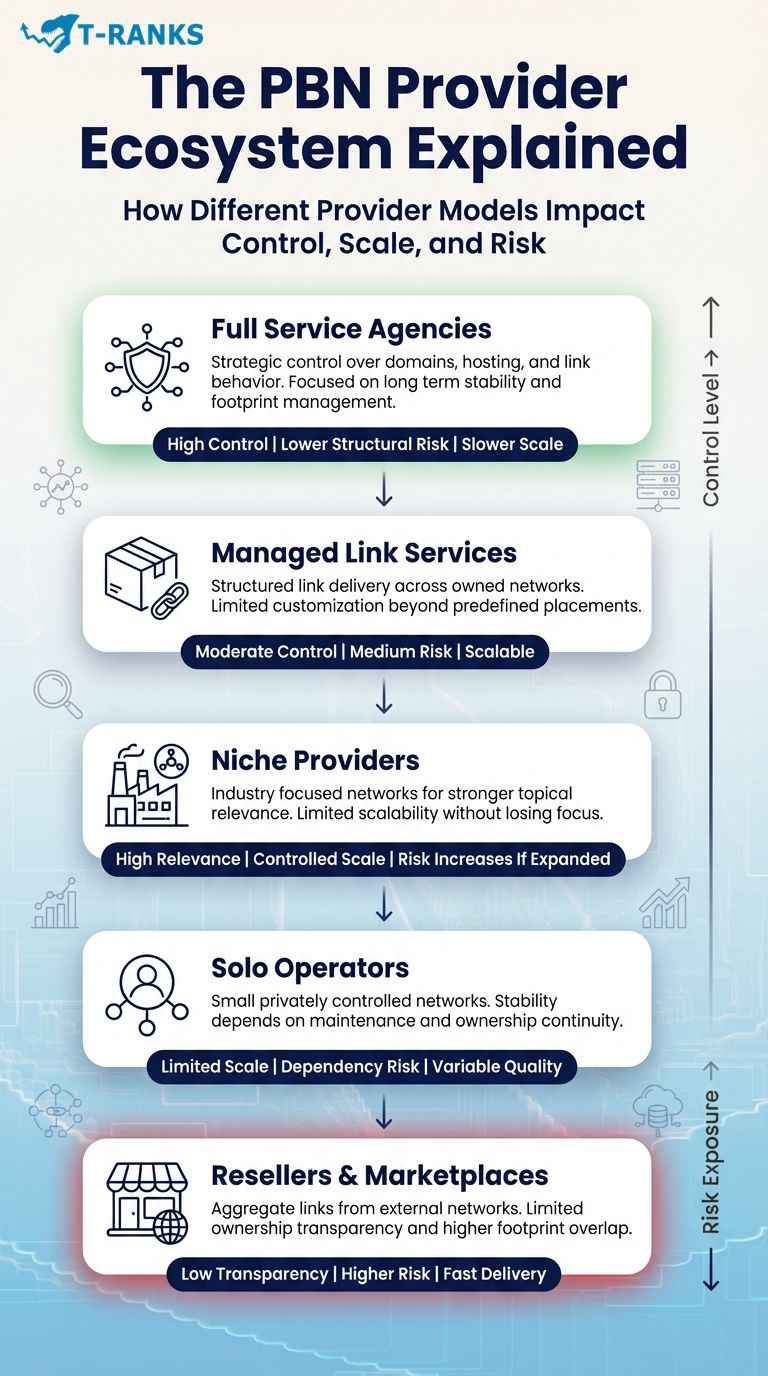
Understanding PBN link providers requires looking at the ecosystem as a whole rather than treating all providers as interchangeable. In practice, PBN providers operate under different models, each with its own approach to control, scale, and risk. These structural differences matter far more than pricing, advertised metrics, or surface level metrics.
The ecosystem exists because PBN links can be created, managed, and distributed in very different ways. Some providers prioritize long term stability and footprint control, while others focus on speed and volume. Knowing where a provider sits in this ecosystem helps explain why similar looking links can behave very differently over time.
Full service PBN agencies
Full service agencies operate at both the strategic and execution levels. They typically control domain acquisition, hosting segmentation, content standards, and link placement rules within a defined framework. The objective is not just link delivery, but managing how PBN links interact with the wider backlink profile and competitive SERP environment.
One example of this model includes T-RANKS and PBNLinks.agency, which structure PBN usage around controlled networks, segmented infrastructure, and long term footprint management rather than high volume link distribution.
This model is commonly used in competitive or long term SEO campaigns where link velocity, placement patterns, and network separation must be carefully managed. The trade off is slower scaling and higher cost, balanced by greater control and reduced structural risk.
Managed PBN link services
Managed PBN services focus primarily on link delivery rather than full campaign strategy. These providers usually offer predefined link placements across their own networks, with limited customization beyond basic relevance or anchor guidelines.
This model appeals to affiliate projects and smaller SEO teams that want predictable access to links without managing infrastructure. Risk levels depend heavily on how the service scales its network and how many clients share the same underlying assets.
Niche specific PBN providers
Niche specific PBN providers build networks centered around a single industry or topical theme, such as finance, health, local services, or SaaS. Their main advantage is contextual relevance rather than scale. When executed carefully, these networks can blend more naturally into industry content and reduce obvious topical mismatches in link placement.
This model is often used when relevance matters more than volume, especially in niches where generic links stand out easily. However, niche networks are inherently limited. Expanding too aggressively often weakens topical focus and increases footprint overlap, which can reduce long term effectiveness and stability.
Solo network operators
Solo network operators usually control a small number of websites and sell links directly, often through private outreach or limited public listings. Because scale is restricted, these networks may remain stable for longer periods if maintained properly. At the same time, quality, content standards, and maintenance vary widely between operators.
This model is typically used for testing, small projects, or short term campaigns. The primary risk is dependency. Buyers have little control if the operator changes direction, repurposes domains, or stops maintaining the network.
Resellers and marketplaces
Resellers and marketplaces act as intermediaries and rarely control the websites where links are placed. Instead, they aggregate placements from multiple external networks, often without clear disclosure of ownership, hosting structure, or reuse patterns. While this model can offer lower pricing and faster turnaround, it significantly reduces transparency.
Examples of this model include freelance and marketplace platforms such as Legiit and Kwork, where PBN links are often sold alongside other SEO services. The platforms themselves are not inherently unsafe, but the underlying network quality depends entirely on individual sellers.
From a risk perspective, reseller driven models are the most unstable. Overlapping footprints, reused domains, and inconsistent link behavior are common issues, which frequently result in links being ignored or losing value over time.
What the ecosystem reveals
The PBN provider ecosystem shows that outcomes are driven by provider models and operational behavior, not by branding or promises. I consider this the first and most important step before buying PBN links, because without this understanding, every other decision is built on weak assumptions.
In my experience, many people buy PBN links without having a basic understanding of how a PBN network operates or what structural factors matter before a link is placed. Most decisions are made based on price or visible metrics, while critical elements like network design, scaling behavior, and footprint control are ignored.
Once you understand how each provider type actually functions, it becomes much easier to judge suitability, scalability, and long term risk. This clarity helps you recognize which PBN provider model you are dealing with and what trade offs come with it before committing to any links.
Why Provider Models Matter More Than DA or Ranking Claims

Most people judge PBN links by DA, DR, or traffic numbers. These metrics are easy to see and easy to compare. However, they do not explain how a link was built, how long it will last, or how risky it is. In 2026, the way a provider operates matters more than any metric shown in a tool.
Metrics show numbers, not structure
DA and similar metrics describe individual pages or domains. They do not show how a PBN network is designed or managed. Two links can have the same DA and still come from completely different setups. One may be part of a clean, well separated network. The other may sit inside a reused or shared system. The numbers look the same, but the risk is very different.
Google does not judge links one by one. It looks for patterns across networks. Provider models decide whether links act independently or become part of a detectable footprint.
Provider behavior affects link lifespan
Links can push rankings up in the short term even when the setup is weak. The real question is what happens later. Provider models influence how links age, whether they keep passing value, or whether they slowly stop working.
Providers that grow too fast, reuse domains, or follow fixed placement patterns often create unstable results. Providers that limit growth, separate networks, and manage links carefully usually deliver slower but more reliable outcomes.
Why ranking proofs are unreliable
Ranking screenshots are often used to sell PBN links, but they hide important details. They do not show how many links were used, how long the ranking change lasted, or whether the site dropped later. Without knowing the provider model behind the result, these proofs offer little real value.
A ranking increase only matters if the setup behind it can remain stable over time.
My experience with how buyers choose PBN links
In my experience, this is one of the most misunderstood parts of buying PBN links. Most buyers start by looking at high DA or traffic and ignore how the network behind the links is built.
What really matters is who controls the network. Some providers run fully managed, private PBNs. Others are solo operators. Some rely on third party networks they do not own. These differences affect risk far more than surface metrics.
Once you understand how a provider operates and what model they use, metrics like DA or traffic become useful. Metrics should be checked after the provider model is clear, not before.
Understanding this order of evaluation helps avoid poor decisions. In the next section, we’ll break down common provider behaviors that increase SEO risk and explain why they are often missed.
Common Provider Behaviors That Increase SEO Risk
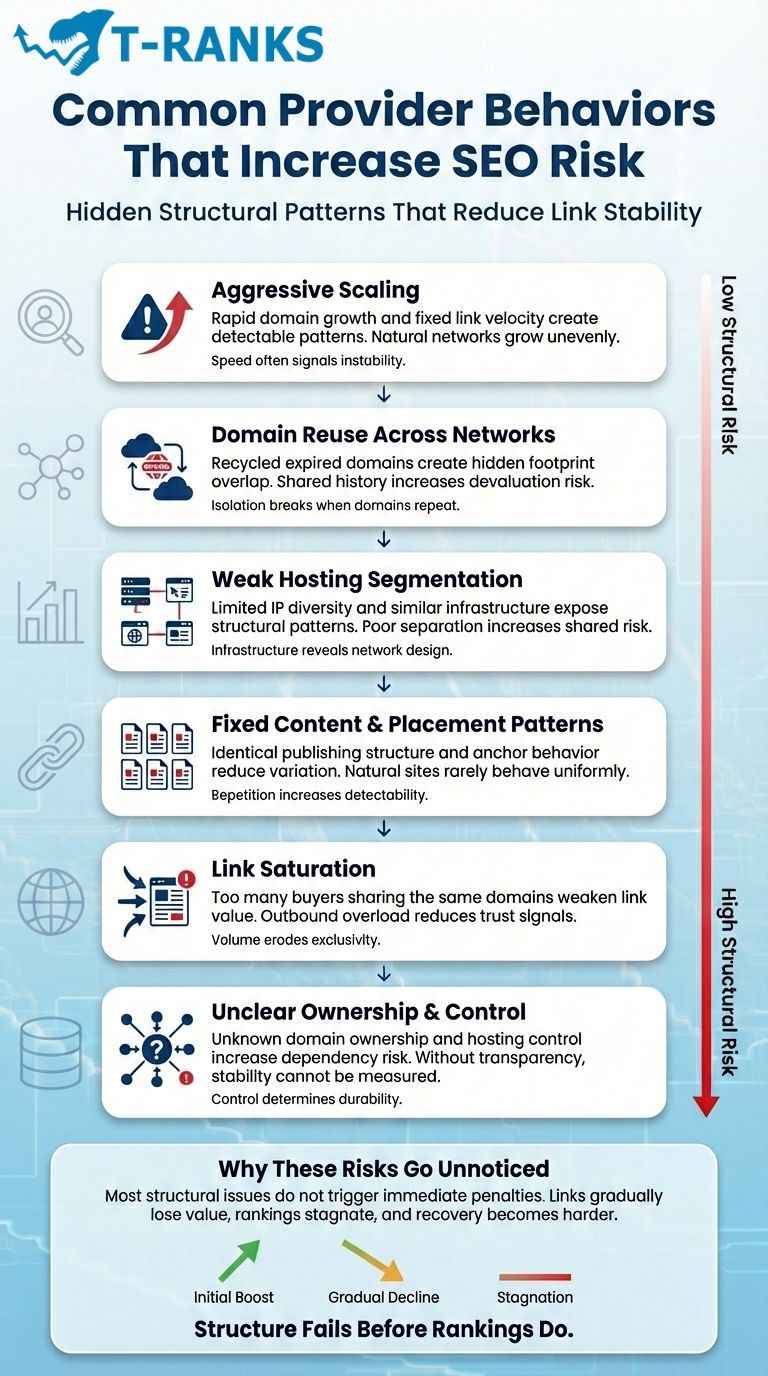
Many SEO issues related to PBN links do not come from the idea of using a PBN itself, but from how providers operate their networks. Certain behaviors consistently increase risk, even when links appear strong on the surface. These problems often stay hidden until rankings stall, drop, or links quietly lose value.
Over scaling networks too quickly
One of the most common risk signals is aggressive scaling. Providers that add too many domains, publish content rapidly, or place links at a fixed pace create patterns that are easy to detect. Natural sites grow unevenly. PBN networks that expand in straight lines tend to stand out over time.
Controlled providers limit growth and allow networks to age naturally. Speed may feel attractive, but it is often the first sign of instability.
Reusing domains across multiple networks
Some providers recycle the same expired domains across different client networks or reuse domains that have already been part of previous PBN setups. This creates hidden connections that buyers cannot see.
When domains are reused, footprint overlap increases. Even if links look isolated at first, shared history makes them easier to devalue once patterns emerge.
Centralized hosting and weak infrastructure separation
Hosting is one of the most overlooked risk factors. Providers that rely on a small number of hosts, similar IP ranges, or identical server setups create clear infrastructure patterns.
Proper segmentation requires effort and cost. Providers that cut corners here often expose all linked sites to the same risk layer.
Predictable content and placement patterns
Risk increases when content follows the same structure, publishing schedule, or linking style across many sites. Fixed templates, similar word counts, repeated anchor usage, and identical outbound link placement make networks easier to identify.
Natural websites vary. Networks that do not introduce variation tend to lose effectiveness faster.
Selling the same links to too many buyers
When too many clients share the same domains or pages, link value weakens. Outbound link saturation reduces trust and increases the chance of links being ignored.
Providers that prioritize volume over exclusivity often sacrifice long term stability for short term sales.
Lack of transparency about ownership and control
Another common risk comes from unclear ownership. If a provider cannot explain whether they own the sites, control the hosting, or manage the content, buyers are exposed to unknown dependencies.
Without transparency, it becomes impossible to assess how stable the links really are.
Why these behaviors go unnoticed
These issues rarely cause immediate penalties. More often, links simply stop contributing value. Rankings stagnate, recovery becomes harder, and buyers are left guessing what went wrong.
Understanding these behaviors helps you spot risk early. In the next section, we’ll focus on how to evaluate a PBN link provider before buying, using practical checks that go beyond promises and metrics.
How to Evaluate a PBN Link Provider Before Buying

Evaluating a PBN link provider properly means looking beyond sales claims and surface metrics. Based on my experience, the following are the key factors I look at before deciding to use PBN linksat all.
The goal of this evaluation is to understand how the provider operates, how much control they have over their network, and what level of risk their model introduces over time. This assessment should happen before any links are placed, not after issues appear.
Start with ownership and control
The first thing to clarify is who actually controls the websites. Some providers fully own and manage their networks. Others rely on freelancers, third party networks, or shared assets.
Ownership matters because control determines stability. Providers that own their domains, hosting, and content can manage risk and make adjustments when needed. Providers that depend on third parties often cannot.
Ask how domains are sourced and maintained
Domain sourcing reveals a lot about quality. Providers should be able to explain where domains come from, whether domains are reused, how past history is checked, and how long domains are held before use.
Providers that rely on recycled or repeatedly used domains usually carry higher hidden risk than those that source and age domains carefully.
Review hosting and infrastructure separation
Infrastructure is a major risk factor. Ask how hosting is handled and whether networks are segmented. Providers using a limited number of hosts or similar setups across sites create patterns that are easier to detect.
Stronger providers separate hosting, IP ranges, and technical setups across networks, even if this slows scaling.
Understand link placement behavior
Link placement should not be fixed or predictable. Ask how links are added, how anchors are chosen, and how frequently placements occur.
Providers that follow rigid rules or guarantee exact placements often sacrifice natural behavior for convenience. Variation and moderation are safer signals.
Evaluate scaling limits
One of the most important questions is how the provider limits growth. Sustainable providers cap the number of links per site, restrict outbound links, and control how fast networks expand.
Unlimited scaling is rarely compatible with long term stability.
Treat metrics as a confirmation step
DA, traffic, and similar metrics still have value, but only after the provider model is clear. Metrics should confirm quality, not replace structural evaluation.
When metrics are used as the main selling point, it often signals that deeper questions are being avoided.
A practical evaluation mindset
The safest way to evaluate a PBN link provider is to focus on process, control, and behavior rather than promises. A provider that can explain trade offs, limitations, and risk openly is usually more reliable than one that only highlights results.
In the next section, we’ll look at which types of PBN providersfit different SEO goals, and how to match provider models to real use cases rather than assumptions.
Which Type of PBN Provider Fits Different SEO Goals
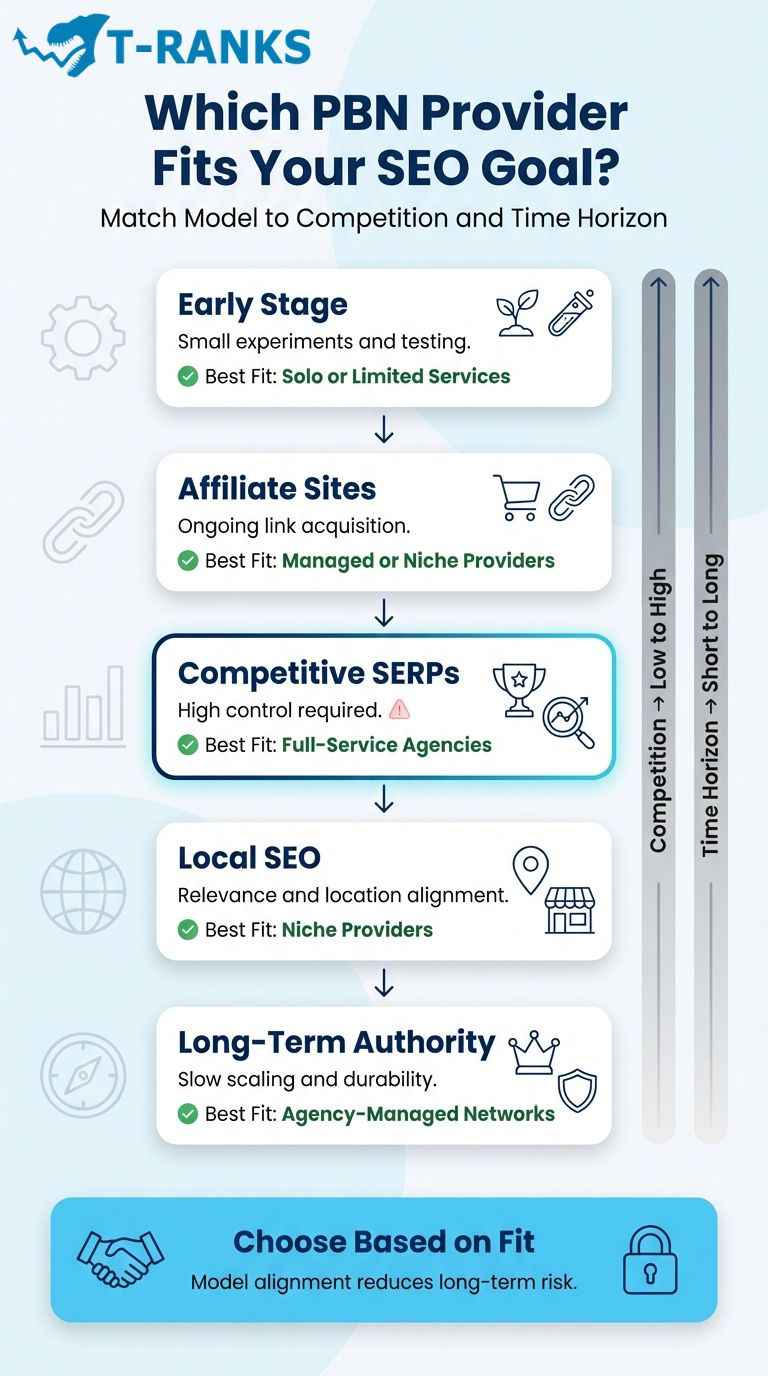
Not every PBN provider model fits every SEO situation. In practice, using the wrong provider model causes more problems than using no PBN links at all. The right choice depends on competition level, time horizon, and how much control the campaign requires.
Early stage or testing projects
For new sites, early testing, or proof-of-concept work, lighter provider models are usually enough. Solo operators or limited managed services can help validate whether links influence movement without committing to long-term infrastructure.
The key at this stage is restraint. Overbuilding early creates patterns before the site has earned baseline trust, which limits future flexibility.
Affiliate and content-driven sites
Affiliate projects need consistent link acquisition without heavy operational overhead. Managed PBN services or niche-specific providers often fit this use case when used in moderation.
Here, topical relevance matters more than raw authority. Networks that blend naturally into content outperform generic, multi-niche setups, especially as competition increases.
Competitive national or international SERPs
This is where provider choice becomes critical. Competitive SERPs require high control over link velocity, placement behavior, and network separation. Full-service PBN agencies are typically better suited because they manage these factors as part of a broader authority strategy.
In highly competitive environments, poorly managed PBN links do not just fail to help, they actively increase risk.
Local SEO campaigns
Local SEO often benefits more from relevance and geographic alignment than from pure authority. Niche or location-focused PBN providers can work when links are placed selectively and combined with other local signals.
Risk increases when local campaigns are scaled using generic networks that do not match location or industry context.
Long-term authority building
For projects focused on durability, provider models that limit scale and prioritize consistency perform better. Controlled agency-managed networks tend to age more predictably than high-volume delivery systems.
Short-term shortcuts at this stage usually create long-term cleanup work.
Choosing based on fit, not convenience
The most common mistake is selecting a provider based on price, availability, or metrics alone. Provider models should be chosen based on how well they align with the SEO goal, not how easy they are to buy from.
When the provider model fits the objective, PBN links can be integrated more safely and with fewer long-term trade-offs.
Where Agencies, Services, and Niche Providers Fit

In real world SEO campaigns, PBN link providers are rarely used in isolation. Problems usually arise when provider roles are mixed together or misunderstood. Knowing where agencies, services, and niche providers fit helps prevent poor decisions, overlapping responsibilities, and avoidable risk.
Agencies as the strategy and control layer
Agencies sit at the top of the provider stack. Their role is to design the overall link strategy, manage risk, and decide how PBN links fit within a broader authority profile. This includes planning link velocity, controlling placement patterns, and deciding when PBNs should or should not be used.
An agency-led approach becomes critical in competitive or long term campaigns where mistakes compound over time. For example, T-RANKS operates at this level by focusing on provider models, footprint control, and integration rather than treating PBN links as standalone ranking tools.
Agencies are not built for speed or volume. Their role is decision making, oversight, and controlling how risk is distributed across the entire link profile.
Services as structured delivery
PBN link services operate below agencies in the ecosystem. Their purpose is execution within defined boundaries. These providers typically deliver links through packages or controlled placements, following an established framework rather than creating a full SEO strategy.
Services work best when strategy is already defined, risk limits are clear, and PBN links are used as one input rather than the entire plan. When services are used without oversight, they often become the source of scaling and footprint issues.
Niche providers for relevance gaps
Niche specific PBN providers play a different role. They are used to strengthen topical or industry relevance when generic networks do not fit the content environment. In these cases, relevance can matter more than raw authority.
Niche providers should be used selectively. Their strength is context, not scale. Overuse often weakens the very signal they are intended to improve.
Execution focused providers
Some providers focus only on link placement and delivery, without strategic involvement. These execution focused models appeal to experienced SEOs who already understand how to manage risk and integrate links into a broader strategy.
A platform such as PBNLinks.agency fits this role by concentrating on PBN link execution rather than campaign planning. Unlike managed services, execution focused providers do not define rules, limits, or scaling decisions. All strategic responsibility remains with the buyer or overseeing agency.
How these models work together
In advanced campaigns, these provider types often work together rather than compete. Agencies define the framework, services handle structured delivery, niche providers fill relevance gaps, and execution focused platforms support controlled placement.
Problems begin when roles blur. Expecting a service to manage strategy or a marketplace to control risk usually leads to unstable outcomes. Understanding how these models fit together allows PBN links to be used deliberately instead of reactively, reducing exposure and improving long term consistency.
Niche Providers for Relevance Gaps
Niche specific PBN providers focus on one industry or topic. Their main purpose is to add relevance, not scale. These networks are useful when generic PBN sites do not match the content or audience of the page being linked.
This model works best when links need to blend naturally into a tight content theme. The limitation is scale. Niche networks cannot grow quickly without losing focus. When expanded too fast, relevance drops and footprint overlap increases, which reduces long term value.
Because of this, niche providers should be used selectively. They are a supporting option, not a primary link source.
Execution Focused Providers
Execution focused providers handle link placement only. They do not plan campaigns or manage overall risk. This model suits experienced SEOs who already know how and when to use PBN links.
Execution platforms can also support niche specific placements when clear limits are set. In this setup, the provider delivers links, while decisions about timing, volume, and usage are made elsewhere.
A platform such as PBNLinks.agency fits this role by focusing on PBN link execution rather than campaign planning. Unlike agencies or managed services, execution focused providers do not define rules, limits, or scaling decisions. Strategic responsibility stays with the buyer or an overseeing agency.
Agencies as the Strategy and Control Layer
Agencies sit at the top of the provider structure. Their role is to plan, control risk, and decide how PBN links fit into a wider authority strategy. This includes setting link velocity, managing placement patterns, and deciding when PBN links should or should not be used.
This approach becomes critical in competitive or long term campaigns, where small mistakes can compound over time. For example, T-RANKS operates at this level by focusing on provider models, footprint control, and integration rather than treating PBN links as standalone ranking tools.
Agencies are not built for speed or volume. Their value lies in oversight, decision making, and controlling how risk is distributed across the entire link profile.
How These Models Work Together
In advanced SEO campaigns, these provider types usually work together. Agencies define the framework, execution focused providers place links, and niche placements are added where relevance is needed.
In layered setups, niche specific PBN links are typically delivered at the execution level, while decisions about when and how they are used remain with the agency. Problems begin when these roles blur. Expecting a service or marketplace to manage strategy or control risk often leads to unstable results.
Understanding how these models fit together allows PBN links to be used deliberately, not reactively. This reduces exposure and improves long term consistency.
Conclusion
In conclusion, PBN link providers differ based on how they operate, not how they market themselves. The real difference between providers lies in their structure, ownership, infrastructure control, scaling limits, and placement behavior. Metrics like DA or traffic only become meaningful after these foundations are understood.
Full-service agencies manage strategy and risk. Services handle structured delivery. Niche providers add topical relevance. Execution-focused platforms manage placement without defining overall direction. Choosing the right model depends on your SEO goal, competition level, and time horizon.
Most problems with PBN links come from misalignment, not from the links themselves. When provider models are selected carefully and integrated with discipline, PBN links can support rankings with fewer long-term risks. When structure is ignored, instability follows.
If you are evaluating PBN link providers and want a controlled, model-based approach that prioritizes long-term stability over volume, explore how T-RANKS structures PBN strategy and execution. A deliberate framework always outperforms reactive link buying.
FAQs About PBN Link Providers
1. What is a PBN link provider?
A PBN link provider is a person, agency, or platform that controls websites used to place backlinks for SEO purposes. The provider manages how domains are sourced, hosted, and used to influence search visibility.
2. Are all PBN link providers the same?
No, PBN link providers operate under different models with different risk levels. Some fully control their networks, while others resell placements or rely on third-party sites they do not own.
3. Do high DA PBN links guarantee rankings?
No, high DA does not guarantee ranking improvements. Metrics measure domain-level signals, but they do not reflect how a network is structured or whether the links are sustainable.
4. Can Google detect PBN link providers?
Google can identify unnatural link patterns when networks are poorly structured. Detection usually happens through footprint overlap, predictable scaling, and infrastructure similarities.
5. Are PBN link providers legal to use?
PBN links do not violate laws, but they do violate Google’s webmaster guidelines. Using them involves platform-level risk rather than legal risk.
6. What is the difference between a PBN service and an execution-focused provider?
A PBN service delivers structured link packages within defined limits, while an execution-focused provider handles placements only. Strategy and risk management remain the buyer’s responsibility in execution-only models.
7. Are niche-specific PBN providers better than generic ones?
Niche-specific providers can offer stronger topical relevance, but they are not automatically safer. Effectiveness depends on how well the network maintains focus and avoids overscaling.
8. How do I know if a PBN provider owns their network?
You should ask about domain ownership, hosting control, and content management. Providers who own their infrastructure can clearly explain how networks are built and maintained.
9. What happens if I use a poorly structured PBN provider?
Rankings may become unstable over time, and link value can decline. Poor infrastructure or aggressive scaling often leads to reduced effectiveness.
10. How many PBN links are safe to build?
There is no fixed safe number of PBN links. The appropriate volume depends on competition, link profile balance, and how carefully the provider manages scaling.
11. Do PBN links still work in 2026?
PBN links can still influence rankings when structured carefully and used within controlled models. Poorly managed networks are more likely to lose value.
12. What is the biggest mistake when choosing a PBN link provider?
The biggest mistake is focusing only on price or metrics. Structural control, ownership, and network behavior matter more than visible numbers.