PBN links are backlinks placed on privately managed websites. Some website owners use them to strengthen specific pages in search results. But do PBN links actually work, and why do results differ from site to site?
The reason is simple. Google does not rank pages based on link labels. It evaluates relevance, quality, and how a page compares to others in the same search results. When PBN links are aligned with the right competition and placed in the right context, they can reinforce authority. When they are misaligned or poorly structured, they often pass little value.
Many people searching for what are PBN links or whether do PBN links work are really trying to understand why some pages improve while others stay stuck. The difference usually comes down to:
- Topic alignment between the linking page and target page
- Page-level authority, not just domain metrics
- Natural contextual placement
- The level of competition inside the SERP
This guide explains how PBN links work in modern SEO, when they influence rankings, when they fail, and how they fit into a balanced strategy.
How PBN Links Function in Modern SEO
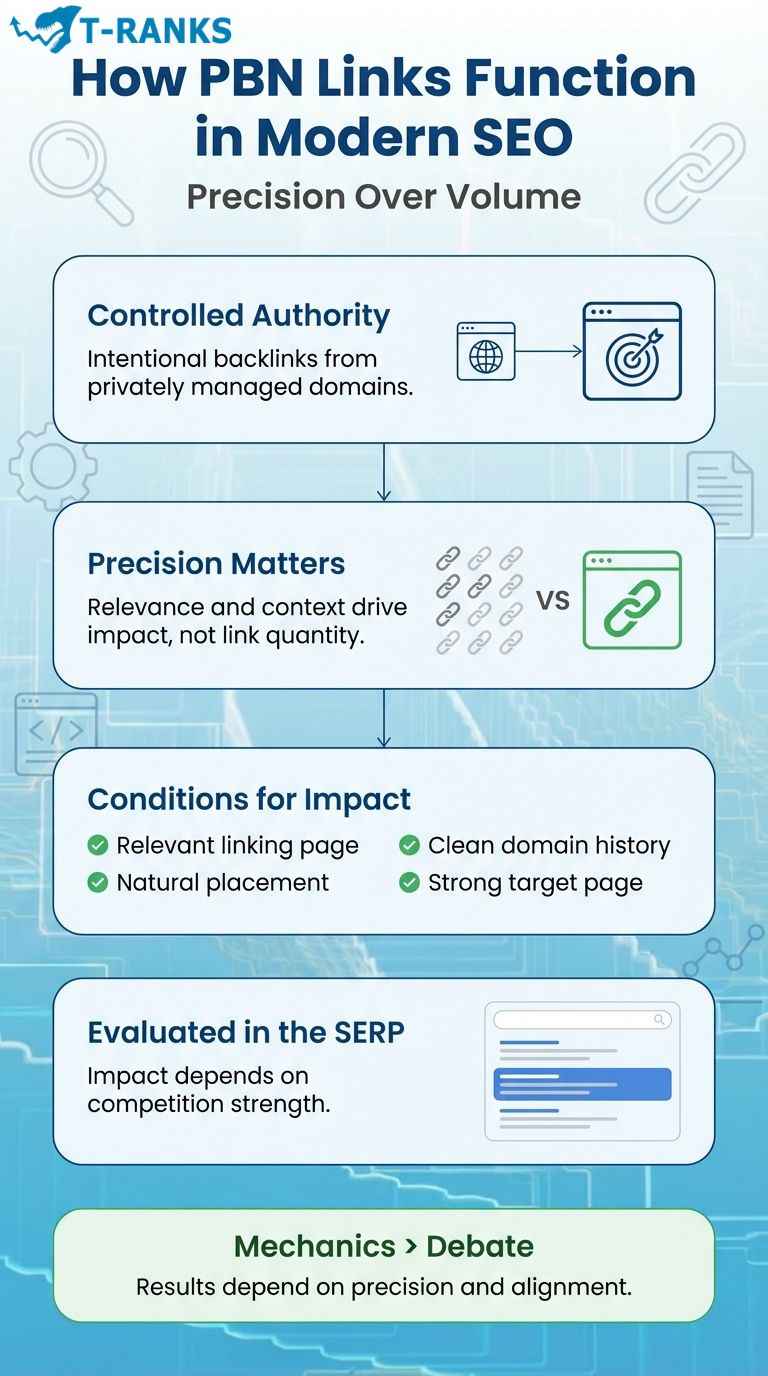
PBN links function as controlled authority signals that are placed intentionally to support rankings. In modern SEO, they are not about sending large numbers of links to a page. They are about strengthening specific pages under specific competitive conditions.
In simple terms, PBN links are backlinks placed on privately managed websites, usually built on aged or expired domains. These domains may still carry authority from their previous history. When rebuilt correctly and aligned with relevant topics, they can pass page-level authority to a target page.
However, modern SEO evaluates links differently than in the past.
PBN Links Work Through Precision, Not Volume
Years ago, many SEO strategies focused on link quantity. Today, search engines look at quality, context, and alignment.
High quality PBN links only influence rankings when:
- The linking page is relevant to the target page
- The content around the link makes sense naturally
- The domain has stable indexing and clean history
- The target page already satisfies search intent
This is why simply placing more links does not guarantee results. More PBN links do not automatically improve rankings. What matters is whether the link strengthens an actual authority gap inside the SERP.
When people ask, “Do PBN links work?” the real answer is: they work when they reinforce pages that are already close to competing.
Evaluation Happens at the Page and SERP Level
Modern search engines do not rely only on domain-level metrics. They analyze links at the page level.
A single contextual link from a relevant page can carry more impact than several links from unrelated pages. Relevance, content depth, and anchor placement matter more than raw numbers.
Beyond the page itself, Google also evaluates links at the SERP level. It compares your page to the other pages ranking for the same keyword. If the top results are supported by strong backlink profiles, adding expert PBN links may help close that gap. If the SERP is dominated by trusted brands or institutions, link influence becomes harder to shift.
This is why PBN links SEO impact depends on competition. The same link may produce movement in one niche and no effect in another.
Understanding Mechanics Matters More Than Debate
Discussions around PBN links meaning often focus on whether they are good or bad. That debate misses the real issue.
PBN links are simply a controlled method of placing backlinks. Their results depend on how they are structured, how they align with relevance, and how they fit into the broader link environment.
Understanding how they function inside modern ranking systems is more useful than arguing about their existence. The real difference between average and expert PBN links is not ownership, but precision.
How Google Interprets PBN Links Today
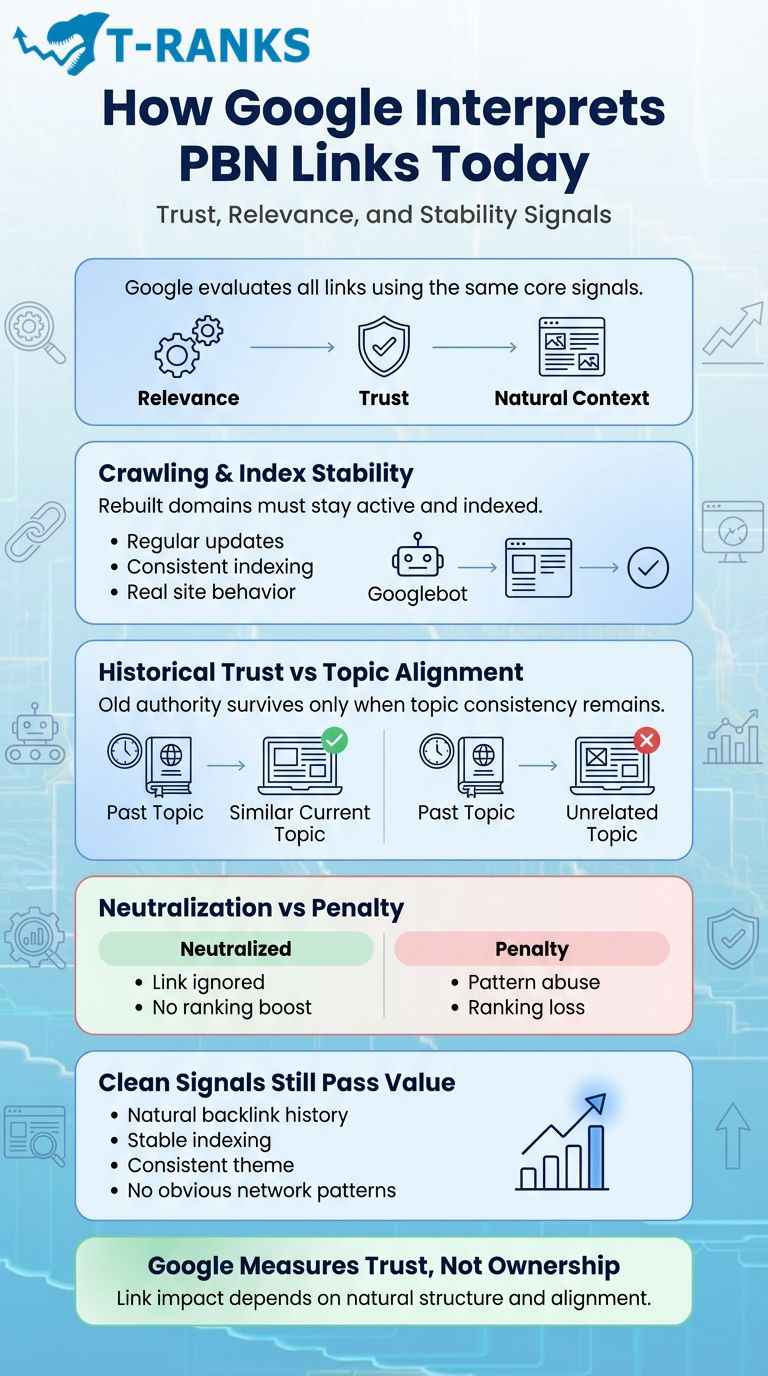
Google does not have a special tag called “PBN link.” It evaluates every backlink using the same core principles: does this link look natural, relevant, and trustworthy within the broader web ecosystem.
When a link comes from a rebuilt or expired domain, Google studies how that website behaves over time. It looks at whether the site appears active, stable, and connected to a consistent topic. The label “PBN” matters far less than the signals the domain sends through its structure, content, and history.
This is why quality matters more than ownership. Anyone considering buying PBN links should focus on how domains are selected, rebuilt, and maintained, rather than assuming all networks operate the same way. The difference between weak and high quality PBN links usually comes down to domain history, topical alignment, and indexing stability.
To understand how PBN links SEO impact works today, we need to look at three main areas: crawling behavior, topic consistency, and how Google handles link value in modern ranking systems.
Crawling and Indexing of Rebuilt Domains
When an expired domain is brought back to life, Google first watches how that site behaves over time.
It looks at questions like:
- Is the site being updated regularly?
- Does it stay indexed in Google consistently?
- Does it look like a real website or an empty shell?
If a site is thin, rarely updated, or disappears from search results often, Google may reduce how much it trusts that site. When trust is low, outbound links from that domain usually pass very little value.
This is one reason many low-quality PBN links fail. The domain itself does not look stable enough to pass meaningful authority.
On the other hand, if the rebuilt site stays indexed consistently and publishes relevant content, Google is more likely to treat it as a normal website.
Historical Trust vs Current Topical Relevance
Expired domains often have backlinks from their previous life. Those past links can still carry authority, but only if the rebuilt content makes sense.
Google compares:
- What the site used to be about
- What the site is about now
- Whether the shift looks natural
If a domain previously covered technology and is rebuilt around a completely unrelated topic like health or finance, the connection may look forced. In that case, much of the old authority becomes weaker.
However, if the rebuilt content stays close to the original theme, more of the historical trust can remain useful.
This is why high quality PBN links depend not just on strong metrics, but on topic consistency. Relevance matters as much as authority.
Neutralization vs Penalty
Many people believe that using PBN links automatically leads to penalties. In reality, Google more often ignores weak links instead of punishing the entire site.
When a link is neutralized, it simply does not pass meaningful ranking power. It exists in the link profile, but it does not move positions.
Penalties usually happen only when patterns are extreme, such as:
- Large networks with identical structures
- Repeated anchor text used aggressively
- Clear connections between multiple sites that look artificial
Most ranking problems linked to PBN links are caused by devaluation, not direct punishment.
This explains why the answer to “do PBN links work” depends on quality. Weak or mismatched domains are filtered. Clean, relevant domains may still pass value.
Why Clean Legacy Signals Still Influence Rankings
Some rebuilt domains continue to pass authority because they meet basic quality conditions:
- They have a natural backlink history
- They remain indexed consistently
- Their current topic matches their past theme
- They do not show obvious network patterns
When those signals are clean, the link can still transfer page-level authority in a meaningful way.
In modern SEO, link influence depends less on ownership and more on how natural the overall setup appears. Google is not trying to label networks. It is trying to measure trust and relevance.
Why High-Quality PBN Links Still Influence Rankings

High-quality PBN links still influence rankings because Google evaluates links based on quality and relevance, not on whether the link comes from a private network or a white-hat source.
Search engines do not label links as “PBN” or “white hat.” They analyze signals. If a backlink comes from a site that looks natural, stable, and relevant, it is evaluated based on those qualities. Ownership alone does not determine value. The source, authority, and context do.
This is why the phrase high-quality PBN links matters more than the word PBN itself.
Authority Gaps in Competitive SERPs
In most competitive keywords, ranking pages already have backlinks supporting them. When your content is similar in quality but slightly weaker in authority, a strong backlink can help close that gap.
If a PBN link comes from a clean domain with relevant content and stable indexing, it can function like any other strong contextual backlink. It reinforces authority where it is missing.
However, this does not guarantee movement. The link must support a page that is already close to competing. Links amplify strength. They do not replace it.
Quality Is About Source, Not Ownership
The real difference between weak and expert PBN links is the source quality.
A high-quality source usually has:
- A natural backlink profile
- Consistent indexing
- Relevant content
- No obvious network patterns
If those signals are strong, Google evaluates the link based on its authority and relevance, not its ownership structure.
This explains why two PBN links can produce very different results. One may come from a well-maintained, topic-aligned domain. Another may come from a thin or mismatched site. Google responds to the signals, not the label.
Context and Anchor Environment
Even a strong domain can lose impact if the link placement looks unnatural.
High-quality PBN links are placed:
- Inside relevant content
- Within logical paragraphs
- With balanced anchor usage
- Without aggressive repetition
Search engines examine how the link fits within the surrounding text. A link that blends naturally into useful content carries more weight than one that appears forced.
Supporting Content and Site Structure
Strong links work best when the target page already satisfies search intent.
If the content is weak, poorly structured, or unrelated to the keyword, even good backlinks may not produce lasting improvements. Links strengthen what is already strong.
This is why experienced providers focus on domain quality and relevance rather than building large networks. Providers like T-RANKS prioritize clean domain history, topical alignment, and stable indexing because those signals determine whether a link behaves like a high-quality backlink in Google’s evaluation system.
In modern SEO, influence comes from signal quality, not from the word “PBN.”
Why Many PBN Links Fail to Produce Results

Many PBN links fail not because the concept is flawed, but because the execution is weak. Search engines evaluate quality, consistency, and relevance. When those signals are missing, the link simply loses impact.
Most failed PBN links share similar patterns.
Reused or Burned Domains
Some networks reuse the same domains repeatedly across many clients. Over time, those domains build unnatural outbound link patterns.
When a domain links to unrelated niches, multiple money pages, or aggressive anchor text repeatedly, its trust weakens. Google may reduce how much authority that site can pass.
A domain with strong past metrics does not guarantee current influence. If it has already been heavily used or mismanaged, its ability to move rankings decreases.
Topic Mismatch After Domain Rebuilds
Expired domains often come with historical backlinks. However, if the rebuilt content does not match the domain’s original topic, relevance drops.
For example, if a domain once focused on technology and is rebuilt around health or finance, the shift may look unnatural. Google compares past theme and current theme. Large topic shifts reduce the value of inherited authority.
High-quality PBN links maintain topical alignment. Poorly rebuilt domains lose much of their strength.
Homepage-Only Abuse Without Context
Some providers place links only on homepages because it appears stronger. In reality, links without contextual relevance often carry less impact.
Modern SEO evaluates links inside content. A contextual link within a relevant article usually performs better than a random homepage placement.
When links are placed without meaningful content around them, their influence weakens. Authority transfer depends on context, not just location.
Weak Indexing and Shallow Content
If a PBN site is not consistently indexed, its outbound links rarely pass value. Domains that drop in and out of the index send unstable signals.
Shallow content also reduces effectiveness. Thin pages built only to host links are easier for search engines to evaluate as low value. Stronger pages with real content structure tend to retain more influence.
Why Mass Networks Often Fail
Large-scale PBN networks often focus on volume instead of control. When too many sites share similar structures, hosting setups, or linking patterns, they create footprints.
Search engines look for patterns. When patterns become obvious, link value is reduced or filtered.
Controlled approaches prioritize:
- Clean domain history
- Stable indexing
- Topic alignment
- Limited outbound linking
- Balanced anchor usage
This is why experienced providers like T-RANKS focus on precision rather than scale. The goal is not to build the largest network, but to maintain domains that behave like real websites.
In modern SEO, failure usually comes from shortcuts. Stability comes from quality and restraint.
Common Misconceptions About PBN Links in SEO

There are many misunderstandings about PBN links, especially among beginners. Most ranking disappointments happen not because PBN links never work, but because expectations are unrealistic or based on incomplete information.
Understanding these misconceptions helps explain why results vary.
PBN Links Are Not Instant Ranking Guarantees
Some believe that adding a few PBN links will immediately push a page to the top of Google.
In reality, rankings depend on multiple factors. Search engines evaluate content quality, user intent, authority level, and competition strength. Even high-quality PBN links cannot guarantee instant movement.
Links increase strength. They do not override weak foundations.
PBN Links Do Not Automatically Trigger Penalties
Another common misconception is that using PBN links leads to automatic punishment.
Most of the time, weak links are simply ignored rather than penalized. Google more often neutralizes low-quality signals instead of applying direct penalties.
Penalties usually occur only when patterns are extreme or clearly manipulative.
More PBN Links Do Not Automatically Improve Rankings
Many beginners assume that adding more links will always improve results.
Modern SEO does not reward raw volume. Adding too many links can create unnatural patterns and reduce stability.
A few well-placed, relevant links often perform better than dozens of poorly aligned ones.
Not All PBN Links Are Equal
Another mistake is assuming that all PBN links behave the same way.
Two links may both come from “PBNs,” yet produce completely different outcomes. The difference depends on:
- Domain history
- Topical alignment
- Content quality
- Indexing stability
- Outbound link patterns
High-quality PBN links are built around clean signals. Low-quality ones often rely only on surface-level metrics.
Metrics Alone Do Not Define Quality
Many buyers focus only on metrics such as domain authority or trust scores.
While metrics can provide hints, they do not tell the full story. A domain with strong numbers but poor relevance or unstable indexing may pass little value.
Search engines evaluate context and behavior, not just visible scores.
Cheap or Volume-Driven PBN Links Often Fail Silently
Low-cost or bulk PBN links often fail not because they are instantly detected, but because they carry weak signals.
When domains are reused, off-topic, or thin in content, Google may simply ignore the link. The result is no ranking improvement and no visible penalty.
This is why the answer to “do PBN links work” depends heavily on quality and execution.
In modern SEO, link ownership matters less than signal strength. Authority comes from relevance, stability, and alignment with the competitive SERP.
How Authority Flows Through PBN Links Today

To understand how PBN links influence rankings, it is important to understand how authority moves from one page to another.
Search engines do not treat authority as a simple domain-wide score. Authority flows at the page level. It moves through content structure, internal links, and contextual placement before reaching the target page.
Page-Level Authority vs Domain-Level Myths
A common misunderstanding is that a link from a “high DA domain” automatically passes strong power.
In reality, Google evaluates the specific page that contains the link. If that page:
- Has relevant, focused content
- Has backlinks pointing to it
- Is properly indexed
- Is internally connected to other pages
then it can pass meaningful authority.
If the page itself is weak or isolated, the domain’s overall metric matters much less.
Authority flows from the strength of the linking page, through its internal structure, and then outward to the target page.
Homepage vs Inner-Page Influence
Homepage links are often considered powerful because the homepage usually carries the strongest overall authority of a site. It often receives the most backlinks, and search engine crawlers visit it more frequently. Because of this, links placed on the homepage can pass strong baseline authority.
However, strong authority alone does not guarantee stronger impact.
Search engines also evaluate relevance. A homepage is usually broad in topic, while an inner page can be highly focused. A contextual link placed inside a well-written, highly relevant article may sometimes produce stronger ranking movement than a general homepage link.
The effectiveness depends on strategy and competition.
In some cases, homepage links help reinforce overall domain authority. In other cases, a contextual link from a tightly aligned article strengthens topical relevance more effectively.
Modern backlink strategy is not about choosing one over the other. It is about understanding what the target page needs. Authority and relevance must work together.
The Role of Internal Linking Inside PBN Sites
Authority does not stay on one page. It flows through internal links within a site.
If a PBN domain has:
- Logical internal linking
- Multiple related articles
- Structured content clusters
then authority can circulate across pages before flowing outward.
A single isolated page built only to host a link usually passes weaker signals than a page supported by internal structure.
Internal linking strengthens the overall signal of the linking page before authority is transferred externally.
Outbound Link Control and Topic Focus
Authority can weaken when a page links out to too many unrelated sites.
If a PBN page links to many different niches or dozens of money sites, its signals may become diluted. Search engines look at patterns. Focused outbound linking appears more natural than broad, unrelated linking.
High-quality PBN links typically come from pages that maintain topic depth and limit unrelated outbound links.
Why Context Matters More Than Link Count
Many beginners focus on how many links they can acquire. Modern SEO focuses on how those links behave.
Search engines evaluate:
- The surrounding text
- Topic alignment
- Anchor naturalness
- Outbound link patterns
- Overall structure of the page
A few well-placed, relevant links can create measurable improvement if they strengthen your authority compared to competing pages in the SERP.
Authority flow is relative. A link only creates movement if it improves your page’s position against others targeting the same keyword.
In modern SEO, signal quality determines impact. Ownership does not.
PBN Links Compared to Other SEO Authority Signals
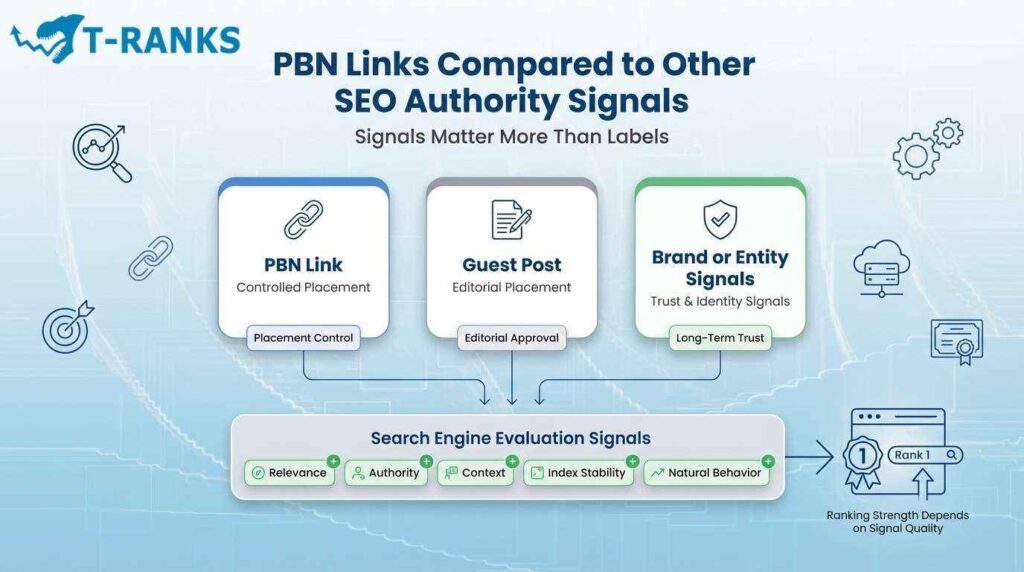
In SEO, a backlink is a backlink. Search engines do not categorize links as “PBN” or “guest post” in a simple way. They evaluate signals such as relevance, authority, placement, and behavior.
The difference between PBN links and other backlink types is not in how Google reads them. The difference is in how those links are acquired and controlled.
PBN Links and Guest Posts
A guest post link is earned through outreach and published on an independent website. A PBN link is placed on a privately managed site.
From Google’s perspective, both are simply links pointing from one page to another.
The key question is not how the link was obtained, but:
- Is the linking page relevant?
- Is the site stable and indexed?
- Does the link appear naturally within content?
- Does it strengthen the page relative to competitors?
If those signals are strong, both guest posts and high-quality PBN links can influence rankings.
The main difference is control. PBN links allow precise placement and timing. Guest posts rely on third-party editorial decisions.
PBN Links and Brand or Entity Signals
Brand mentions, citations, and entity signals help search engines understand who you are and what topics you cover.
These signals strengthen overall trust and long-term authority.
However, they do not always pass direct ranking strength in the same way contextual backlinks do.
PBN links, when structured properly, function as direct authority reinforcement. They do not build brand identity on their own. They support pages that are already aligned with search intent.
Both signals serve different roles inside a complete SEO strategy.
What Actually Determines Link Strength
The strength of any backlink depends on:
- The authority of the linking page
- The topical alignment between pages
- Internal structure of the linking site
- Outbound link patterns
- Anchor balance
- Competitive SERP conditions
These rules apply equally to PBN links, guest posts, and editorial backlinks.
Ownership does not change evaluation. Signals do.
When Backlinks Become the Deciding Factor
In some competitive SERPs, ranking pages already satisfy search intent equally well. In those situations, authority differences often determine movement.
If two pages are similar in content quality, the page with stronger backlink signals may rank higher.
In other cases, weak content, poor structure, or unclear intent will limit ranking potential, regardless of how many backlinks are added.
This is why PBN links SEO impact depends on context. They do not replace foundational SEO. They reinforce it.
In modern search, authority signals work together. PBN links are not separate from SEO. They operate under the same evaluation principles as every other backlink.
When PBN Links Still Make Strategic Sense
PBN links make strategic sense only when they match your niche competition, your target page type, and what the ranking pages in your SERP are already doing. A backlink strategy should never start with “Should I use PBN links?” It should start with “What does this SERP reward, and what is my page missing?”
When the SERP Is Driven by Backlink Strength
In many commercial keywords, the top-ranking pages are not winning because they have perfect content. They are winning because they are supported by strong backlink profiles.
If your page already satisfies search intent and the main gap is authority, high-quality PBN links can sometimes help close that gap. This is most common in SERPs where:
- Ranking pages are built by SEO teams and affiliates
- Multiple results show clear backlink support
- The SERP is not dominated by major brands, news sites, or institutions
In these cases, controlled authority reinforcement can move a page that is already close to competing.
When You Are Reinforcing the Right Page Type
PBN links tend to work best when they support pages that already have a clear purpose and intent match, such as:
- A money page that is already converting but not ranking well
- A service page competing with similar local or niche providers
- A supporting article that is close to page one but lacks authority
If the target page is weak, unclear, or mismatched to the keyword, links rarely create stable improvement.
When You Use PBN Links as Reinforcement, Not a Full Strategy
The safest strategic use of PBN links is as reinforcement, not as the only authority signal.
In practice, this usually means the site already has:
- Strong content and internal linking
- Some natural or editorial signals
- A clear topical direction
Then PBN links act as a controlled boost where it is needed.
This also depends on how you plan to use the link. Some campaigns use PBN links as direct authority support for key pages. Other strategies use them more conservatively as a supporting layer behind stronger link types. The best choice depends on your competition level and how sensitive the niche is.
When You Want Controlled Testing and Faster Feedback
Because placement is controlled, PBN links can be useful when you want to test whether authority is the limiting factor.
If a page improves after a small set of high-quality links, it suggests that authority was the missing piece. If nothing changes, the problem is often content quality, intent mismatch, or SERP dominance rather than backlinks.
When Your Approach Is Measured and Quality-Driven
PBN links make strategic sense only when the approach is controlled and quality-driven. That means:
- Clean domain history and stable indexing
- Relevant content and natural placement
- Balanced anchors and realistic pacing
- A plan based on competition, not volume
In modern SEO, PBN links can support rankings, but only when they are used with clear intent and realistic SERP awareness.
When PBN Links Are a Poor Choice

PBN links are not a fit for every keyword, niche, or website stage. In some situations, they may deliver limited value compared to other improvements, or they may not be the most efficient path for long-term growth.
Knowing when to avoid them helps you build a more stable SEO strategy.
When the SERP Is Controlled by Strong Brands or Institutions
Some search results are dominated by brands and institutions with deep trust signals and long-term authority. In these SERPs, rankings are often shaped by brand strength, reputation, and broad trust signals, not just backlinks.
If the top results are mostly large publishers, government websites, or major brands, adding PBN links alone rarely changes the competitive balance. In those cases, better outcomes often come from improving content depth, building brand signals, earning editorial links, and strengthening topical authority over time.
When Your Page Is Not Yet Strong Enough to Benefit From Links
Backlinks work best when the target page already satisfies search intent and is structurally sound.
If the page has weak foundations, such as unclear intent match, thin coverage, or weak internal linking, even high-quality backlinks may produce limited or unstable improvement. In these cases, fixing the page itself usually provides a better return than adding authority signals.
A useful rule is simple. If the page is not close to competing, links will not “create” competitiveness. They support it.
When Trust Standards Are Higher for the Topic
Some topics require stronger trust signals to rank consistently, especially when users expect accuracy and safety. In these niches, search engines often rely more heavily on reputation signals, editorial validation, and long-term trust patterns.
PBN links may still exist in these spaces, but they are rarely the main driver of stable rankings on their own. A strategy built around credible sources, expert content, and real editorial signals is typically more reliable.
When the Approach Is Based on Volume Instead of Strategy
PBN links tend to underperform when the approach is built around scale instead of planning.
Common situations that reduce effectiveness include:
- Repeating anchors too aggressively
- Overusing one link type
- Using domains with unclear history or weak topical alignment
- Adding links without measuring whether authority is the real limitation
In modern SEO, patterns matter. Strategy should be based on what the SERP rewards, not on how many links can be placed.
When Your Goal Is Long-Term Brand Growth
If the main goal is to build a durable brand presence, authority signals like editorial links, mentions, and strong topical coverage often provide stronger long-term value.
PBN links can be used as tactical reinforcement in some cases, but they are not a replacement for brand trust, content leadership, and independent validation.
The most stable SEO results come from alignment. If the SERP is trust-driven, or the page foundations are weak, PBN links are often not the best next step. If the SERP is authority-driven and the page is already competitive, controlled reinforcement may have more value.
How PBN Links Fit Into a Balanced SEO Strategy Today
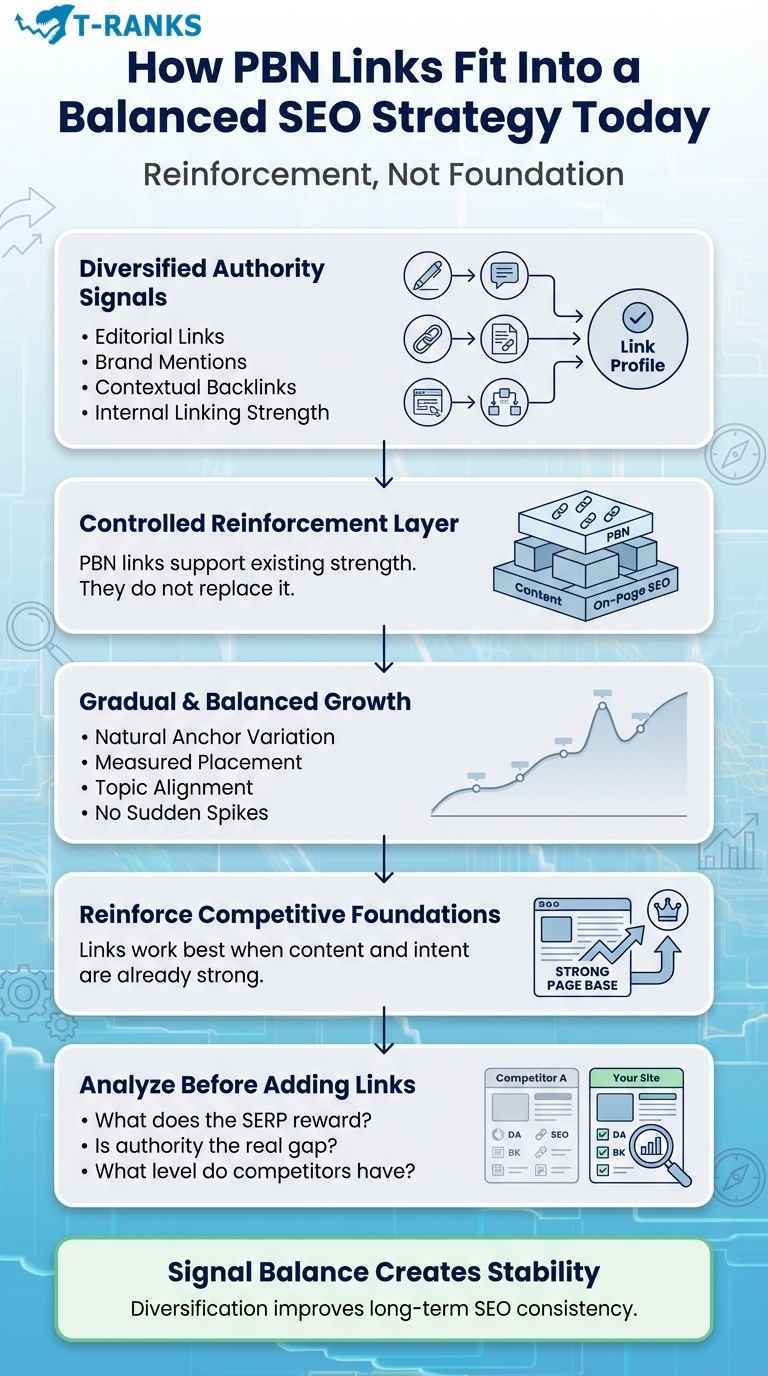
PBN links work best when they are part of a broader SEO strategy, not the foundation of it.
Search engines evaluate overall link patterns, not just individual backlinks. A stable link profile usually contains a mix of signals, such as editorial links, brand mentions, contextual references, and internal linking strength. When PBN links exist inside a balanced structure, they appear as reinforcement rather than replacement.
Blending With Other Authority Signals
Relying on a single link source increases pattern visibility and reduces stability. A more durable approach includes:
- Natural editorial links
- Topical content depth
- Strong internal linking
- Gradual authority growth
PBN links can support this ecosystem, but they should not dominate it.
Controlled Pacing and Anchor Balance
How links are added matters as much as which links are added.
Gradual placement, natural anchor variation, and topic-aligned linking patterns create more stable results than aggressive scaling. Modern SEO rewards consistency and realism over speed.
A sudden spike in similar links often creates instability, while measured reinforcement blends more naturally into an existing link profile.
Supporting Pages That Are Already Competitive
PBN links are most stable when they strengthen pages that are already structured properly and aligned with search intent.
When content, internal linking, and topical direction are clear, external authority signals reinforce those foundations. When the base is weak, links struggle to create lasting improvement.
Strategy Before Scale
In modern SEO, link strategy should begin with analysis:
- What does the SERP reward?
- What authority level do top pages have?
- Is authority truly the limiting factor?
Only after answering these questions should link reinforcement be considered.
PBN links are not separate from SEO. They operate under the same evaluation principles as every other backlink. When used carefully within a diversified strategy, they can act as controlled reinforcement. When used in isolation or without planning, their impact becomes unpredictable.
Conclusion
In conclusion, PBN links are evaluated on quality, relevance, and context, not on labels. When they come from clean, topic-aligned domains and support pages that already match search intent, they can reinforce authority and improve competitive positioning. They do not replace strong content or long-term trust signals, and results depend on strategy, not volume.
Used carefully within a balanced SEO plan, high-quality PBN links act as controlled reinforcement rather than shortcuts.If you want a precision-driven approach focused on domain quality, relevance, and stability, explore how T-RANKS delivers high-quality PBN links built around real competitive analysis.
Frequently Asked Questions About PBN Links in SEO
Do PBN links still work in SEO today?
Yes, PBN links can still influence rankings when used carefully and strategically. Their impact depends on domain quality, topical alignment, placement context, and competitive SERP conditions.
What are PBN links in SEO?
PBN links are backlinks placed from privately managed websites, often built on expired or aged domains. They are used to provide controlled authority support to specific pages.
How do PBN links work in modern SEO?
PBN links pass page-level authority when relevance and placement context align with the target page. Search engines evaluate their influence based on quality, structure, and how naturally they fit within the broader link environment.
Are PBN links safe for SEO?
PBN links are not automatically safe or unsafe. Their risk level depends on domain history, placement patterns, relevance, and overall link strategy balance.
Why do some PBN links improve rankings while others do not?
Some PBN links improve rankings because they reinforce real authority gaps. Others fail due to weak domains, poor topic alignment, unstable indexing, or overused link patterns.
Does Google penalize websites for using PBN links?
Google does not automatically penalize sites for PBN links, but it may ignore or devalue weak or patterned links. Penalties become more likely when networks are aggressive, obvious, or combined with other spam signals.
Are PBN links better than guest posts?
PBN links are not inherently better than guest posts. Guest posts often build editorial trust, while PBN links provide controlled placement. Both are evaluated using the same core quality signals.
What is the difference between PBN links and regular backlinks?
The main difference is control. PBN links are placed on privately managed sites, while regular backlinks are earned from independent websites.
How many PBN links are needed to rank?
There is no fixed number. The required authority depends on competition level, content strength, existing backlink profile, and SERP dynamics.
Can strong PBN links reduce reliance on large backlink volume?
In some cases, highly relevant and authoritative links can reduce the need for excessive link volume. However, results always depend on competition and overall strategy.
What happens if too many PBN links are used?
Excessive or aggressive use may lead to link devaluation or instability. Balanced deployment is generally more stable than large-scale placement.
Are rented PBN links detectable by Google?
Search engines evaluate patterns, not rental status. Poorly managed networks with repeated anchors or identical structures increase the likelihood of devaluation.
What makes a PBN link high quality?
A high-quality PBN link comes from a stable, aged domain with relevant history, consistent indexing, limited outbound patterns, and natural contextual placement.
Do cheap PBN links work for SEO?
Low-cost PBN links often underperform due to reused domains, weak content, or poor alignment. Quality and relevance usually matter more than price.
Can PBN links support local SEO?
Yes, PBN links can support local SEO when the domain, content, and target page are locally relevant and aligned with the search intent.
Should PBN links point to the homepage?
They can, but contextual links to relevant internal pages often provide stronger topical reinforcement.
Do PBN links replace content quality or topical authority?
No, PBN links reinforce authority. They do not replace content quality, internal structure, or clear search intent alignment.
Is it better to buy PBN links or build them?
Building a PBN requires experience, domain evaluation skills, hosting control, and risk management. Buying links depends on the provider’s quality standards and domain integrity.
Are PBN links considered black hat?
PBN links are generally considered a manipulative link-building method under search engine guidelines. Their evaluation depends on implementation quality and detectable patterns.
Do PBN links get deindexed?
Domains within poorly managed networks can lose indexing or link value. Stable domains with consistent signals are less likely to experience indexing issues.
When should PBN links not be used?
They are generally unsuitable in brand-dominated SERPs, high-trust niches, or when the target page lacks strong content foundations.
Are PBN links worth the risk in 2026?
They may be worthwhile when used strategically, in moderation, and within a diversified SEO plan. Their value comes from controlled authority reinforcement, not shortcuts.