Private Blog Networks (PBNs) give website owners more control over where and how backlinks are placed. But a bigger network does not automatically mean better SEO results. The right PBN size depends on how many suitable links your SEO strategy actually requires.
So, how many PBN sites do you actually need? There is no fixed number that works for every website. Your target pages, existing backlink profile, SERP competition, and the quality of available PBN sites can all affect the number you may need.
Cost and management matter too. As your PBN grows, you have more domains, hosting, content, renewals, and maintenance to manage. Building more sites than your campaign requires can therefore add cost and workload without guaranteeing better rankings.
In this guide, we’ll explain what determines the right PBN size, how small and large networks differ, and how network size affects cost and management. We’ll also show you how to assess your own requirements and decide when adding more PBN sites makes sense.
How Many Sites Should a PBN Have?

The number of sites a PBN should have depends on how much link support your SEO strategy requires. There is no standard PBN size that works for every website because each site has different target pages, existing backlinks, competition, and ranking goals.
A website targeting a few pages may have different requirements from one competing across many commercial keywords. The same applies to websites entering different search engine results pages (SERPs), where the strength of competing pages and their backlink profiles can vary considerably.
This is why simply building more PBN sites does not guarantee better rankings. A network with 30 domains is not automatically more useful than a smaller network because the history, relevance, and backlink quality of those domains can differ.
It is also important to separate PBN size from the number of PBN links used for a specific campaign. A network may contain 30 sites without all 30 linking to the same money site. Only some of those sites may be suitable for a particular website or target page.
So, instead of asking, “Should my PBN have 10, 20, or 50 sites?” the better question is, “How many suitable PBN sites does my SEO strategy actually require?” The answer becomes clearer when you look at your goals, current backlink profile, SERP competition, PBN quality, budget, and management capacity.
What Determines the Right PBN Size?
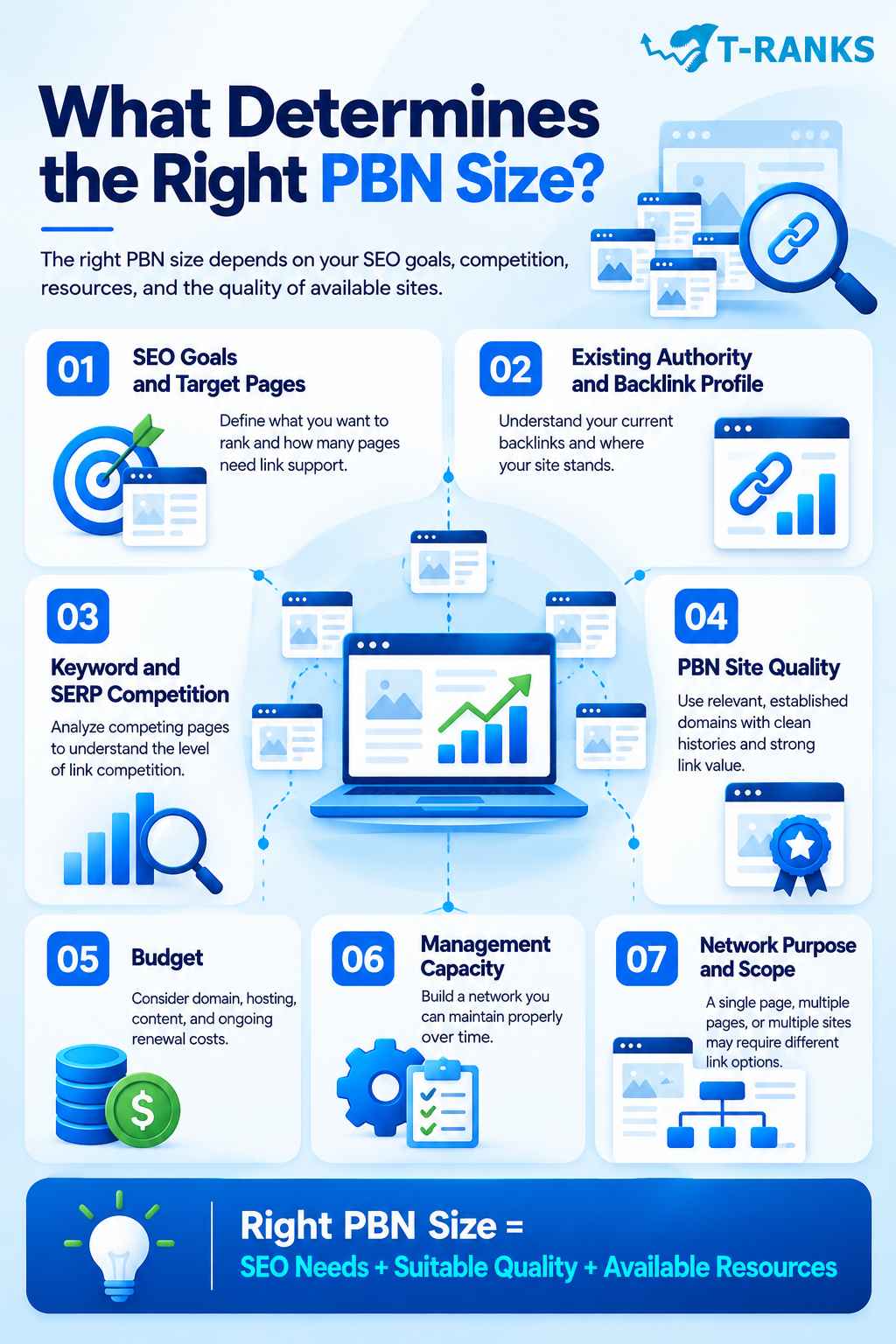
The right PBN size depends on the demands of your SEO campaign and the resources available to support it. The main factors are your SEO goals, target pages, existing backlinks, SERP competition, PBN site quality, budget, and management capacity.
These factors work together. A campaign targeting several competitive pages may require more link options than one focused on a single page, but that does not automatically mean building a large network. Your existing authority and the quality of the PBN sites also affect the decision.
SEO Goals and Target Pages
Start with what you want the PBN to accomplish. A campaign supporting one important page has different requirements from one targeting several commercial, service, or location pages.
For example, if you are targeting one page, only a limited number of suitable sites may be relevant to that campaign. If you are supporting several pages or multiple money sites, you may need access to a wider pool of suitable PBN sites.
Define your target pages and ranking goals first. This gives the network a clear purpose instead of building more sites simply to increase its size.
Existing Authority and Backlink Profile
Your website’s current backlink profile shows where the campaign is starting. A site that already has relevant referring domains and established rankings has different link requirements from a site with little existing link support.
Review the backlinks already pointing to your site, which pages receive them, and how relevant those links are. SEO metrics can provide additional context, but no single authority score can tell you exactly how many PBN sites you need.
The purpose of this check is simple: understand what the site already has before deciding what additional link support it may need.
Keyword and SERP Competition
Your target SERP also affects PBN requirements. Some search results contain pages with stronger and more established backlink profiles, while others have much lower link competition.
Look at the pages that actually rank for your target keywords and use their backlink profiles as context. Do not simply copy their referring domain counts.
If a competitor has 50 referring domains, for example, that does not mean your campaign needs 50 PBN links. Competitor data helps you understand the landscape, not calculate an exact PBN size.
PBN Site Quality
Not every PBN site provides the same link value. Domain history, backlink quality, and topical relevance can differ significantly from one site to another.
This means two networks containing the same number of sites can offer very different levels of useful link support. PBN size should therefore be considered alongside site quality, not as a standalone number.
We will look at this quality versus quantity relationship in more detail later.
Budget and Management Capacity
The practical size of a PBN is also limited by what you can afford and manage. Every additional site can add domain, hosting, content, renewal, and maintenance costs.
A growing network also means more sites to update, monitor, maintain, and troubleshoot. If the network becomes larger than your resources can support, simply adding more domains can create extra cost and workload without guaranteeing better rankings.
For this reason, the right PBN size should fit both your SEO requirements and your ability to maintain the network properly.
PBN Size vs Number of PBN Links Needed

PBN size and the number of PBN links needed for a campaign are not the same thing. PBN size refers to the total number of sites available in your network, while PBN link requirements refer to the links considered for a specific website, target page, or SEO campaign.
This distinction matters because having a larger network does not mean every PBN site should be used for every campaign. A network may contain sites with different backlink profiles, topics, and levels of relevance, so only some may be suitable for a particular target.
Total Network Size
Total network size is the number of websites available within your PBN. If you own and maintain 30 PBN sites, for example, your total PBN size is 30.
But those 30 sites should not be treated as 30 identical backlink opportunities. Some domains may be more relevant to one niche, while others may have backlink profiles that make them more suitable for a different campaign.
So, the useful question is not only “How many PBN sites are in my network?” It is also “How many of those sites are suitable for the website or page I want to support?”
Campaign Link Requirements
Campaign link requirements focus on the website or page you want to rank. A campaign targeting one page may use only part of the available network, while a campaign supporting several pages may require access to a wider selection of suitable sites.
For example, having a 30 site PBN does not mean one money site needs 30 PBN links. Only some of those sites may fit that campaign, while the remaining sites may be better suited to other pages or websites.
Existing backlinks, target pages, SERP competition, and the quality of available PBN sites can all influence how much additional link support a campaign may require.
| Factor | PBN Size | PBN Links Needed |
| Meaning | Total number of sites in the PBN | Links considered for a specific campaign |
| Scope | Entire network | One website, page, or campaign |
| Depends On | Overall SEO needs, budget, and management capacity | Target pages, existing backlinks, competition, and suitable PBN sites |
| Example | You manage 30 PBN sites | Only some of those 30 sites may be suitable for one campaign |
| Main Question | How large should the network be? | How much link support does this campaign need? |
The key point is that total PBN size should not become the link target for every campaign. A network can contain many sites while only a relevant portion of those sites is suitable for a particular money site or target page.
How Does Competition Affect PBN Size?
Competition can affect how much link support an SEO campaign may need, but it cannot tell you an exact PBN size. The best approach is to study the pages already ranking for your target keywords and use their backlink profiles to understand the level of competition.
A less competitive SERP may contain ranking pages with fewer established referring domains, internal linkswhile a more competitive SERP may contain pages supported by stronger backlink profiles. However, backlink numbers alone do not explain why a page ranks. Content relevance, internal links, site authority, search intent, and other signals also matter.
Analyze the Backlinks of Ranking Competitors
Start with the pages that currently rank for your target keyword. Review their referring domains, backlinks, and the pages receiving those links rather than looking only at a general keyword difficulty score.
For example, if the top ranking pages consistently have established backlink profiles while your target page has much less link support, that difference can help identify a backlink gap. It gives you context for deciding whether additional links should be part of your strategy.
The comparison should focus on the actual ranking pages, not just the backlink profile of each competitor’s entire domain. A strong homepage and a strong ranking page can have very different link profiles.
Compare Link Quality, Not Just Link Counts
Two competitors can have the same number of referring domains without having equally strong backlink profiles. The relevance, authority, placement, and quality of those links can differ.
The same applies when planning PBN links. Ten suitable PBN sites should not be treated as equal to ten unrelated or weaker sites simply because the link count is the same.
For this reason, competitor analysis should look beyond numbers and ask what kind of links are supporting the pages that already rank?
Do Not Turn Competitor Data Into a Fixed PBN Formula
Competitor backlink data is useful for understanding the SERP, but it should not be converted directly into an exact PBN requirement.
For example, if a competing page has 40 referring domains and your page has 20, the difference does not automatically mean you need 20 PBN links. Those referring domains can vary significantly in relevance and quality, and backlinks are only one part of the ranking picture.
Use competitor data as a benchmark, not a formula. The purpose is to understand how much link competition exists and where your backlink profile differs, then use that information alongside your existing authority, target pages, and available PBN quality when deciding whether your network needs to grow.
Does PBN Quality Matter More Than Network Size?
PBN quality can matter more than the total number of sites because every PBN domain does not provide the same link value. A smaller network with relevant, established domains may offer more useful link opportunities than a larger network built mainly around weak or unrelated sites.
This is why PBN size should never be judged by site count alone. Before adding another domain to a network, look at what that site actually brings to the campaign.
Domain History and Backlink Quality
A PBN domain inherits a backlink history from its previous use. That history can include links from different websites, pages, and topics, so two expired or aged domains can have very different backlink profiles.
Review the referring domains, link relevance, anchor text history, and signs of previous misuse before treating a domain as a useful addition to the network. Third party authority metrics can help with initial screening, but a high metric alone does not prove that a domain has a clean or valuable backlink profile.
For example, a domain with many low quality or unrelated referring domains should not automatically be considered stronger than a domain with fewer but more relevant links.
Topical Relevance
Topical relevance helps determine whether a PBN site makes sense for a particular campaign. A site with a history and content related to the target niche can provide a more natural context for a relevant link than a site built around an unrelated topic.
This becomes especially important when one PBN supports different campaigns. A domain suitable for a home improvement website, for example, may not be equally suitable for a finance or healthcare campaign.
So, having more sites is only useful when those sites give you suitable options for the topics and pages you need to support.
Why More PBN Sites Do Not Automatically Mean More SEO Value
Adding more domains increases the size of a PBN, but network growth and SEO value are not the same thing. If the additional sites have weak backlink profiles, poor relevance, or little value for your target campaigns, the network becomes larger without necessarily becoming more useful.
Consider two networks with 15 and 30 sites. The 30 site network may look stronger based on size alone, but the smaller network could contain more suitable domains for a particular campaign. Raw site count does not show that difference.
The goal should therefore be to build or maintain enough quality PBN sites to meet your actual link requirements, rather than increasing PBN size simply to reach a larger number.
Small PBN vs Large PBN: What Changes?
The main difference between a small and large PBN is the amount of link capacity, cost, and management involved. A larger network gives you access to more potential link sources, but it also requires more domains, content, hosting, maintenance, and ongoing management.
There is no universal number that separates a small PBN from a large one. Instead of defining network size with arbitrary thresholds, it is more useful to compare what changes as additional sites are added.
Smaller PBNs
A smaller PBN is generally easier and less expensive to manage because fewer websites need hosting, content, renewals, updates, and monitoring.
It can make sense when the SEO strategy has a limited number of target pages or when only a smaller pool of suitable PBN sites is required. Starting with fewer sites also allows the network to grow according to actual campaign needs rather than building unused sites from the beginning.
The main limitation is capacity. If more target pages, money sites, or campaigns are added later, the existing network may not provide enough suitable options for every requirement.
Larger PBNs
A larger PBN provides a broader pool of sites that may be used across different pages, topics, or campaigns. This can provide more flexibility when several money sites or target pages need link support.
However, that additional capacity comes with additional work. More domains mean more hosting, content, renewals, maintenance, monitoring, and technical issues to manage. A larger network can therefore become inefficient if many of its sites are rarely useful for the campaigns being supported.
The goal is not to choose between a small or large PBN based on size alone. The better network size is the one that provides enough suitable sites for your SEO requirements without creating unnecessary cost or management workload.
| Factor | Smaller PBN | Larger PBN |
| Link Capacity | Fewer potential link sources | More potential link sources |
| Initial Cost | Generally lower | Generally higher |
| Ongoing Costs | Fewer sites to host and renew | More sites to host and renew |
| Management | Easier to monitor and maintain | Requires more ongoing management |
| Campaign Flexibility | More limited | Broader pool of sites for different campaigns |
| Best Fit | Limited SEO requirements | Multiple pages, sites, or broader campaign requirements |
| Main Concern | Running out of suitable sites | Paying for and managing unnecessary capacity |
The key difference is capacity, not a fixed site count. A smaller PBN can be sufficient when it meets the campaign’s needs, while a larger PBN only becomes useful when the additional sites serve a clear SEO purpose.
How Much Does PBN Size Cost?
The cost of a PBN increases as the network grows because every additional site can add domain, hosting, content, renewal, and maintenance expenses. The real cost of PBN size is not only what you spend to build the network, but what you need to keep it running over time.
There is no standard cost for every PBN site. Some domains cost more to acquire, while hosting, content, and maintenance requirements can also vary. This is why PBN budgeting should consider both the initial setup cost and ongoing expenses before the network is expanded.
Domain, Hosting, and Content Costs
The initial cost usually starts with acquiring a suitable domain. The price can vary depending on factors such as the domain’s history, backlink profile, relevance, and how it is acquired.
The domain also needs hosting and content before it becomes part of an active network. As your PBN size grows, these expenses increase across more websites.
Content should also be included in the initial budget. Buying a domain alone does not create a usable PBN site. Each website needs content that fits its topic and purpose, with additional content required when the site is updated or expanded.
Renewal and Maintenance Costs
PBN expenses continue after the initial setup. Domains need renewal, hosting needs to remain active, and websites require ongoing maintenance.
Maintenance can include software updates, backups, security checks, content updates, broken page fixes, and technical troubleshooting. These costs may be manageable across a few websites, but they become more significant as the network grows.
For this reason, calculate recurring costs before expanding the PBN, not after the additional sites have already been built.
Cost Per PBN Site
Calculating the approximate cost per site can make PBN budgeting easier. Include both the initial investment and the recurring expenses needed to keep each website active.
A simple budgeting calculation is:
Cost per PBN site = Domain acquisition + Hosting + Content + Maintenance + Recurring expenses
This is a budgeting method, not a fixed pricing formula. The actual cost can vary considerably between PBN sites.
Once you understand what each site costs to build and maintain, you can better judge whether expanding the network makes financial sense. If a new site does not serve a clear campaign requirement, it may simply increase the cost and workload of the network.
The right PBN size should fit both your SEO requirements and your long term budget. Build enough capacity to support your campaigns without creating a network that becomes too expensive to maintain.
How Does PBN Size Affect Management and Infrastructure?
As PBN size grows, managing the network becomes more demanding because every additional site adds more content, maintenance, hosting, renewals, and technical work. A network should therefore be sized around what you can consistently manage, not simply how many domains you can acquire.
This becomes important when a PBN grows from a few manageable sites into a larger collection of websites. Tasks that seem minor on one site can become significant when they need to be repeated across an entire network.
Maintenance Workload
Every PBN site requires ongoing attention. This can include publishing or updating content, renewing domains, updating the content management system and plugins, checking backups, fixing broken pages, and monitoring whether the site remains accessible.
As more sites are added, these tasks multiply. For example, an update that takes only a few minutes on one website can become a much larger maintenance task when it must be checked across dozens of sites.
This is why management capacity should grow with PBN size. Adding sites faster than you can maintain them can lead to outdated content, technical problems, missed renewals, and neglected websites.
Hosting and Infrastructure Complexity
A larger PBN also requires more infrastructure to manage. Hosting accounts, servers, domains, Domain Name System (DNS) settings, website software, backups, and other technical resources all need to remain organized and functional.
The challenge is not simply having more hosting. It is keeping the infrastructure reliable as the number of websites increases. A hosting failure, configuration problem, or missed renewal can affect individual sites and reduce the amount of usable network capacity.
Infrastructure planning should therefore be considered before expanding a PBN, especially when the existing setup is already becoming difficult to monitor.
Operational Risk as the Network Grows
A larger network creates more opportunities for operational problems. Domains can expire, websites can go offline, software can become outdated, content quality can become inconsistent, and technical issues can remain unnoticed if monitoring is weak.
Network growth can also create more repeated decisions involving hosting, site setup, content, and administration. These need to be managed carefully, but network size itself should not be treated as a direct Google detection signal.
The practical question is simple: Can you maintain every additional PBN site to the same standard over time? If the answer is no, increasing the network size may create more management problems than useful link capacity.
When Should You Expand Your PBN?
You should expand a PBN when your existing network no longer provides enough suitable sites for your SEO campaigns. Growth should follow a clear need, such as supporting additional target pages or websites, rather than reaching an arbitrary PBN size.
A larger network can provide more link options, but every new site also brings additional cost and management. Before expanding, first check whether your existing PBN already has suitable sites that can support the campaign.
When Additional Network Capacity May Be Needed
Expansion may make sense when the scope of your SEO strategy grows. For example, you may start targeting more commercial pages, enter additional niches, or begin supporting multiple money sites.
Your existing network may also have enough sites in total but not enough suitable sites for a particular campaign. If only a small portion of the network has relevant topics and useful backlink profiles, adding carefully selected domains can increase the options available for that campaign.
The important point is to connect every expansion decision with an actual requirement. Add PBN sites because you need additional suitable link opportunities, not simply because a larger network appears stronger.
When You May Not Need More PBN Sites
You may not need to expand if your existing network already provides enough suitable sites for the pages and campaigns you are supporting.
For example, if you own 30 PBN sites but regularly use only part of that network, purchasing another 10 domains simply to increase your PBN size may add more cost than practical value. It may be more useful to review the quality and suitability of the sites you already have.
You should also avoid treating slow ranking progress as automatic evidence that the PBN is too small. Rankings can be affected by content, search intent, technical SEO, internal linking, competition, existing backlinks, and other factors. Adding more PBN links does not guarantee that rankings will improve.
Expand when your SEO requirements outgrow the useful capacity of your existing network. If your current PBN already meets those requirements, increasing the site count alone gives you no guaranteed SEO advantage.
How to Determine the Right PBN Size
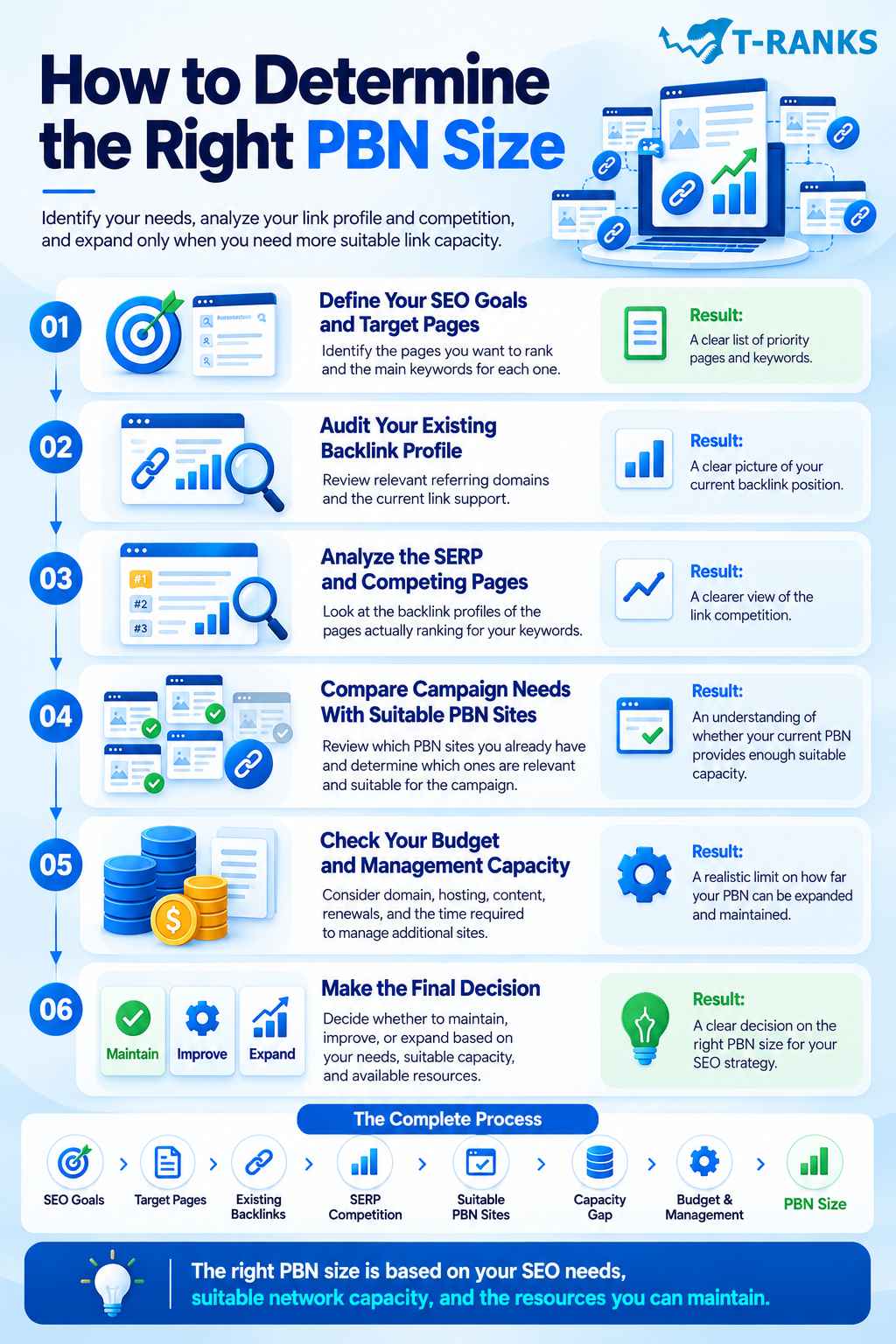
To determine the right PBN size, identify your target pages, audit existing backlinks, analyze SERP competition, review the PBN sites already available, and expand only when your campaign needs additional suitable link capacity.
There is no reliable formula that converts keyword difficulty, Domain Rating, or competitor referring domains into an exact number of PBN sites. Instead, look at what your campaign needs, what link support your website already has, and whether your existing network can meet those requirements.
Step 1: Define Your SEO Goals and Target Pages
Start with the pages you actually want to rank. Identify your priority target pages and the main keywords associated with each one before deciding how large your PBN should be.
A campaign focused on one commercial page has different requirements from a campaign supporting several service, product, or location pages. The same applies when a PBN supports more than one money site.
Do not start by deciding that you need 10, 20, or 50 PBN sites. Start by defining what the network needs to support.
Result: A clear list of priority pages and keywords that defines the scope of your campaign.
Step 2: Audit Your Existing Backlink Profile
Next, review the backlink support your target pages already have. Look at relevant referring domains, the pages receiving backlinks, anchor text patterns, and the overall quality of those links.
This establishes your starting position. A page that already has relevant backlinks and established rankings should not be treated the same as a page with little existing link support.
Third party SEO metrics can provide useful context, but no single authority score can tell you exactly how many PBN sites you need.
Result: A clear picture of the existing backlink position of each priority page.
Step 3: Analyze the SERP and Competing Pages
Now study the pages currently ranking for your target keywords. Compare the backlink profiles of the actual ranking URLs with your target page instead of looking only at the authority of the competitors’ entire domains.
The goal is to understand the level of link competition and identify where your backlink profile differs from the pages already ranking.
For example, suppose a competitor page has 40 referring domains while your page has 20. That does not mean:
40 referring domains − 20 referring domains = 20 PBN links needed
Those links can differ in relevance, authority, placement, and quality. Rankings can also be influenced by content, search intent, internal linking, site authority, and other factors.
Use competitor backlink data as context, not a fixed PBN formula.
Result: A clearer view of the backlink competition surrounding your target pages.
Step 4: Compare Campaign Needs With Suitable PBN Sites
Next, review the PBN sites you already have and determine which ones are actually suitable for the campaign.
Do not assume every site in your network represents an equally useful link opportunity. Check factors such as:
- Domain and backlink history
- Quality of existing referring domains
- Topical relevance to the target website
- Suitability for the page or campaign being supported
This creates an important distinction:
Total PBN size ≠ usable PBN capacity for every campaign
For example, you might own 30 PBN sites but find that only part of the network is suitable for a particular campaign. The remaining sites still count toward your total PBN size, but they should not automatically be counted as link opportunities for that campaign.
Compare the suitable sites you already have with what you learned from your backlink and SERP analysis. If the existing network provides enough suitable options, expansion may not be necessary. If suitable options are limited, you may have a capacity gap.
Result: An understanding of whether your current PBN provides enough suitable capacity for the campaign.
Step 5: Check Your Budget and Management Capacity
Before adding more PBN sites, determine whether you can afford and maintain them over time.
Consider domain acquisition, hosting, content, renewals, maintenance, monitoring, and the time required to manage additional websites. The cost of expanding a PBN does not end when the domain is purchased.
Your budget and management resources create a practical limit on network size. If additional sites cannot be maintained properly, increasing PBN size may create more cost and workload without providing enough useful capacity.
Result: A realistic limit on how far your PBN can be expanded and maintained.
Step 6: Decide Whether to Maintain, Improve, or Expand
At this stage, your findings should lead to one of three practical decisions:
- Maintain the network: Your existing PBN already provides enough suitable sites for the campaigns you need to support. There is no reason to add sites simply to make the network larger.
- Improve the network: You have enough sites overall, but too few are relevant or suitable for your current campaigns. The real issue may be site quality or relevance rather than total PBN size.
- Expand the network: Your SEO strategy has grown beyond the suitable capacity currently available. Additional sites may make sense when new target pages, money sites, or campaigns create a genuine need for more suitable link opportunities.
The complete decision process looks like this:
SEO Goals → Target Pages → Existing Backlinks → SERP Competition → Suitable PBN Sites → Capacity Gap → Budget and Management → PBN Size
| Check | Question to Ask | What It Tells You |
| SEO Goals | What do I want the campaign to achieve? | Overall campaign scope |
| Target Pages | Which pages and keywords need support? | Where link support may be needed |
| Existing Backlinks | What relevant link support already exists? | Starting backlink position |
| SERP Competition | What supports the pages already ranking? | Competitive context |
| Suitable PBN Sites | Which existing sites fit this campaign? | Usable network capacity |
| Capacity Gap | Is the existing suitable capacity enough? | Whether more capacity may be needed |
| Resources | Can I afford and maintain additional sites? | Practical limit on PBN size |
A Simple PBN Size Example
Suppose you manage a 25 site PBN, but after reviewing a new campaign, you find that only 8 of those sites are suitable for its topic and target pages. These figures are only an example, not a recommended PBN size.
The important number for that campaign is not simply the 25 sites you own. You first need to determine whether the 8 suitable sites provide enough useful options based on your existing backlinks and the competition in the SERP.
If your existing suitable capacity is sufficient, there is no reason to expand simply to own more domains. If a genuine capacity gap remains and you have the budget and resources to maintain additional sites, you can consider expanding specifically to address that need.
The right PBN size is not the total number of domains you can own. It is the amount of suitable network capacity your SEO strategy requires and that you can realistically maintain.
What Are the Risks of Making a PBN Too Large?
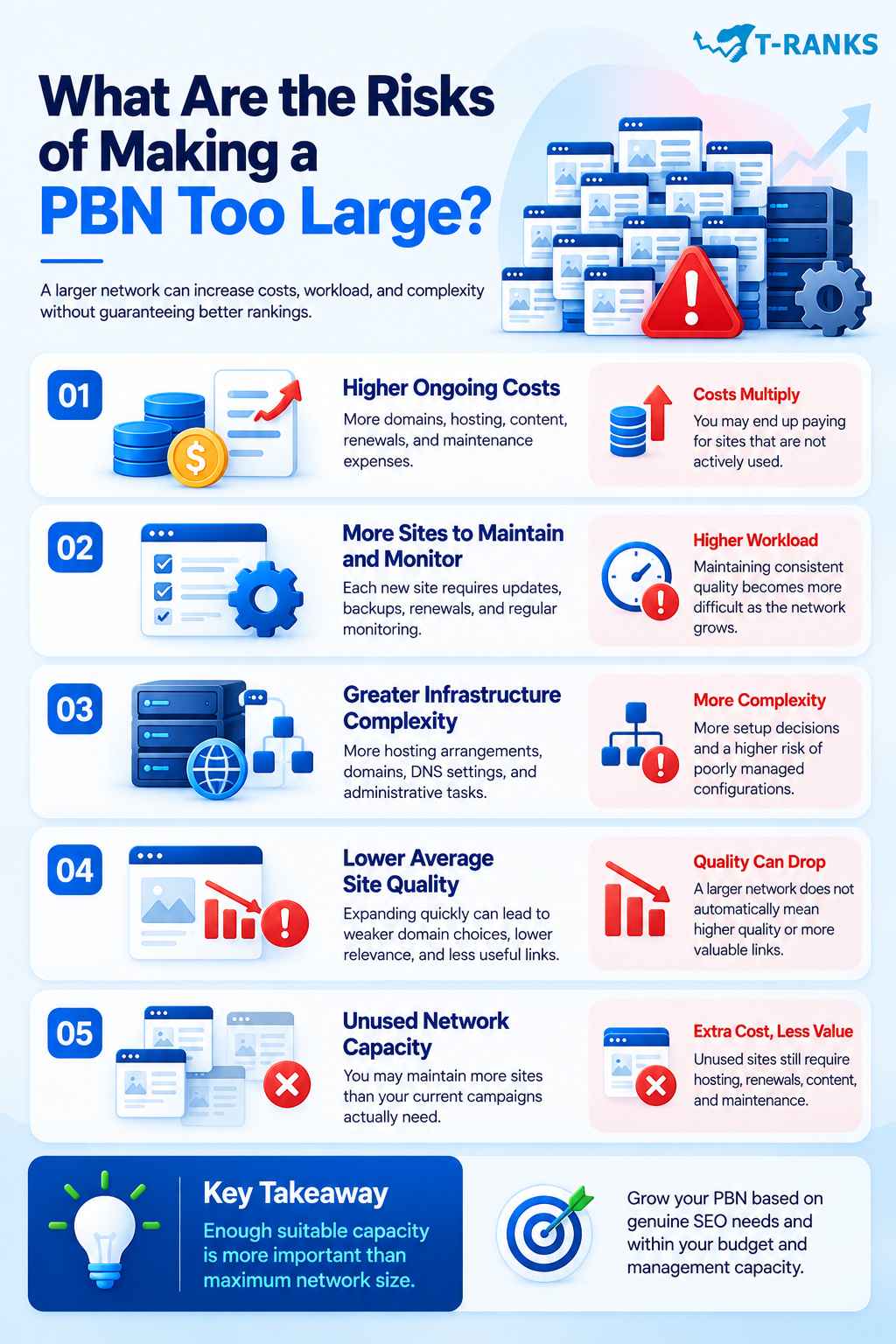
Making a PBN larger than your SEO strategy requires can increase cost, maintenance workload, and operational complexity without guaranteeing better rankings. The larger the network becomes, the more websites you need to maintain consistently and the more resources the network consumes.
The issue is not that a specific number of PBN sites suddenly makes a network unsafe. There is no established threshold where a PBN becomes risky simply because it contains too many sites. The practical problem is what happens when network growth exceeds your ability to manage it properly.
Higher Ongoing Costs
Every additional PBN site can create recurring expenses. Domains need renewals, hosting must remain active, content may need updating, and technical maintenance continues throughout the life of the site.
These costs multiply as the PBN grows. If many sites provide little useful capacity for your active campaigns, you may end up paying to maintain websites that serve no clear SEO purpose.
A larger PBN therefore makes the most sense when the additional sites fill an actual campaign requirement.
More Sites to Maintain and Monitor
Each new site adds another website that needs attention. Content, software, backups, hosting, domain renewals, broken pages, and site availability may all need monitoring.
As the network expands, maintaining the same standard across every site becomes more difficult. Missed renewals, outdated software, neglected content, or unnoticed technical problems can reduce the number of sites that remain useful.
This is why PBN growth should stay within your management capacity.
Greater Infrastructure Complexity
A larger network also means more hosting arrangements, domains, DNS settings, website configurations, and administrative tasks to organize.
This does not mean that network size itself is a direct Google detection signal. The practical concern is that managing more websites creates more infrastructure decisions and more opportunities for repeated or poorly managed setups.
Growth should therefore be planned around operational capacity rather than the assumption that more domains automatically create a stronger network.
Lower Average Site Quality
Expanding too quickly can shift attention from which domains are worth adding to how many domains can be added.
For example, if suitable domains are difficult to find, increasing the network rapidly may lead to weaker choices based on backlink history, relevance, or overall usefulness. The PBN becomes larger, but its average quality may not improve with its size.
This is another reason to evaluate each potential addition individually rather than setting an arbitrary network-size target.
Unused Network Capacity
A large PBN can also contain more sites than your current campaigns actually need.
If you maintain 40 sites but only a portion are regularly suitable for your target websites, the remaining sites still require hosting, renewals, content, and maintenance. That creates unused capacity.
The goal should therefore be enough suitable capacity, not maximum PBN size.
A PBN becomes unnecessarily large when its additional sites create more cost, workload, and complexity without serving a clear campaign requirement. Network growth should follow genuine SEO needs and remain within the budget and management resources available.
Conclusion
In conclusion, there is no universal PBN size that works for every SEO strategy. The right network size depends on your SEO goals, target pages, existing backlink profile, SERP competition, available PBN quality, budget, and management capacity.
A larger PBN does not automatically provide better SEO results. Total network size and campaign link requirements are different. What matters is how many sites in your network are actually suitable for the website or pages you want to support.
Before expanding, review your existing backlinks, analyze the pages competing in the SERP, and assess the quality and relevance of your available PBN sites. Use competitor backlink data as context rather than converting referring domain counts or SEO metrics into a fixed formula. Expand only when your existing network no longer provides enough suitable capacity.
Ultimately, the right PBN size is the amount of suitable network capacity your SEO strategy requires and that you can realistically afford and maintain. If you need relevant PBN links without the cost and workload of building a larger network yourself, T-RANKS can help you find PBN link opportunities aligned with your target pages and SEO requirements.
FAQs About PBN Size
How many sites should a PBN have?
There is no fixed number of sites a PBN should have. The right PBN size depends on your target pages, existing backlinks, SERP competition, site quality, budget, and management capacity.
Is there a minimum PBN size?
No, there is no established minimum PBN size for SEO. A network should contain enough suitable sites for its intended campaigns rather than being built to reach an arbitrary minimum.
How many PBN sites do I need?
You need enough suitable PBN sites to meet your campaign requirements. Assess your target pages, existing backlink profile, SERP competition, and usable network capacity before deciding whether more sites are needed.
Is a bigger PBN better for SEO?
No, a bigger PBN is not automatically better for SEO. Additional sites are useful only when they provide suitable link opportunities; otherwise, they mainly increase cost, maintenance, and management requirements.
How many PBN links do I need to rank?
There is no fixed number of PBN links that guarantees rankings. Backlink needs vary by page and SERP, while content, search intent, existing authority, internal links, and backlink quality can also affect rankings.
Does keyword competition affect PBN size?
Yes, competition can influence how much link support a campaign may require, but it cannot determine an exact PBN size. Analyze the backlink profiles of actual ranking pages and use that information as competitive context rather than a formula.
Should I match a competitor’s referring domains with PBN links?
No, a competitor’s referring domain count should not be matched one-for-one with PBN links. Referring domains differ in relevance and quality, and backlinks are only one part of the ranking picture.
Can one PBN support multiple money sites?
Yes, a PBN can contain sites suitable for different money sites, but every site will not necessarily fit every campaign. Topical relevance, backlink history, and overall site quality should be evaluated for each use.
When should I expand my PBN?
Expand when your campaigns need more suitable link capacity than your existing network provides. New target pages or money sites can create that need, but increasing PBN size without a clear requirement only adds cost and workload.
Are PBNs against Google’s guidelines?
PBN links created primarily to manipulate Google rankings can violate Google’s link spam policies. Google states that links created mainly to manipulate search rankings are link spam, and policy violations can result in ranking losses or removal from search results.