Most PBN owners spend weeks finding the right expired domains, setting up clean hosting, and writing quality content. Then they ruin it all with one simple mistake. Too many outbound links on a PBN post leaks link juice. Too few looks unnatural. Getting the ratio wrong in either direction means your network either underperforms or gets flagged.
The pbn outbound link ratio is one of the most debated and least understood aspects of PBN management. Most guides give vague advice like “keep it low” or “link to authority sites.” Nobody explains what the right numbers actually look like, how content length changes the equation, or how to manage OBLs across a network of 50 sites without creating detectable patterns.
This guide covers everything. From the safe OBL formula for a single post to managing outbound link ratios across a large PBN network. It also covers how niche edits change the balance, how anchor text on OBLs creates footprint risk, and how to audit your entire network before Google does it for you.
What Is a PBN Outbound Link Ratio

When you publish a post on a PBN site you are deciding how many external websites that post will link to. The PBN outbound link ratio is simply that number. It tells you how many outbound links exist on a post compared to all the links on that page. Every outbound link you add splits the ranking power of that post between more destinations.
So why does this matter so much? Because every PBN post has a finite amount of link juice to give. Think of it like a bucket of water. Every outbound link you add is another hole in that bucket. A post with one outbound link sends nearly all of its link juice to your money site. A post with ten outbound links splits that same power ten ways. Your money site ends up with a fraction of what it could have received.
But getting the OBL ratio wrong does not just hurt your link juice. It also creates footprint risk. Google evaluates outbound link patterns across entire networks. When it sees multiple sites linking to the same money site with identical OBL counts it flags that as an unnatural pattern. Vary your OBL ratio across posts and sites. A natural network is one where no two posts follow the exact same linking pattern.
How Outbound Links Affect Link Juice on a PBN Post

Outbound links directly reduce the amount of link juice your PBN post passes to your money site. Every time you add an outbound link you split the available link equity between more destinations. The more outbound links you have the less power each one receives.
The math is simple and unforgiving. A PBN post with four outbound links passes roughly 25 percent of its available link equity to each destination. A post with ten outbound links drops that to around 10 percent each. Push it to 20 outbound links and your money site receives only about 5 percent. According to LinkBuilder.io this dilution is one of the most overlooked reasons PBN campaigns underperform.
This is exactly why experienced PBN owners keep their OBL counts low. Every extra outbound link is a direct cut in the ranking power your money site receives. A post with one money site link and one authority link passes far more value than a post with five scattered outbound links. When a PBN seller claims 50 or 100 outbound links per site be very careful. That level of dilution leaves almost nothing for your money site.
The same logic applies differently based on DA. A high DA site has more juice available so it can support slightly more outbound links. A low DA site has less to give so every additional OBL cuts deeper. Keep OBL counts tight on low DA sites. Even on your strongest domains the safe maximum is rarely more than 3 to 5 outbound links per post.
What Is the Safe OBL Ratio for a PBN Post

The safe OBL ratio for a PBN post is 1 money site link plus 1 authority site link. That is the formula most experienced PBN practitioners agree on in 2026. It keeps your link equity concentrated and your outbound link pattern natural enough to avoid detection.
The 1 Plus 1 Formula Explained
One outbound link goes to your money site. One outbound link goes to a trusted authority source. That is the complete formula. Two outbound links per post. Nothing more is needed for a short to mid-length post and nothing more should be added without a good reason.
This formula keeps roughly 50 percent of the available link equity flowing to your money site. It also makes your PBN post look like genuine editorial content. A post that only links to your money site is an obvious link placement. A post that links to your money site and a respected authority source looks like real content written for a real audience.
According to the T-RANKS safe PBN strategy guide the core safe linking rules for every PBN post are:
- Use 1 link to your money site and 1 link to an authority source
- Place both links contextually inside the body content
- Never place outbound links in footers, sidebars, or the opening sentence
- Do not use the same authority site link on every post across your network
- Keep your money site link dofollow and vary the tag on authority links
How Content Length Changes the Safe OBL Count
Content length is the single biggest variable that determines how many outbound links a post can safely support. A 500 word post with four outbound links looks unnatural. A 2000 word post with four outbound links looks completely normal. The OBL count that is safe on a long post becomes suspicious on a short one.
Use this as your content length reference:
- 500 to 800 words — maximum 2 outbound links including your money site link
- 800 to 1500 words — 2 to 3 outbound links is natural and safe
- 1500 to 2500 words — 3 to 4 outbound links works with proper contextual placement
- 2500 words and above — up to 5 outbound links can look natural
Safe OBL Ranges From Practitioner Experience
Most experienced PBN builders use a maximum of 2 outbound links per post. This is the safest approach for preserving link equity and reducing footprint detection risk. It is also the approach that passes the most ranking power to your money site.
For longer content or more established PBN sites pushing to 3 to 5 outbound links per post is acceptable. Every link must be contextually placed and point to a relevant destination. Public PBNs often average 30 plus outbound links per site. That level of outbound link dilution significantly increases detection risk. Your private PBN should never approach those numbers. The goal is always to look like a real editorial website — not a link farm.
OBL Ratio by Page Type

Not every page on your PBN site should follow the same outbound link rules. The safe OBL count for a homepage post is very different from what works on an inner page or a category page. Getting this distinction right separates a professional PBN from an amateur one.
Homepage Posts — What Is Safe
The homepage of your PBN site carries the most link authority. It collects authority from every internal link on the site and passes it directly to whatever it links out to. Practitioners call this the waterfall effect — authority flows from the root domain down through every outbound link on the homepage.
Because the homepage is your most powerful page protect its link equity carefully. Keep outbound links on the homepage to an absolute minimum. Ideally zero external outbound links on the homepage itself. If your money site link is placed in a homepage post keep the total OBL count to 1 or at most 2.
Inner Page Posts — What Is Safe
Inner page posts are your safest and most flexible placement for outbound links. A contextual inner page post with 2 to 3 outbound links looks completely natural to Google. This is where the 1 plus 1 formula works best — one money site link and one authority link placed contextually within a well-written article.
For longer inner page posts of 1500 words and above you can push to 3 to 4 outbound links. According to PBN.ltd three to seven outbound links in a typical blog post looks natural. More than that starts to look like a link directory. Keep every outbound link contextual and relevant to the surrounding content.
Category Pages — What Is Safe
Category pages are navigation pages. Their job is to organize content and pass internal authority to individual posts. Adding outbound links to category pages breaks this internal authority flow and creates an unnatural linking pattern.
Keep outbound links off category pages entirely. Category pages should only contain internal links pointing to posts within that category. Save your outbound link budget for inner page posts where the context is strongest and the links look most natural.
| Page Type | Safe OBL Count | Money Site Link | Outbound Link Placement |
| Homepage | 0 to 2 maximum | 1 at most | Contextual body content only |
| Inner page post | 2 to 4 depending on length | 1 per post | Contextual body content |
| Long inner page post | 3 to 5 for 1500 words plus | 1 per post | Contextual body content |
| Category page | 0 — avoid entirely | Never | Internal links only |
How to Make PBN Outbound Links Look Natural
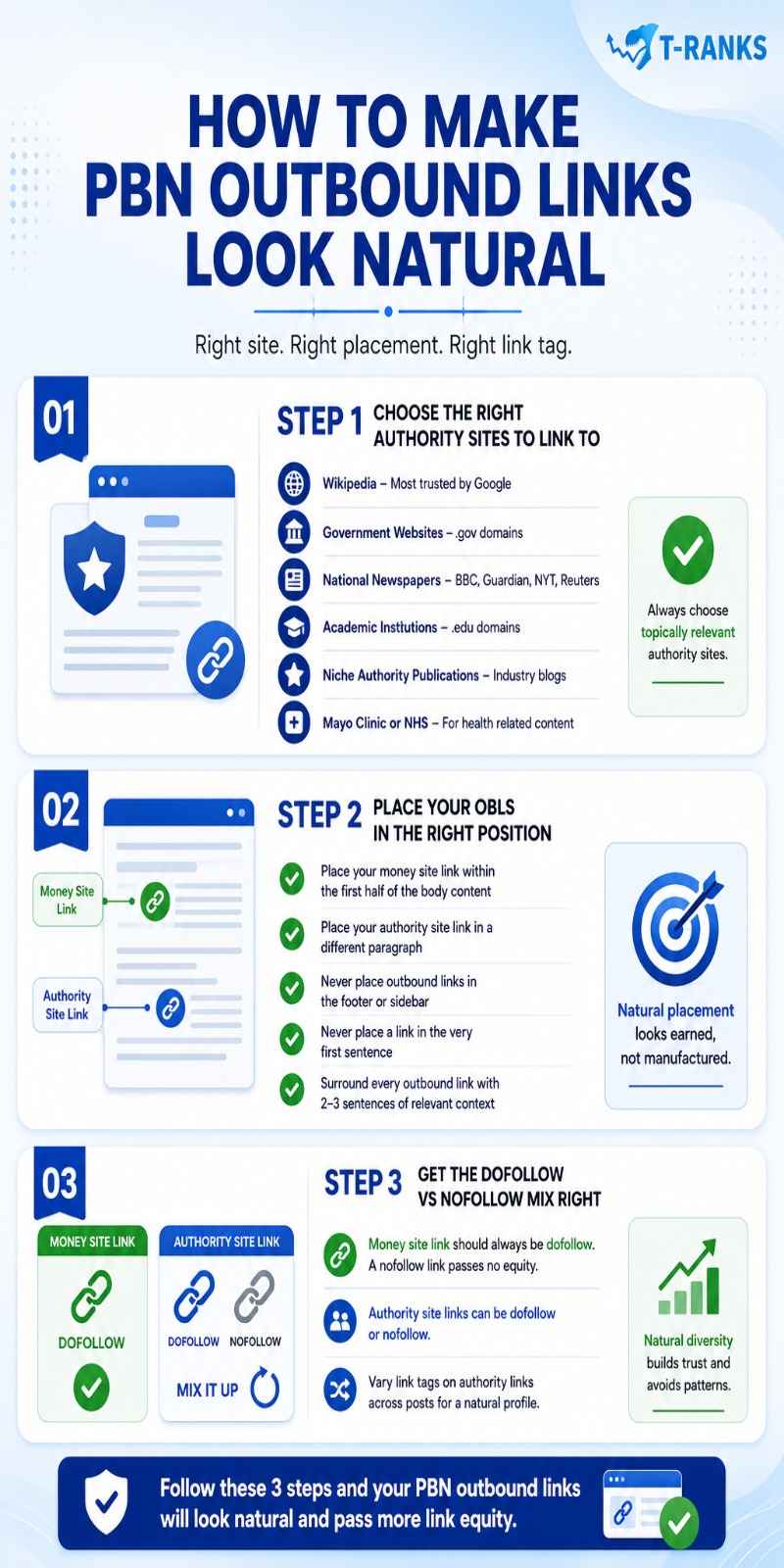
Making your PBN outbound links look natural comes down to three things. Who you link to, where you place the link, and what tag you use. Follow all three steps in order and your PBN posts will read like genuine editorial content.
Step 1: Choose the Right Authority Sites to Link To
The authority site link you include alongside your money site link is what makes your PBN post look like real content. A post that only links to your money site screams link placement. A post that links to your money site and a trusted authority source reads like a genuine article helping its readers.
The best authority sites to link to from PBN posts are:
- Wikipedia — the most commonly used and most trusted by Google
- Government websites — .gov domains carry exceptional trust signals
- National newspapers — BBC, The Guardian, New York Times, Reuters
- Academic institutions — .edu domains and published research papers
- Niche authority publications — respected industry blogs in your PBN niche
- Mayo Clinic or NHS — for health related PBN content
Always choose an authority site that is topically relevant to your PBN post content. Once you have your authority site chosen the next step is deciding exactly where to place both links in your content.
Step 2: Place Your OBLs in the Right Position
Where you place your outbound links matters as much as how many you use. Google evaluates link placement as a signal of editorial intent. Links placed naturally within body content look earned. Links stuffed into footers or the opening sentence look manufactured.
Follow these placement rules on every PBN post:
- Place your money site link within the first half of the body content
- Place your authority site link in a different paragraph from your money site link
- Never place outbound links in the footer or sidebar of a PBN site
- Never place an outbound link in the very first sentence of a post
- Surround every outbound link with at least 2 to 3 sentences of relevant context
With both links positioned correctly the final step is making sure you are using the right link attributes on each one.
Step 3: Get the Dofollow vs Nofollow Mix Right
Your money site link should always be dofollow. A nofollow tag on your money site link means Google will not pass link equity to your target page. The entire purpose of the PBN post is to pass authority. A nofollow money site link defeats that purpose entirely.
Your authority site links are more flexible. Using a mix of dofollow and nofollow tags on authority links adds natural diversity to your PBN outbound link profile. A real website does not nofollow every external link but it also does not make every external link dofollow. Vary the tags on your authority links across different posts and the pattern looks exactly like genuine editorial content.
How Anchor Text on OBLs Affects Footprint Detection

Anchor text on PBN outbound links directly affects footprint detection risk. Google evaluates anchor text patterns across all your outbound links — not just the money site link. Using the same anchor text repeatedly across multiple PBN posts creates a detectable pattern.
Most PBN owners focus only on money site anchor text and ignore authority link anchors. This is a mistake. Real editorial websites link using natural varied language. A PBN that repeats the same anchor text on every post looks nothing like a genuine website.
The safe anchor text mix for PBN outbound links should look random and uneven. Use this reference for every post you publish:
- Branded anchors — your money site brand name. Use for 40 to 50 percent of money site links
- Naked URL anchors — your raw URL as the anchor. Natural and impossible to over-optimize
- Generic anchors — “read more”, “click here”, “this resource”, “learn more”
- Partial match anchors — natural phrases that include your keyword without exact match
- Exact match anchors — keep below 3 to 5 percent of your total anchor profile
- Authority link anchors — descriptive natural phrases matching the authority page content
According to the T-RANKS safe PBN strategy guide exact match anchors should stay below 3 to 5 percent of your total profile. Never use the same anchor text on the same destination across multiple PBN posts. Vary it on every post and every site.
Managing OBL Ratios Across a Large PBN Network
Running a large PBN network is where most operators create their biggest footprint problems. Getting the OBL ratio right on one post is straightforward. Avoiding identical patterns across 20, 50, or 100 sites is where networks get caught.
Google does not evaluate PBN posts in isolation. It evaluates statistical patterns across groups of sites. When multiple sites all use exactly 2 outbound links per post, all link to the same money site, and all use similar anchor text the pattern becomes statistically impossible to explain as a coincidence.
The solution is deliberate variation. Here is a practical framework for managing OBL ratios across your entire network:
Vary your OBL count across posts and sites:
- Some posts should have 1 outbound link
- Some should have 2
- Some should have 3 to 4 on longer content
- Leave some posts with zero outbound links entirely
Vary your outbound link destinations:
- Do not use Wikipedia on every single post
- Rotate between government sites, niche publications, newspapers, and research papers
- Never link to the same money site URL from every post
- Vary the specific target pages you link to across different posts
Vary your publishing and linking schedule:
- Do not add money site links to every new post immediately after publishing
- Stagger your link placements across different posts and time periods
- A safe benchmark is one money site link per PBN site every 35 to 55 days
These three variation rules work together. Varying only one while keeping the others identical still creates a detectable pattern.
Monitor your network with these tools:
- Ahrefs — check outbound link counts on individual PBN posts and spot over-linked pages
- Screaming Frog — crawl PBN sites to audit all outbound links and their anchor text
- T-RANKS PBN management tools — purpose built for managing outbound link health across multiple PBN sites
Run a full outbound link audit across your network every 90 days. A network that is actively monitored and deliberately varied is far harder for Google to detect than one that was built well but never maintained.
How Niche Edits Affect OBL Ratio

Adding a niche edit to an existing PBN post changes its outbound link ratio immediately. Most PBN owners do not think about this before placing a niche edit. They should.
Every new link inserted into a PBN post reduces the share of link juice flowing to every existing outbound link on that page. If your PBN post had 2 outbound links before the niche edit it now has 3. The link juice that was split two ways is now split three ways. Your money site link receives less ranking power than it did before.
Before placing any niche edit on a PBN post check these three things:
- How many outbound links does the post already have
- Which of those links points to your money site
- Will adding one more link reduce your money site’s link juice to an unacceptable level
If a post already has 4 or 5 outbound links adding another niche edit pushes the OBL count too high. At that point the niche edit is hurting your PBN’s effectiveness more than helping it.
The better move in that situation is to publish a fresh post first. A new post of 800 to 1000 words gives you a clean OBL slate with full link juice available. Let it sit for 2 to 4 weeks before placing the niche edit. A link inserted into aged content looks far more natural than one placed in a brand new post on the day it goes live.
The simple rule is this. Before you add a niche edit to any PBN post always check the existing OBL count first. Protect your money site link’s share of the link juice. If the OBL count is already at the safe limit publish new content first and use that as your niche edit placement instead.
How to Audit Your PBN Outbound Link Profile
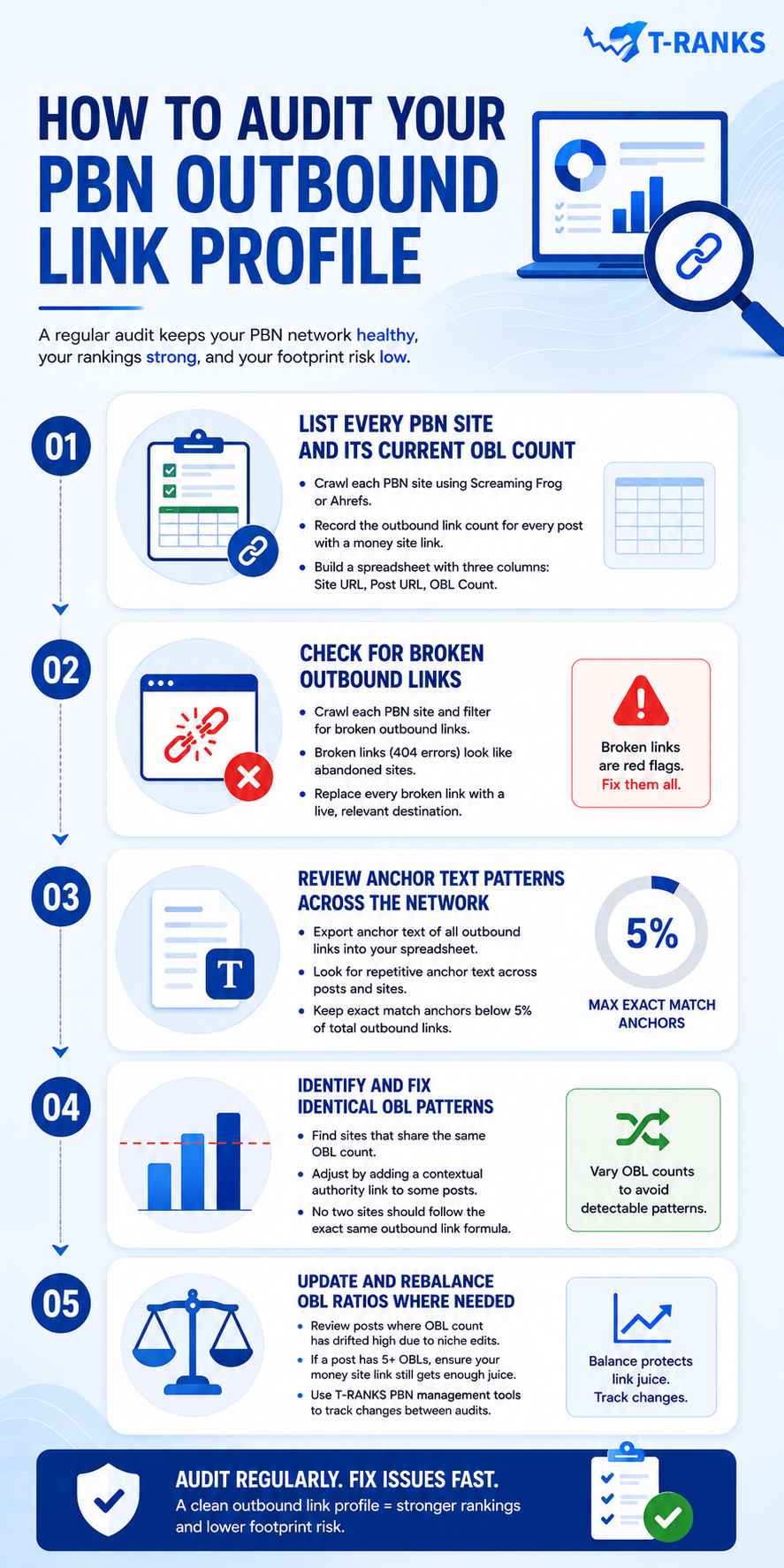
Most PBN owners build their network and never look at it again. That is one of the fastest ways to lose rankings. Outbound links break over time. OBL counts drift as niche edits are added. Anchor text patterns become repetitive. A regular outbound link audit keeps your network healthy and your footprint risk low.
Run a full audit across your entire network every 90 days. Here is the process:
Step 1: List Every PBN Site and Its Current OBL Count
Open Screaming Frog or Ahrefs and crawl each PBN site individually. Record the outbound link count for every post containing a money site link. Build a simple spreadsheet with three columns — the PBN site URL, the post URL, and the current OBL count. This gives you a clear picture of where your network stands.
Step 2: Check for Broken Outbound Links
Broken outbound links on a PBN post are a red flag for Google. A post pointing to a 404 error looks like an abandoned site — not a genuine editorial website. Use Screaming Frog to crawl each PBN site and filter for broken outbound links. Fix every broken link immediately by replacing it with a live relevant destination.
Step 3: Review Anchor Text Patterns Across the Network
Export the anchor text of every outbound link across your network into your spreadsheet. Look for repetitive patterns — the same anchor text appearing on multiple posts across multiple sites. Flag any post where exact match anchor text exceeds 5 percent of its total outbound link profile. Vary those anchors immediately.
Step 4: Identify and Fix Identical OBL Patterns
Look across your spreadsheet for sites that all share the same OBL count. If ten of your PBN sites all have exactly 2 outbound links per money site post that is a detectable pattern. Adjust the OBL count on some posts by adding a contextual authority link. No two sites should follow the exact same outbound link formula.
Step 5: Update and Rebalance OBL Ratios Where Needed
After completing the audit update any post where the OBL count has drifted too high due to added niche edits. If a post now has 5 or more outbound links consider whether your money site link is still passing enough juice to justify its placement. Use T-RANKS PBN management tools to track outbound link changes between audits so nothing slips through.
OBL Ratio Mistakes PBN Owners Must Avoid

The biggest OBL ratio mistakes PBN owners make are predictable and avoidable. Most come down to one problem — treating every PBN post the same way. Here is what to watch out for.
Linking Only to the Money Site
A post with only one outbound link pointing to your money site is one of the clearest footprint signals Google looks for. Always include at least one authority site link alongside your money site link.
Using the Same OBL Count on Every Post
Identical OBL counts across every site in your network is a detectable pattern. Vary your OBL count deliberately. Some posts should have 1 outbound link. Some should have 2. Some should have 3.
Placing OBLs in Unnatural Positions
Outbound links in footers, sidebars, or the very first sentence of a post are immediate footprint signals. Always place your outbound links contextually inside the body content surrounded by relevant text.
Never Auditing Your OBL Profile
PBN networks drift into bad patterns over time without regular audits. Run a backlink audit across your network every 90 days. Check for broken links, identical OBL patterns, and repetitive anchor text.
Over-Optimizing OBL Anchor Text
Using exact match anchor text repeatedly across multiple PBN posts creates a manipulation pattern Google identifies quickly. Keep exact match anchor text below 5 percent of your total OBL anchor profile and vary everything else.
Conclusion
In conclusion, your PBN outbound link ratio controls how much ranking power reaches your money site and how natural your network looks to Google. Getting it right is the foundation of a safe and effective PBN.
Keep your OBL count low. Vary your counts, destinations, and anchor text across every post and site. Audit your network every 90 days. Regular maintenance is what separates a network that holds rankings from one that quietly fails.
Stop thinking about PBN posts as link placements. Start thinking about them as genuine editorial content. When every post reads like real content the OBL ratio looks after itself.
Ready to Build a Safer PBN?
T-RANKS builds PBN links with safe OBL ratios and low footprint risk. Get started today.
FAQs About PBN Outbound Link Ratio
What is a PBN outbound link ratio?
A PBN outbound link ratio is the number of external links on a PBN post compared to all the links on that page. It determines how much link juice reaches your money site and how natural your PBN looks to Google.
How many outbound links per PBN post is safe?
The safest OBL count is 1 money site link plus 1 authority site link per post. Most experienced PBN practitioners agree that a maximum of 2 outbound links per post preserves the most link juice while keeping the post looking natural.
Does the number of OBLs affect how much link juice reaches my money site?
Yes. Every outbound link on a PBN post splits the available link juice between all destinations equally. A post with 4 outbound links passes only 25 percent of its available link equity to your money site compared to nearly 100 percent from a post with one outbound link.
Should PBN outbound links be dofollow or nofollow?
Your money site link should always be dofollow. Authority site links can be a mix of dofollow and nofollow to add natural diversity to your outbound link profile. A real editorial website does not make every external link dofollow or nofollow exclusively.
How many money site links should a PBN post have?
One money site link per post is the standard safe practice. Placing multiple links to the same money site in a single post looks unnatural and reduces the link juice each individual link passes. One well-placed dofollow link per post is always safer and more effective.
What authority sites should I link to from my PBN posts?
Link to Wikipedia, government websites, national newspapers, academic institutions, and niche-relevant publications. Always choose an authority site that is topically relevant to the content of your PBN post. Linking to an unrelated authority source looks as unnatural as having no authority link at all.
Can too many outbound links on a PBN trigger a Google penalty?
Yes. A high outbound link count on a PBN post creates two problems — it dilutes the link juice reaching your money site and creates a detectable footprint pattern. Posts with excessive outbound links look like link directories rather than genuine editorial content and are more likely to be flagged by Google’s SpamBrain.
How often should I audit my PBN outbound link profile?
Audit your entire PBN network every 90 days. Regular audits help you catch broken outbound links, identify identical OBL patterns across sites, and fix anchor text that has become repetitive. A network that is never audited drifts into detectable patterns over time.
What happens if I link only to my money site from every PBN post?
A post that links exclusively to your money site is one of the clearest PBN footprint signals Google looks for. Real editorial websites link to multiple destinations. Linking only to your money site from every post across your network creates a star-shaped link pattern that Google’s spam detection systems are specifically trained to identify.
How do niche edits affect the OBL ratio of an existing PBN post?
Adding a niche edit to an existing PBN post increases its OBL count by one. If a post already has 2 outbound links adding a niche edit creates 3 and reduces your money site link’s share of the available link juice. Always check the existing OBL count before adding a niche edit to any PBN post.
What tools should I use to audit PBN outbound links?
Use Screaming Frog to crawl individual PBN sites and audit all outbound links and their anchor text. Use Ahrefs to check outbound link counts and identify over-linked pages. T-RANKS PBN management tools are purpose-built for monitoring outbound link health across multiple PBN sites simultaneously.
Is PBN outbound link ratio still important in 2026?
Yes. The PBN outbound link ratio is more important in 2026 than ever before. Google’s SpamBrain AI has become significantly better at detecting unnatural outbound link patterns across networks. Getting the OBL ratio wrong is one of the fastest ways to have your PBN network identified and your money site deindexed or penalized.
Can Google detect a PBN through its outbound link patterns alone?
Yes. Google evaluates outbound link patterns as one of its primary PBN detection signals. When multiple sites all link to the same money site with identical OBL counts and anchor text the statistical pattern is impossible to explain as a coincidence. Outbound link variation across your network is essential for avoiding detection.
What is the difference between OBL ratio on a homepage and an inner page?
Homepage posts should have zero to a maximum of 2 outbound links because the homepage carries the most link authority and every additional OBL reduces the power flowing to your money site. Inner page posts can support 2 to 4 outbound links depending on content length. Category pages should have no outbound links at all.