Many people think PBN success comes from buying strong expired domains and placing a few links. Add more links and rankings should improve. In reality, that approach often fails.
SEO PBN strategy is not about link quantity. It is about how a private blog network is structured and how it behaves over time. When networks are built without planning, even good domains leave clear patterns. When structure is planned correctly, links look natural and rankings become more stable.
This guide explains SEO PBN strategy in simple terms. You will learn how PBN networks are structured, how authority moves inside them, and why good design matters more than adding more links.
What an SEO PBN Strategy Really Means
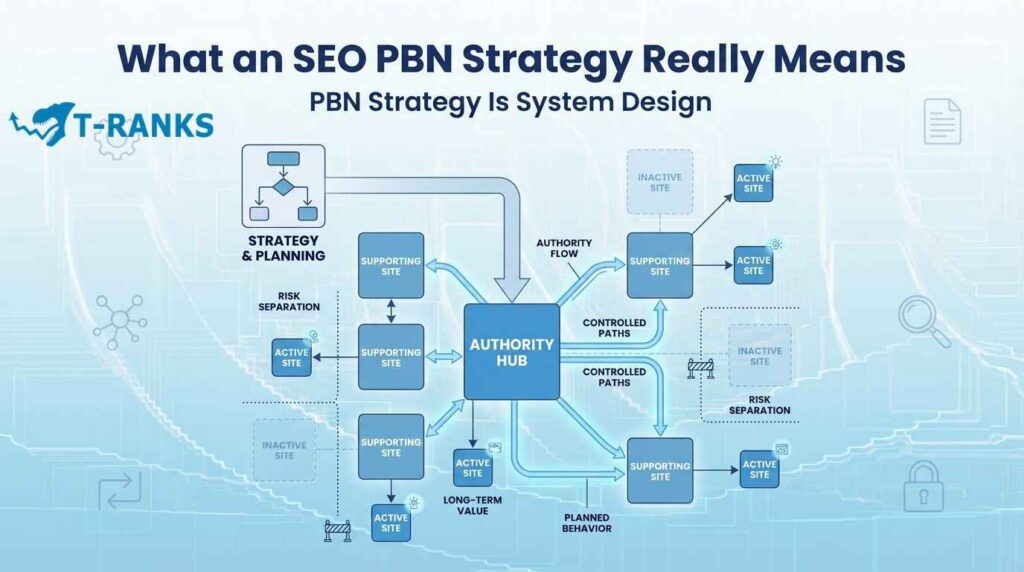
An SEO PBN strategy explains how a private blog network is planned and managed as a system. It focuses on how sites are arranged, how authority moves between them, and how risk is kept under control. Instead of treating each site separately, the network is designed to work together in a natural way.
A strong SEO PBN strategy starts before buying domains or placing links. The focus is on structure, not numbers. Decisions like which sites can link, which should stay inactive, and when links should be added decide whether the network looks natural or leaves clear patterns that search engines can detect.
Many PBNs fail because this planning step is skipped. People chase strong domains or copy other networks without understanding the structure behind them. That is why similar domains can produce very different results. One network stays stable, while another loses effectiveness. The difference is not domain strength. It is how the network was designed from the beginning.
Why Structure Is Critical for SEO Success
Risk Isolation
Good structure keeps sites separated. When domains, content timing, and linking behavior are different, one problem does not affect the entire network.
Authority Flow
Structure controls how authority moves. Instead of pushing all power directly to target pages, authority is passed slowly through selected paths. This avoids sudden spikes and keeps link behavior natural.
Asset Aging
Not every site should link right away. Letting sites publish content and age first builds trust and supports better long-term results.
Systemic Planning
A PBN works best when treated as a long-term system. Sites are added, updated, or removed based on performance and stability, not short-term ranking pressure.
When structure comes first, links become a controlled result instead of a constant risk.
SEO PBN Strategy vs PBN Setup vs PBN Tactics
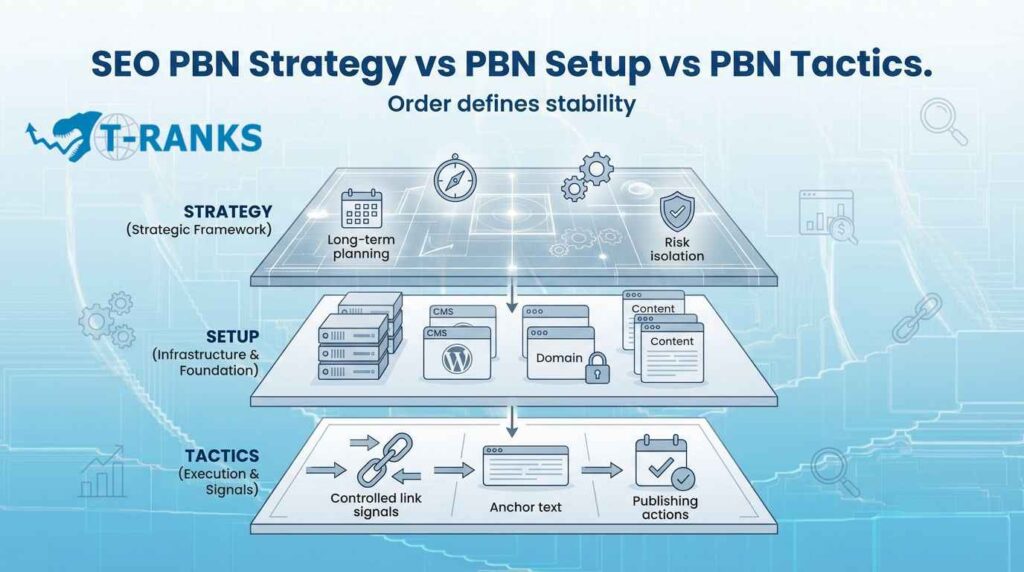
SEO PBN strategy, PBN setup, and PBN tactics represent three different layers of how a private blog network is planned and operated. Confusing these layers often leads to unstable networks and inconsistent results because decisions are made in the wrong order.
Strategy defines the behavior of the network as a whole. Setup provides the technical foundation needed to support that behavior. Tactics apply links and signals only after the network is stable. When these layers are clearly separated and executed in sequence, the network remains controlled and scalable instead of reactive.
Layer 1 – The Strategic Framework
This layer defines the architectural logic of the network before any infrastructure is built. It focuses on how the system should function over time rather than on individual actions.
- Network design and asset role definition
- Authority movement rules across the network
- Pattern avoidance through isolation and spacing
- Growth pacing aligned with a footprint minimization strategy
Layer 2 – Infrastructure & Setup
This layer converts strategy into a usable environment. A strategic PBN setup follows predefined architectural rules instead of making isolated technical decisions.
- Domain selection based on intended asset roles
- Hosting separation and provider diversity
- CMS configuration, theme variation, and indexing control
- Baseline content creation to establish initial trust
Layer 3 – Tactical Execution
This layer handles operational activity. It applies links and signals within the limits defined by the strategy and supported by the setup.
- Anchor selection and variation planning
- Contextual and editorial link placements
- Link velocity control and tiering decisions
- Tool usage and tracking for PBN SEO execution
| Layer | Intent | Focus | Result |
| Strategy | Define long term network behavior | Architecture and isolation design | Stable and predictable PBN structure |
| Setup | Build the supporting environment | Infrastructure and configuration | Clean and reliable network base |
| Tactics | Execute links within defined limits | Anchors, placement, velocity, tracking | Controlled authority transfer |
When SEO PBN strategy leads, setup becomes consistent and tactics remain disciplined. This layered approach keeps the PBN deployment strategy focused on long term stability rather than short term pressure.
Why PBN Structure Matters More Than Individual Links

PBN structure matters more than individual links because search engines evaluate how links behave together, not how many links exist. A well-planned network controls patterns, authority flow, and intent signals, while focusing only on link quantity often leads to instability and detection.
In modern SEO, rankings improve when links appear natural as a group. Adding more links without structure usually creates visible repetition in timing, placement, and behavior, which weakens results instead of strengthening them.
Search Engines Evaluate Patterns, Not Single Links
Search engines look for patterns across domains, not isolated backlinks. When multiple PBN sites show similar link timing, placement, or publishing behavior, those signals group together as unnatural link patterns. A strong PBN network structure reduces repetition by varying domains, content styles, and outbound linking behavior, making links harder to classify as coordinated.
Structure Controls Authority Distribution
Without structure, authority concentrates too quickly on a few pages. This creates obvious signals and ranking volatility. A structured network spreads authority across different roles. Some sites link directly, some support indirectly, and some do not link at all. This separation keeps authority distribution balanced and makes links appear intentional rather than forced.
PBNs perform best when structure leads and links follow. When the network is designed correctly, each link fits naturally into a broader system. When structure is ignored, links stand out on their own and become a short-term risk instead of a long-term asset.
Core PBN Network Structures Used in SEO
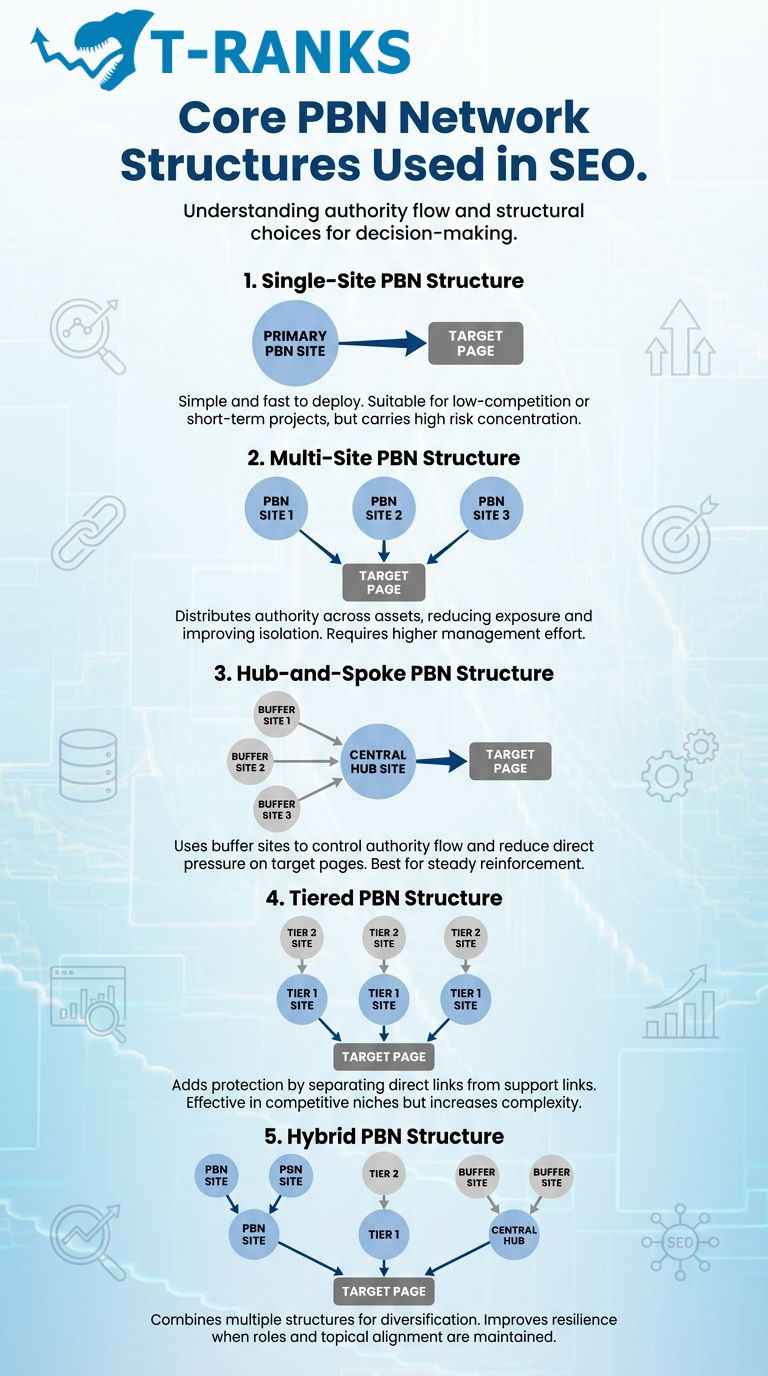
PBN network structure defines how authority moves, how risk is managed, and how stable rankings become over time. The goal is not to build something complex. The goal is to choose a structure that fits your competition level, budget, and risk tolerance.
Different structures solve different problems. Below are the main PBN network structures used in SEO, explained in simple terms with clear use cases.
Single Site vs Multi Site PBN Structures
Single site PBN structure uses one main domain to pass authority.
This setup is easy to manage and quick to deploy. It is sometimes used for low-competition niches, test projects, or short-term ranking pushes.
The main weakness is risk concentration. If that one site loses value, gets deindexed, or stops passing authority, the entire strategy fails. There is no backup layer.
Multi site PBN structure spreads authority across multiple isolated PBN assets.
Each site plays a smaller role, which reduces exposure and improves network isolation. Authority moves more naturally because links come from different sources over time.
The tradeoff is management effort. More sites mean more hosting decisions, more content, more publishing schedules, and more monitoring.
In practice:
- Low competition and small budgets may tolerate single site setups.
- Higher competition and lower risk tolerance favor multi site structures with clear asset segmentation.
Hub and Spoke PBN Structure
The hub and spoke PBN model is built around one strong authority hub.
This hub does not rely only on its own strength. It is supported by multiple spoke sites that link to the hub first.
Once the hub gains strength, authority flows outward in a controlled way. This reduces direct pressure on target pages and gives better control over signal flow.
Spoke sites act as buffers. They spread authority instead of forcing all links directly to the money page. This structure works well when rankings need steady reinforcement rather than sudden boosts.
Common mistakes weaken this model:
- Using the same theme or layout across all sites.
- Publishing content on the same schedule.
- Repeating the same outbound link behavior.
Consistency should exist in strategy, not in appearance or timing.
Tiered PBN Structure
Tiered PBN structure separates direct links from support links.
- Tier 1 links point directly to the target page.
- Tier 2 links support Tier 1 sites instead of linking to the money page.
This indirect linking reduces direct pressure on the target page and helps authority build more gradually. It is useful in competitive niches where direct PBN links alone increase risk.
Tiered link building adds protection, but it also adds complexity. It requires more domains, more content, and closer monitoring.
For smaller projects or low-competition keywords, tiering may be unnecessary and even inefficient.
Hybrid PBN Structures
Hybrid PBN structures combine different asset types.
These may include expired domains, niche content sites, and lighter supporting assets.
The purpose is diversification, not scale. A mixed asset strategy reduces reliance on one repeated structure and makes the network harder to analyze as a single system.
Different site roles, content depth, and linking behavior improve layered network design. This helps avoid uniform patterns that expose intent.
Hybrids require discipline:
- Assets must stay topically aligned.
- Roles must remain clear.
- Over linking between asset types should be avoided.
When managed carefully, hybrid structures improve resilience and long-term stability.
Each PBN structure has a purpose. The right choice depends on competition, budget, and acceptable risk. In PBN network SEO, success comes from aligning structure with intent and long-term stability, not from adding more links
How Authority Flows Inside a PBN Network

Authority flow inside a PBN network explains how ranking strength moves between assets without creating unstable or detectable patterns. It is not about pushing maximum power from every site. It is about managing link equity distribution so authority reaches target pages in a controlled and believable way.
In a strong SEO PBN strategy, authority does not move randomly. Each asset has a role, each link has timing, and each pathway is designed to avoid sudden pressure. When authority flow is unmanaged, links create spikes and volatility. When it is structured, links behave like editorial signals and support long-term stability.
How Authority Flow Is Controlled Inside a PBN Network
A PBN network controls authority flow through a combination of paths, asset roles, and timing decisions:
- Direct Authority Flow to Target Pages
Direct flow occurs when a PBN site links straight to a target page. This transfers authority efficiently and can reinforce rankings quickly. The risk appears when direct links accumulate too fast. Repeated direct paths increase pressure and create visible spikes in link equity distribution. - Indirect Authority Flow Through Intermediary Assets
Indirect flow strengthens intermediary assets before authority reaches the target. This process, known as authority stacking, reduces direct exposure and spreads pressure across the network. Intermediary assets act as buffers, releasing authority gradually instead of all at once. - Non-Linking Assets That Build Trust
Not every PBN site should link out. Some assets are designed to remain quiet. These sites publish content, age naturally, and build credibility without passing authority. Quiet assets support dampening link signals and improve the overall trust profile of the network. - Internal Linking as a Control Layer
Internal links within a PBN site affect how much authority an outbound link can pass. Pages with strong internal support release authority more effectively than isolated pages. Internal structure works as a gatekeeper, helping with smoothing link signals instead of forcing abrupt transfers. - Pacing to Prevent Authority Spikes
Authority should move in steps, not jumps. Links introduced gradually, from different assets, and through mixed paths reduce concentration. Pacing allows authority to accumulate naturally instead of triggering volatility.
When authority flow is planned, rankings stabilize and growth becomes predictable. When authority flow is rushed, even strong networks expose patterns and lose effectiveness. For a deeper breakdown of how authority is amplified and regulated, refer to the PBN link juice guide.
Link Placement Strategy Inside PBN Sites
Link placement strategy inside PBN sites defines where links appear and how authority is released without creating detectable patterns. It controls placement behavior across assets so links resemble normal editorial references rather than repeated insertions.
In a strong SEO PBN strategy, placement follows rules, not convenience. Different placement types serve different roles, and repeating the same placement logic across sites is what creates exposure.
How Link Placement Is Structured Inside a PBN Network
Effective PBN networks use placement intentionally to support natural behavior and avoid predictable patterns:
- Homepage Link Placement
Homepage links concentrate authority and can influence rankings quickly. They are best reserved for trusted assets, brand-style mentions, or authority hubs. Overuse creates visibility and repetition that makes patterns easy to detect. - Inner Page Link Placement
Links placed on inner pages distribute authority more quietly. Articles, guides, and topical content provide natural environments for links and reduce pressure on a single URL. Inner pages support smoother authority movement across the network. - Contextual PBN Links Within Content
Contextual PBN links placed inside relevant paragraphs appear editorial because they support the surrounding topic. When placement aligns with content intent, links look purposeful rather than inserted. This is one of the most reliable ways to control placement and context. - Editorial Style and Resource Placements
Editorial style links appear as references, citations, or recommended resources. These placements often feel safer because they mirror how real sites link out. Used selectively, editorial style links help diversify placement without concentrating authority. - Avoiding Repeated Placement Templates
Reusing identical link positions across multiple domains creates patterns. Repeated footer links, fixed paragraph positions, or uniform layouts expose intent. Varying placement logic across assets helps break correlations and keeps behavior natural.
When placement is structured correctly, links function as part of the content instead of standing out. When placement is repetitive, even strong domains reveal themselves. In PBN strategy, placement is not about visibility. It is about controlling patterns while allowing authority to move naturally.
Strategic Isolation and Footprint Control
Strategic isolation is a design choice, not a reaction driven by fear. In a mature SEO PBN strategy, network isolation is planned from the start so no single pattern can expose the wider system. The objective is independence at every layer, allowing assets to operate without forming correlations when viewed together.
Footprints emerge when networks share the same logic across infrastructure, software, visuals, timing, or outbound behavior. A safe scaling strategy focuses on footprint minimization by building diversity into the network architecture before links are placed. This approach keeps growth controlled and prevents patterns from forming as the network expands.
How Strategic Isolation Is Designed Into a PBN Network
Effective PBN networks apply isolation through deliberate structural decisions:
- Asset Separation and Network Isolation
Each site should function as an independent property with its own role. Separating assets ensures that one exposed pattern does not cascade across the network. - Infrastructure and Platform Diversity
Host diversity reduces infrastructure-level correlation by spreading assets across different providers and environments. CMS variation further limits shared signals by avoiding identical software stacks and configurations. - Theme, Layout, and Content Voice Diversity
Theme and layout diversity prevents visual repetition. Content voice variation matters just as much. Different writing styles, depth, and formatting help break content-level similarities that create correlations. - Timing Diversity and Publishing Cadence
Avoid synchronized publishing and linking across sites. Staggered updates introduce link pattern randomness and reduce time-based clustering that exposes intent. - Outbound Link Policies
Not all sites should link out, and not all posts should contain links. Defining outbound rules at the network level reduces repetition and supports long-term stability.
When isolation is embedded into the design, scaling becomes safer. Assets grow independently, patterns remain fragmented, and authority can move without exposing structure. For practical implementation details on infrastructure choices and footprint control, refer to the hosting and footprint guide.
SEO PBN Strategy for Different Use Cases
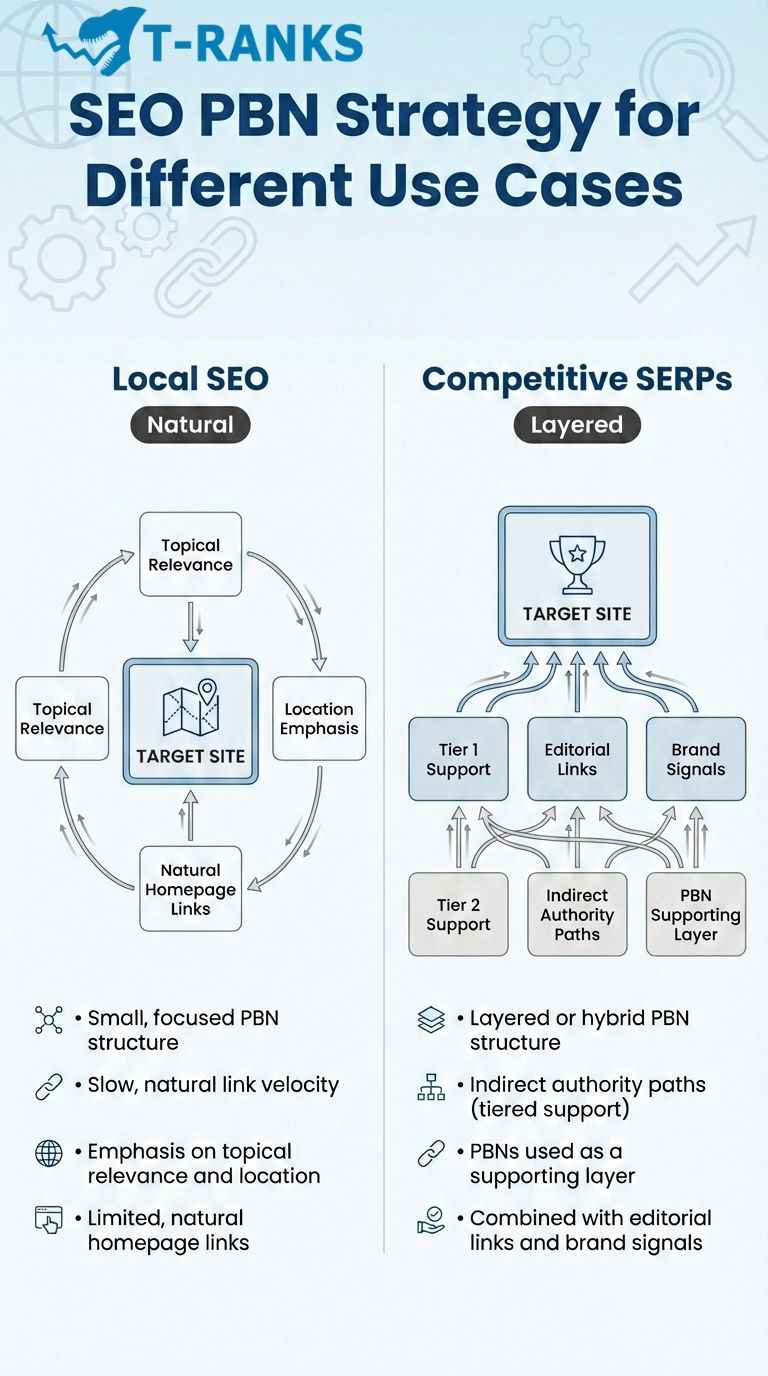
An SEO PBN strategy does not work the same way in every situation. Search intent, competition level, and how Google evaluates results all affect how a network should be designed. A structure that performs well for local service pages may fail in highly competitive, brand-driven search results. This section explains how PBN strategy should change based on the use case instead of following one fixed approach.
PBN Strategy for Local SEO
A PBN for local SEO works best when the network stays small and focused. Local ranking pages usually respond better to a limited number of highly relevant links than to a large network. Smaller structures reduce unnecessary signals and make patterns harder to detect.
Link velocity should remain slow and natural. Adding links too quickly often looks forced for local service keywords, especially when search volume is low. Gradual link placement allows authority to build without creating timing signals.
Relevance and proximity matter more than raw authority in local SEO. PBN content should support the service topic and location while reinforcing trust. This approach works best when combined with local citations and consistent business information. Homepage links can help in some cases, but only when they appear natural and resemble brand mentions. Overusing homepage placements usually draws attention.
PBN Strategy for Competitive SERPs
In competitive SERPs, PBNs should support rankings rather than act as the main driver. Brand-dominated results rely heavily on trust and authority, and using only PBN links increases risk. A more careful deployment focuses on stability instead of speed.
Hybrid structures and tiered linking help reduce direct pressure on target pages. Indirect paths allow authority to move more evenly and limit exposure. In these environments, PBNs work best when combined with editorial links, guest posts, digital PR, and brand mentions to improve link diversity.
In high-competition searches, success does not come from link volume. It comes from balance. When PBNs are used as part of a broader strategy, they strengthen existing signals instead of becoming the weakest part of the profile.
Different use cases require different levels of control. Aligning SEO PBN strategy with search intent and competition helps networks stay effective and resilient across changing SERP conditions.
Scaling a PBN Network Without Breaking It

Scaling is where most PBN networks fail. The problem is rarely domain quality. It is uncontrolled growth. A strong SEO PBN strategy treats scaling as a careful process based on performance, stability, and risk, not as a constant push to add more sites or links.
The goal of scaling a PBN network is to increase results without increasing visibility. This means knowing when to grow, when to pause, and when to reduce exposure. Networks that scale safely do so in clear phases, supported by regular monitoring and maintenance rather than aggressive expansion.
When to Add New Domains and Assets
New domains should only be added when the current network is stable. Stability means pages are indexing consistently, traffic patterns look normal, and linked pages are not showing unusual ranking volatility. Adding assets before reaching this stage often copies existing problems into a larger structure.
Growth decisions should be driven by performance. If rankings improve steadily and authority flow remains smooth, limited expansion may be justified. If results stall or fluctuate, scaling should stop until the cause is identified and corrected.
Knowing When to Stop Adding Links
Adding more links does not always improve rankings. When new links stop producing movement or begin creating visible repetition, it is time to stop. This usually happens when authority becomes concentrated or timing patterns start to appear.
Stopping link placement is not a setback. It is a strategic choice. Pausing allows signals to settle and often leads to improved stability instead of further volatility.
Refresh vs Expand Strategy
Before expanding the network, existing assets should be reviewed. A refresh vs expand strategy focuses on improving what is already in place through content updates, stronger internal links, and deeper topical coverage.
A clear content aging strategy builds trust and improves outbound link performance without introducing new domains. In many cases, refreshing older sites delivers better results with far less risk than expansion.
Decommissioning Weak or Risky Assets
Not every PBN asset should remain active forever. Decommissioning weak PBNs is part of responsible network management. This may include reducing outbound links, removing risky pages, or retiring sites that no longer index cleanly.
Pruning weak assets often improves overall network health. Reducing exposure can be more effective than adding new sites and helps keep authority distribution clean.
Scaling works when it is deliberate. Networks that grow slowly, maintain regularly, and remove weak points remain effective far longer than those built on constant expansion.
Monitoring and Feedback Loops for PBN Strategy

Monitoring is what separates a controlled SEO PBN strategy from guesswork. A PBN network should be observed as a system, not as a collection of isolated links. The purpose of monitoring is not to chase metrics, but to confirm that structure, timing, and authority flow behave as expected over time.
Effective PBN monitoring creates feedback loops. These loops help you decide when to continue, when to pause, and when to correct course before patterns become visible. Without monitoring, even a well-designed network can drift into risk.
What to Track Inside a PBN Network
Tracking should focus on behavior and change, not on raw scores.
Key signals to monitor include index status of each asset, basic traffic trends, outbound link behavior, anchor distribution, and movement of target pages. Sudden changes often indicate imbalance in link velocity control or authority concentration.
Target page movement matters more than individual link metrics. If rankings improve smoothly, authority flow is likely stable. If rankings spike and drop, further volatility analysis is required before adding anything new.
Avoiding Metric-Driven Misjudgments
Third-party tools can mislead when used in isolation. Domain ratings, traffic estimates, and link counts are approximations, not truth. Making decisions based only on these numbers often leads to overbuilding or unnecessary pruning.
Metrics should be used comparatively. Look for changes over time rather than absolute values. Stability across weeks is usually a better signal than a sudden metric jump.
Using Tools for Pattern Detection, Not Validation
Tools like Ahrefs for PBN checks are most useful for spotting patterns, not for validating success. Backlink tracking helps identify anchor repetition, timing clusters, or unexpected outbound changes that may introduce risk.
Use tools to compare assets against each other and against past states. If multiple sites begin behaving similarly, it signals a structural issue that needs adjustment. Tools support decision making, but they should never replace judgment.
A strong SEO PBN strategy relies on observation, restraint, and adjustment. Monitoring closes the loop between planning and execution, ensuring the network stays predictable as it grows and evolves.
Common SEO PBN Strategy Mistakes to Avoid
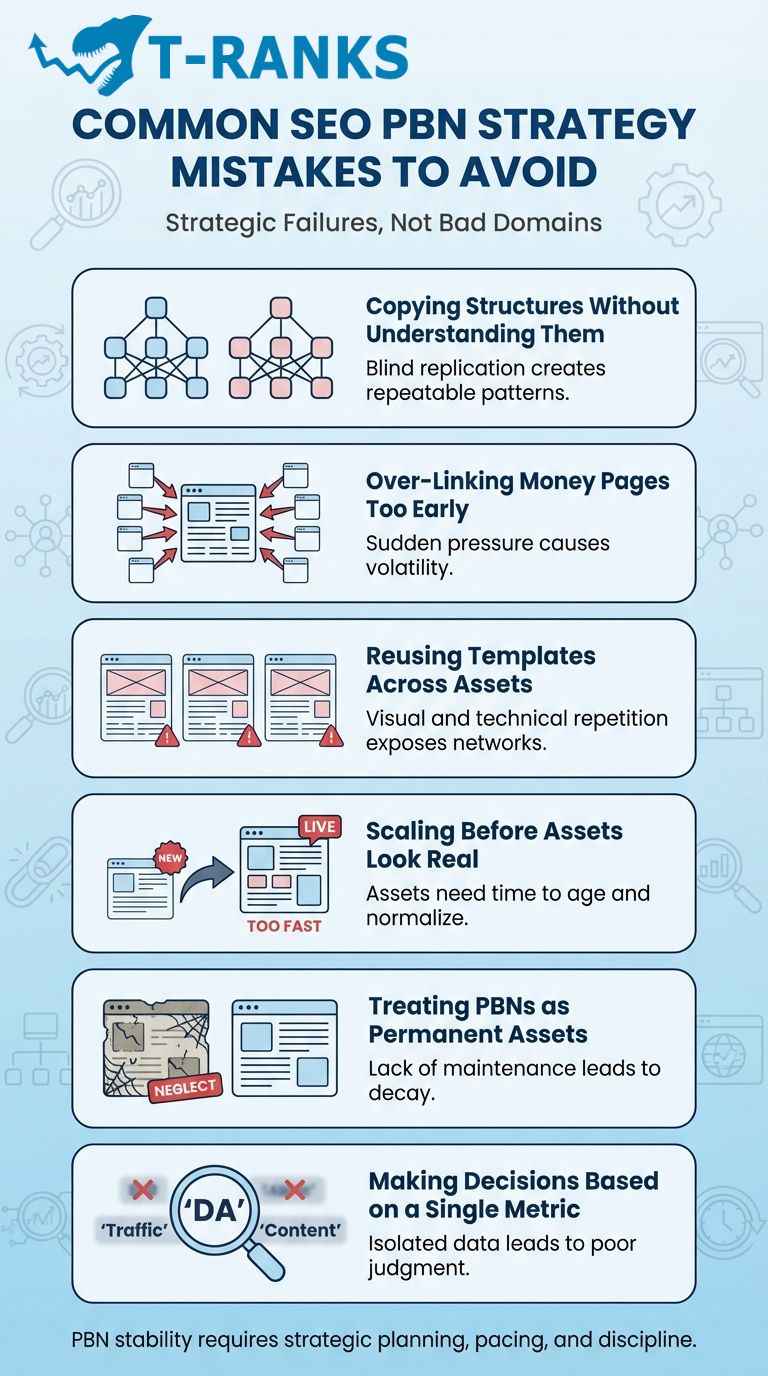
Most PBN failures do not come from bad domains. They come from strategic mistakes that create visible patterns over time. Avoiding these errors is critical if you want your SEO PBN strategy to remain stable, predictable, and useful beyond short-term gains.
Copying Structures Without Understanding Them
Replicating a competitor’s PBN setup without understanding the underlying structure is one of the fastest ways to introduce risk. What works in one niche or timeline may fail in another. Blind copying often leads to pattern repetition and misaligned authority flow that does not match your use case.
Over-Linking Money Pages Too Early
Pushing too many links directly to money pages creates obvious link concentration. This behavior produces unnatural pressure spikes and increases volatility. Authority should build gradually through controlled paths, not be forced all at once.
Reusing Templates Across Assets
Using the same themes, layouts, plugins, or content formats across multiple sites creates structural similarities that are easy to correlate. Repetition at the visual or technical level weakens network isolation and makes the system easier to profile.
Scaling Before Assets Look Real
Adding new domains or increasing link velocity before existing assets appear stable is a form of unnatural scaling. Assets need time to age, publish content, and develop normal behavior before being expanded or activated.
Treating PBNs as Permanent Assets
PBN sites are not set-and-forget properties. Ignoring content refresh, internal structure, or outbound pruning leads to link decay. Weak or outdated assets should be improved, reduced, or removed to protect the network as a whole.
Making Decisions Based on a Single Metric
Relying on one tool or one metric to guide strategy often results in overreaction. Rankings, traffic estimates, and third-party scores must be evaluated together. Decisions based on isolated numbers usually introduce instability instead of clarity.
A strong SEO PBN strategy avoids shortcuts. When mistakes are minimized, structure stays intact, authority flows smoothly, and the network remains adaptable rather than fragile.
How SEO PBN Strategy Fits Into a Safer Link Building Mix
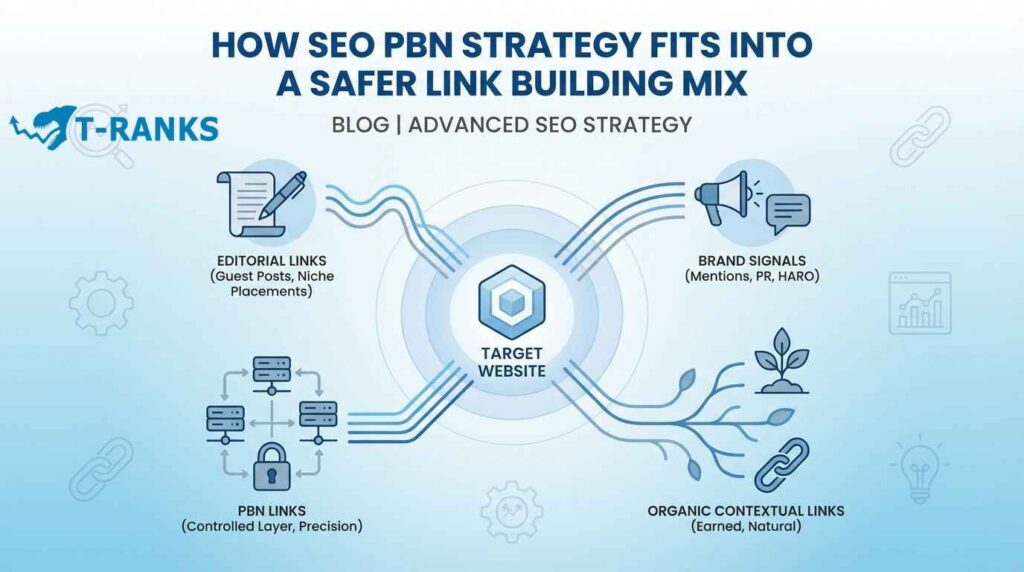
An effective SEO PBN strategy works best when it is treated as a controlled lever, not as a complete SEO system. PBNs are designed to give you precision and timing control over authority, but they are not meant to replace organic growth signals or brand-driven trust. When used alone, they increase dependency. When used as part of a broader mix, they increase stability.
Search engines evaluate link profiles holistically. A network that relies on a single source of authority, even if well structured, becomes easier to profile over time. This is why PBNs perform better when they support, rather than dominate, the overall link profile.
Why PBNs Work Better as a Supporting Layer
PBNs provide predictability. They allow you to reinforce pages when needed and smooth authority gaps. However, predictability must be balanced with diversity. Editorial-style signals introduce uncertainty that algorithms expect to see.
A safer link building mix typically combines PBNs with:
- Editorial links from guest posts and niche placements that introduce natural context and third-party validation
- Brand mentions, HARO placements, and digital PR that strengthen brand signals and trust
- Contextual links earned through content that attract organic references over time
This approach creates link portfolio diversification. Each link type behaves differently, appears at different times, and originates from different intent sources. That variation reduces reliance on any single pattern and makes the overall profile more resilient.
Reducing Pattern Dependency Through Link Diversity
When PBNs are only one part of the equation, their role becomes clearer. They stabilize rankings instead of carrying them entirely. If one channel slows down, others continue to support visibility.
A safer link building mix also allows you to scale more cautiously. PBN activity can be reduced or paused while editorial and brand-driven links continue to accumulate. This flexibility lowers long-term risk and improves consistency.
For a practical example of how editorial links complement controlled networks, see our guest posting guide.
When PBNs are positioned correctly within a broader strategy, they enhance performance without becoming a liability.
Conclusion, Strategy First, Links Second
In conclusion, an effective SEO PBN strategy depends on structure, not volume. When the network is planned with clear architecture, controlled authority flow, and proper isolation, links work more predictably and support long-term performance. Structure determines how risk is managed, how authority is distributed, and how patterns remain fragmented instead of exposed.
When structure is weak, even strong domains become inconsistent and risky. Adding more links in that situation increases volatility rather than improving results. A strategy-first approach keeps authority movement controlled, supports sustainable growth, and avoids reliance on aggressive or reactive link building.
If you want predictable rankings and controlled authority building, the focus must stay on planning, pacing, and system-level decisions. If you need expert guidance on structuring or refining a PBN network safely, a strategic consultation can help identify gaps before they turn into risks.
Frequently Asked Questions About SEO PBN Strategy
What is an SEO PBN strategy?
An SEO PBN strategy is a structured plan for designing, isolating, and scaling a private blog network to influence rankings. It focuses on network architecture and authority flow rather than placing links randomly.
How is an SEO PBN strategy different from just building PBN links?
An SEO PBN strategy controls how links are distributed across assets over time. Building PBN links without planning often creates detectable patterns and unstable results.
Why does PBN structure matter more than the number of links?
Search engines evaluate patterns across entire networks, not individual backlinks. A smaller, well-structured PBN can outperform a larger network with poor organization.
How does authority flow work in a PBN network?
Authority can pass directly to target pages or indirectly through supporting assets. Using both approaches helps manage pressure and reduce unnatural spikes.
Should every PBN site link to the main site?
No, not every PBN site should link out. Some assets are better used to age naturally and build trust before passing authority.
How do you scale a PBN network without increasing risk?
Scaling should be gradual and based on performance stability. Adding domains or links too quickly often creates repeatable footprints.
When should you stop adding PBN links?
You should pause link building when rankings stabilize or patterns begin repeating. Overbuilding often causes volatility instead of long-term gains.
What is PBN in SEO?
PBN in SEO refers to using privately controlled websites to pass authority through backlinks. Search engines evaluate how these sites behave as a group, not individually.
What does PBN SEO mean?
PBN SEO means influencing rankings through owned sites rather than earned editorial links. Its effectiveness depends on structure, relevance, and controlled deployment.
Is PBN SEO still effective in 2026?
Yes, PBN SEO can still be effective in 2026 when networks are carefully planned. Most failures happen due to poor structure and repeated patterns.