PBN links may seem valuable while they are helping a site rank, but that value can disappear if Google detects PBN links as spam. Google may stop giving those links ranking value, which can affect rankings if the site was relying on them.
But losing PBN link value does not automatically mean your site has received a manual penalty. When Google detects PBN links being used to manipulate rankings, it may neutralize their value instead. A manual action is different because it involves human review and can appear in Google Search Console.
If your rankings drop after using PBN links, the cause is not always obvious. The links may have lost their ranking value, a manual action may exist, or another SEO issue may be responsible. That is why it is important to check the evidence before deciding what happened.
If you’re wondering what happens when Google detects PBN links, this guide breaks it down clearly. You’ll learn how link devaluation differs from a manual action, what can happen to rankings, how to check for warning signs, and what steps you can take toward recovery.
What Happens When Google Identifies PBN Links?
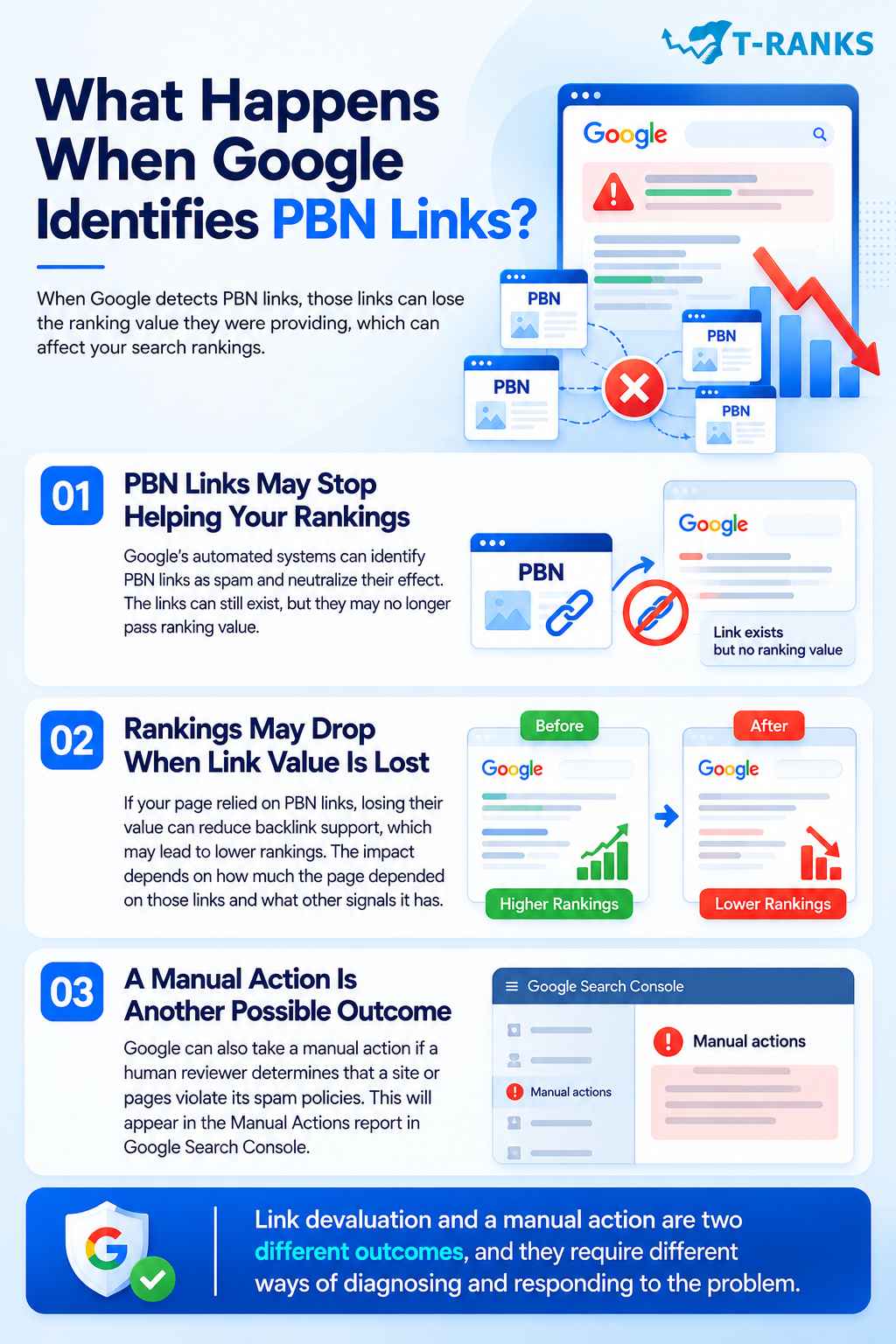
When Google detects PBN links that it considers link spam, those links can lose the ranking value they were providing. The backlinks may remain live, but if your site depended on them, losing that value can affect its search rankings.
This is where PBN problems can be confusing. You may open Ahrefs, Semrush, or another backlink tool and still see the same links pointing to your site. The PBN pages may even remain indexed. But neither of these things proves that Google still gives those links the same ranking value.
PBN Links May Stop Helping Your Rankings
Google uses automated systems to identify link spam and neutralize its effect. So, a PBN backlink does not necessarily need to disappear before it stops helping your SEO.
Think of a page that has been ranking with support from several PBN backlinks. If Google stops counting some of those links, the page loses part of the link value that previously supported it. The links can still exist, but their SEO benefit may no longer be the same.
This is also why third party backlink data needs context. SEO tools can show that a backlink exists, but they cannot confirm exactly how much ranking value Google gives that individual link.
Rankings May Drop When Link Value Is Lost
If PBN links were helping a page rank, losing their value can reduce the backlink support behind that page. The ranking impact will depend on how much the page relied on those links and what other signals continue to support it.
For example, a page with useful content and relevant editorial backlinks may still have strong signals after some PBN links lose value. A page that relied heavily on those links may see a more noticeable change.
But a ranking drop by itself is not proof that Google detected a PBN. Rankings can change for many reasons. Search Console data, affected pages and queries, backlink changes, and other SEO issues should be checked before connecting the decline to PBN links.
A Manual Action Is Another Possible Outcome
There is also a more direct outcome. Google can take a manual action when a human reviewer determines that a site or pages violate its spam policies. If this happens, the issue can appear in the Manual Actions report in Google Search Console.
This is different from a PBN link simply losing ranking value. A site can lose the SEO benefit of spammy links without receiving a manual action at all.
That difference is important because the next step depends on what actually happened. Link devaluation and a manual action are two different situations, and they require different ways of diagnosing and responding to the problem.
PBN Link Devaluation vs Manual Action: What Is the Difference?

PBN link devaluation means Google reduces or removes the ranking benefit of links it considers spammy, while a manual action happens when a human reviewer finds a spam policy violation. The main difference is how the issue is handled and whether Google reports it in Search Console.
These two outcomes can sometimes look similar because both may be associated with lost search visibility. However, they are not the same. Understanding the difference helps you avoid assuming that every ranking drop caused by lost PBN link value is a Google penalty.
What Is PBN Link Devaluation?
PBN link devaluation happens when Google’s automated systems identify links as spammy and neutralize their effect. Instead of giving those links the ranking value they were intended to provide, Google may stop counting that benefit.
The important point is that link devaluation focuses on the value of the link. The backlink can remain live on the referring page, and the page itself can remain accessible. What changes is the ranking benefit the link provides.
For example, if a page was benefiting from several PBN links and Google neutralizes those links, the page may lose some of the link value that previously supported its rankings. This can happen without a manual action appearing in Google Search Console.
What Is a Manual Action?
A manual action occurs when a human reviewer at Google determines that pages or a site do not comply with Google’s spam policies. Unlike automated link devaluation, Google reports manual actions to the affected site owner through the Manual Actions report in Google Search Console.
A manual action can affect specific pages or a broader part of a website, depending on the violation. The site owner must address the reported issue before requesting Google to review the site again when a reconsideration request is available.
This makes a manual action easier to confirm than suspected link devaluation. If Google Search Console reports a manual action, you have direct evidence that manual enforcement has occurred.
Key Differences Between Link Devaluation and a Manual Action
The simplest way to separate the two is to look at what Google is doing and how the site owner is informed.
| Factor | PBN Link Devaluation | Manual Action |
| What happens | Spammy links may lose ranking value | Google manually acts on a spam policy violation |
| How it happens | Automated spam detection systems | Human review |
| Main effect | Link benefit may be neutralized | Search visibility may be affected by the action |
| Search Console notice | Not necessarily | Yes |
| Does the backlink have to disappear? | No | No |
| Reconsideration request | Not applicable simply because a link was devalued | Used after the reported violation is addressed, where applicable |
The key distinction is simple: link devaluation is about Google no longer giving a spammy link its intended ranking benefit, while a manual action is direct enforcement following human review.
Can PBN Link Devaluation Cause Rankings to Drop?
Yes, PBN link devaluation can contribute to ranking drops if those links had been helping the page rank. When Google neutralizes spammy links, the backlinks may remain live, but the ranking benefit they were providing can be lost.
What happens next depends on how much the page relied on those links. A page supported by strong editorial backlinks and other useful signals may see limited movement. A page that depended heavily on PBN links may be more affected when that link value disappears.
How Lost PBN Link Value Affects Rankings
A PBN backlink does not need to disappear before its SEO benefit can be lost. The referring page may remain indexed, and the backlink may still appear in Ahrefs, Semrush, or another SEO tool.
The difference is that Google may no longer give the link the same ranking benefit. If several PBN links had been supporting a page and those links are neutralized, the page is left competing with the ranking signals Google continues to count.
Think of two pages targeting similar searches. One has relevant editorial backlinks alongside its PBN links. The other relies heavily on PBN links for backlink support. If the PBN links lose their value, the second page has more to lose because fewer useful link signals remain.
This is also why rankings can decline without a manual action. The page may simply have lost link value that previously contributed to its search performance.
How Much Can Rankings Drop?
There is no fixed amount a page will fall after PBN links are devalued. Google does not provide a formula that connects a certain number of neutralized links with a certain number of lost ranking positions.
The impact depends on the links involved, the other backlinks supporting the page, the quality and relevance of the page itself, and the strength of competing results. Losing PBN link value may have little visible effect on one page and a much larger effect on another.
For this reason, counting lost or suspected PBN links cannot reliably predict how far rankings will move.
Does a Ranking Drop Confirm PBN Link Devaluation?
No. A ranking drop alone does not prove that Google devalued PBN links. It shows that search visibility changed, but it does not identify the cause.
A page can lose rankings because important legitimate backlinks disappeared, competitors improved, content became less relevant to the search intent, technical problems developed, or Google’s ranking systems changed. PBN link devaluation is only one possible explanation.
So, if rankings fall while your PBN backlinks remain live, do not treat the ranking drop itself as proof of detection or devaluation. The next step is to examine the evidence and determine what actually changed.
How Does Google Identify PBN and Link Spam Patterns?
Google uses automated spam detection systems and manual reviews to identify links created mainly to manipulate search rankings. However, Google does not publish a complete formula showing exactly how it identifies a private blog network or which individual PBN footprints trigger detection.
This distinction matters. SEO professionals can identify patterns that make a group of sites look connected or unnatural, but those observations should not be presented as confirmed Google detection factors.
What Google Confirms About Link Spam Detection
Google defines links created primarily to manipulate search rankings as link spam. Its spam policies cover practices such as buying or selling links for ranking purposes, excessive link exchanges, automated link creation, and other links designed primarily to manipulate ranking signals.
Google has also explained that its spam prevention system, SpamBrain, can identify sites involved in buying links as well as sites used for passing outgoing links. This means Google is not limited to looking at the website receiving a backlink. It can evaluate suspicious link activity across the linking ecosystem.
For PBNs, the important point is the purpose and pattern of the links. If sites are being used primarily to create backlinks that manipulate rankings, those links can fall within Google’s link spam policies.
Common PBN Patterns SEOs Audit

Although Google does not provide a public PBN detection checklist, SEO professionals commonly review a combination of site and linking patterns when assessing a network.
These can include similar outbound linking behavior, repeated use of optimized anchor text, sites with little genuine purpose beyond publishing link placements, similar content or page structures, and obvious connections between multiple referring domains.
Technical similarities such as shared hosting infrastructure, nameservers, themes, analytics identifiers, or registration information may also be reviewed when auditing a network. But seeing one shared characteristic does not prove that Google has identified the sites as a PBN.
The larger concern is usually a repeated pattern rather than one isolated similarity. For example, two websites using the same WordPress theme tells you very little on its own. A group of low value sites publishing similar content and repeatedly linking to the same commercial websites with optimized anchors creates a much broader pattern to investigate.
What Google Does Not Confirm About PBN Footprints
Google does not publicly provide a list of PBN footprints that automatically trigger detection. There is no confirmed rule stating that sharing an IP address, hosting company, WordPress theme, nameserver, or another individual technical feature automatically causes a network to be classified as a PBN.
This is where many discussions about PBN detection become too certain. A footprint that helps an SEO auditor discover relationships between websites is not automatically proof that Google’s systems use that same signal in the same way.
The safer distinction is simple: Google confirms that it detects link spam, but it does not reveal the complete system it uses to identify every PBN or evaluate every network pattern.
That means PBN detection should be understood through Google’s documented link spam policies and the overall linking behavior of a network, rather than through a single supposed footprint that guarantees detection.
What Happens to the Money Site and PBN Site?
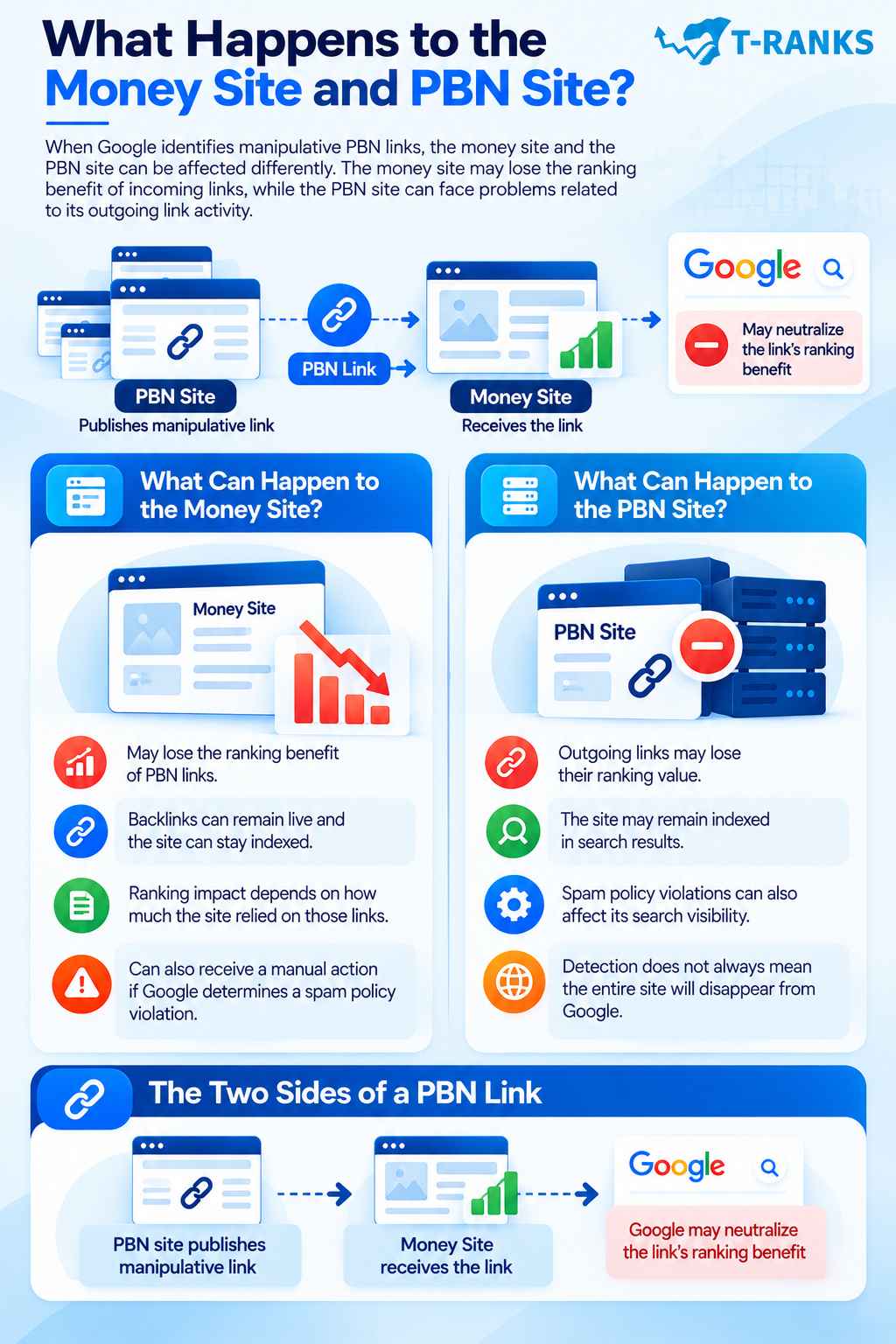
When Google identifies manipulative PBN links, the money site and the PBN site can be affected differently. The money site may lose the ranking benefit of incoming links, while a PBN site used to pass manipulative links can face problems related to its outgoing link activity.
This distinction matters because a PBN link connects two different websites. One site is receiving the backlink, while the other is providing it. Google has stated that its link spam systems can identify both sites buying links and sites being used to pass outgoing links.
What Can Happen to the Money Site?
The money site is the website the PBN links are intended to support. If Google neutralizes those links, the money site can lose some of the backlink value that may have been helping its pages rank.
Nothing necessarily changes visually. The PBN backlinks can remain live, and the money site can remain indexed. What changes is that the links may no longer provide the same ranking benefit.
For example, suppose a commercial page has legitimate backlinks alongside several PBN links. If Google stops counting the PBN links, the page has to compete using the other signals Google continues to value. If the page relied heavily on those PBN links, the ranking impact may be more noticeable.
A money site can also be affected by a manual action when Google determines through manual review that a spam policy violation has occurred. This is a separate outcome from links simply losing their ranking value.
What Can Happen to the PBN Site?
The PBN site is the referring website publishing the backlink. If the site is being used to pass links primarily for ranking manipulation, its outgoing linking activity can fall within Google’s link spam policies.
Google’s response does not have to mean that the entire PBN site immediately disappears from search results. Depending on what Google’s systems identify, the manipulative outgoing links may lose their effect, and spam policy violations can also affect a site’s search visibility.
This is an important distinction because PBN detection should not automatically be described as PBN deindexing. A PBN page remaining indexed does not prove that its outgoing links still provide ranking value, just as a site disappearing from some search results does not by itself explain exactly why it happened.
The Two Sides of a PBN Link
The easiest way to understand the relationship is to follow the link:
PBN site publishes manipulative link → money site receives the link → Google may neutralize the link’s ranking benefit
If manual enforcement is involved, the situation can become more serious. But simply seeing the PBN site and money site still indexed does not tell you whether Google continues to value the link between them.
How Can You Tell If PBN Links Were Devalued or a Manual Action Occurred?
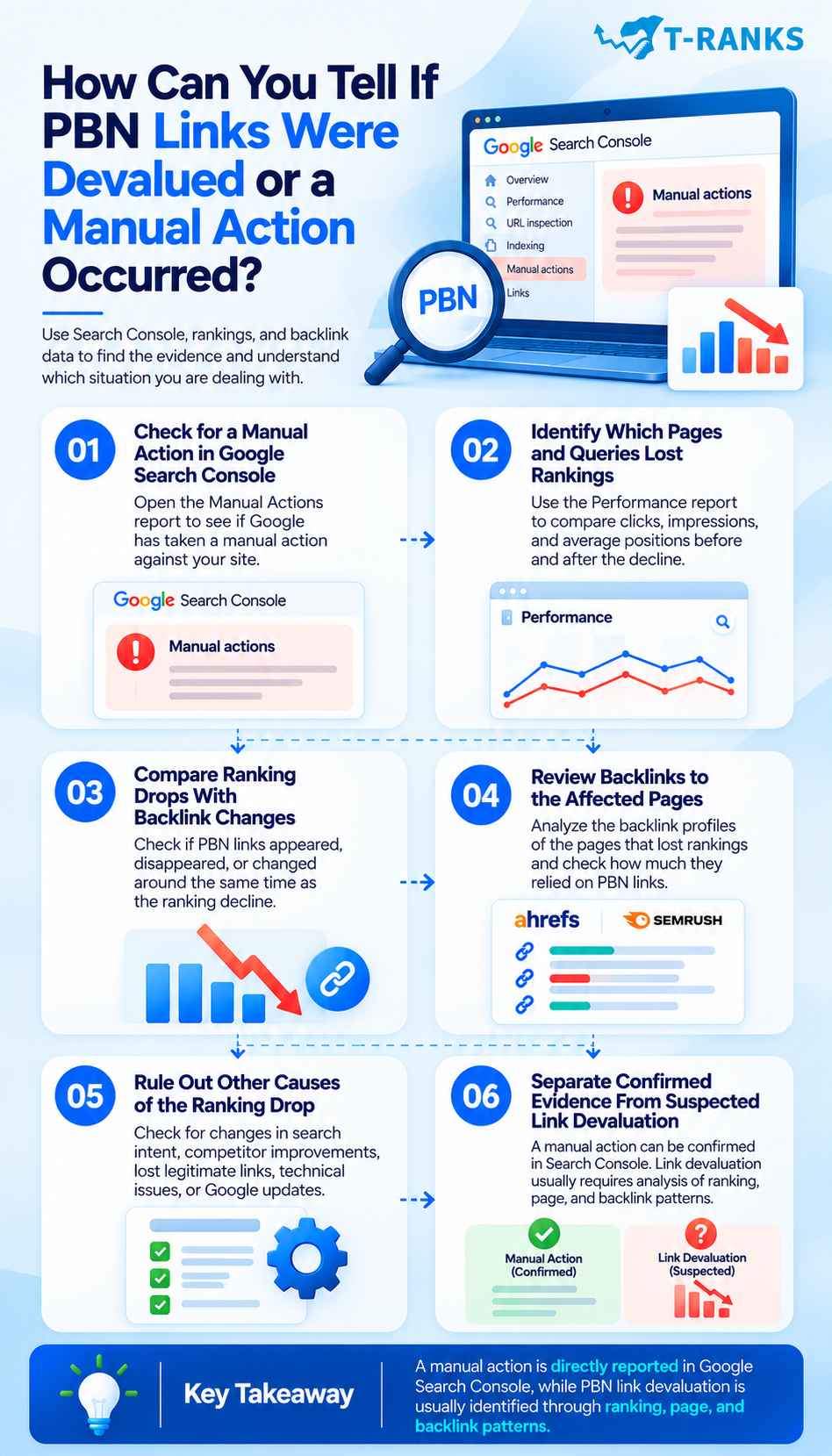
Start with Google Search Console to check for a manual action, then analyze ranking and backlink changes for evidence that PBN links may have lost value. A manual action can be directly confirmed, while link devaluation usually has to be assessed from patterns rather than a specific Google notification.
This distinction matters because both situations can be associated with lost search visibility, but they leave different evidence. PBN backlinks may remain live and their referring pages may stay indexed even when the links no longer provide the expected ranking benefit.
Step 1: Check for a Manual Action in Google Search Console
Start with the Manual Actions report in Google Search Console. If Google has taken a manual action against your site, the report identifies the issue and shows which parts of the site are affected.
An unnatural links related manual action provides direct evidence that manual enforcement has occurred. Review the reason Google provides before deciding how to address the problem.
If no manual action appears, however, that does not confirm that your PBN links are still passing ranking value. Google’s automated spam systems can neutralize spammy links without generating a manual action notice.
Step 2: Identify Which Pages and Queries Lost Rankings
Next, determine exactly where the visibility loss occurred.
Use the Performance report in Google Search Console to compare clicks, impressions, and average positions before and after the decline. Focus on the pages receiving PBN backlinks and the queries for which those pages lost visibility.
For example, if several pages supported by PBN links decline while unrelated pages remain relatively stable, the pattern may justify a closer investigation. It still does not prove that Google devalued those links.
Step 3: Compare Ranking Drops With Backlink Changes
Compare the timing of the ranking decline with changes in the backlink profile.
Check whether PBN links appeared, disappeared, or changed around the same period. Also look for legitimate backlinks that may have been lost.
Timing can help narrow the possible causes, but correlation is not confirmation. A ranking decline after a PBN campaign or Google update does not prove that Google detected and devalued the links.
Step 4: Review Backlinks to the Affected Pages
Examine the backlink profiles of the pages that lost rankings. Determine how much those pages appeared to rely on PBN links and whether other important backlinks also changed.
Third party SEO tools such as Ahrefs and Semrush can show whether a backlink still exists. They cannot confirm exactly how much ranking value Google assigns to an individual link.
This creates an important diagnostic limitation: a PBN backlink remaining live does not prove that Google is still counting it for rankings.
Step 5: Rule Out Other Causes of the Ranking Drop
Before connecting the decline to PBN link devaluation, check for other SEO changes that could explain it.
A page can lose rankings because search intent changed, competitors improved their content or backlink profiles, important legitimate backlinks disappeared, or technical and indexing problems developed. Changes in Google’s broader ranking systems can also affect visibility.
If several factors changed during the same period, there may not be enough evidence to attribute the decline specifically to PBN links.
Step 6: Separate Confirmed Evidence From Suspected Link Devaluation
Finally, separate what Google directly confirms from what the available data only suggests.
A manual action reported in Google Search Console is direct evidence of manual enforcement. A ranking decline concentrated on pages receiving PBN links may support the possibility that those links lost value, but it does not prove that Google devalued a specific backlink or detected a particular network.
The key difference is simple: a manual action can be confirmed in Search Console, while suspected PBN link devaluation usually requires analysis of ranking, page, and backlink patterns.
Once you have identified which situation the evidence supports, the next step is deciding how to respond and whether recovery requires addressing a manual action or rebuilding ranking signals that may have been lost.
How Do You Recover From PBN Link Devaluation or a Manual Action?
Recovery depends on what actually happened. If Google issued a manual action, you need to address the reported link spam issue and request reconsideration where available. If PBN links were simply devalued, there is no manual action to remove, so recovery depends on strengthening legitimate ranking signals.
This is why diagnosing the problem first matters. The recovery process for a confirmed manual action is different from the response to PBN links that may have stopped providing ranking value.
Recovery After an Unnatural Links Manual Action
If Google Search Console shows a manual action related to unnatural links, start with the issue described in the Manual Actions report.
Review the affected links and address the practices that caused the violation. Depending on the situation, this may involve removing or changing links that were created to manipulate rankings and documenting the corrective work.
Once the violation has been addressed, submit a reconsideration request through Google Search Console when that option is available. The request should explain what caused the issue, what was corrected, and what has changed to prevent the same problem from continuing.
A successful reconsideration request can result in the manual action being revoked. However, removing a manual action does not guarantee that previous rankings will return. If PBN links or other manipulative links no longer contribute ranking value, the site may have fewer useful signals than it had before enforcement.
Recovery After PBN Links Lose Their Ranking Value
If there is no manual action and PBN links appear to have lost value, there is no manual penalty to remove and no reconsideration request to submit simply for suspected link devaluation.
The focus instead shifts to replacing the ranking support the site may have lost with legitimate signals.
This can include improving pages that lost visibility, strengthening internal linking, earning relevant editorial backlinks, updating content to better satisfy search intent, and resolving technical SEO problems that may also be limiting performance.
For example, if a commercial page previously depended heavily on PBN links, simply waiting for those links to start working again is not a reliable recovery strategy. Building relevant links that Google can continue to value gives the page a stronger foundation independent of the devalued network.
Recovery may also look different from restoring the site’s exact previous positions. Search results, competitors, content, and backlink profiles can all change while the site is rebuilding.
The key principle is straightforward: a manual action requires correcting the reported violation and completing Google’s review process, while PBN link devaluation requires rebuilding the legitimate ranking signals that were lost or were previously being supplemented by those links.
Should You Remove or Disavow PBN Links?
You should not automatically remove or disavow every PBN link simply because it looks risky. The appropriate response depends on whether Google has issued a manual action, whether the links were intentionally created for ranking manipulation, and whether there is a realistic risk from an unnatural backlink profile.
Removing and disavowing links are also different actions. Link removal eliminates or changes the backlink at its source, while disavowing asks Google not to take specified links into account when assessing your site.
When Should You Remove PBN Links?
Link removal may be relevant when you control the PBN links or can contact the site owner and the links are part of a manipulative link building pattern that needs to be corrected.
This becomes particularly important when responding to an unnatural links manual action. In that situation, review the links connected to the violation and take reasonable steps to address them.
For example, if you purchased PBN placements that use repeated commercial anchor text, removing those links may be part of cleaning up the backlink profile. If you control the referring sites, removing or changing manipulative links may be more direct than leaving them in place.
However, removing links should not become a broad cleanup exercise where every unfamiliar or low quality backlink is treated as harmful. Websites naturally accumulate links they did not create or request.
When Should You Disavow PBN Links?
Google’s Disavow Links tool is intended for limited situations rather than routine backlink maintenance.
Google advises that most websites do not need to use the tool. It is mainly relevant when there are substantial numbers of spammy, artificial, or low quality links pointing to a site and those links have caused, or are likely to cause, a manual action.
If problematic PBN links cannot reasonably be removed, disavowing may be considered in those circumstances. A disavow file tells Google which links or domains you do not want considered when Google assesses links pointing to your site.
Disavowing should therefore not be treated as an automatic response to every ranking decline. If Google has already neutralized particular spammy links algorithmically, submitting a disavow file does not create a separate recovery mechanism or guarantee that rankings will return.
Remove or Disavow: Which Comes First?
If you are dealing with a confirmed unnatural links manual action, address links you can reasonably control or remove first. For problematic links that cannot be removed, the Disavow Links tool may be relevant as part of the cleanup process.
If there is no manual action, avoid assuming that a ranking decline means you should immediately upload a large disavow file. First determine whether there is substantial evidence of an unnatural backlink problem and rule out other causes of the ranking loss.
The key principle is simple: remove or correct manipulative PBN links when appropriate, and use Google’s Disavow Links tool cautiously rather than as a routine solution for every suspicious backlink or ranking drop.
Can Rankings Recover After PBN Links Lose Their Value?
Yes, rankings can recover after PBN links lose their value, but recovery is not automatic and previous positions are not guaranteed. The site may need to replace lost link value with legitimate backlinks while improving the content, internal linking, and other ranking signals supporting affected pages.
The recovery path also depends on what caused the decline. A site recovering after a manual action is in a different situation from one where PBN links were simply neutralized by Google’s automated systems.
What Happens After a Manual Action Is Removed?
If Google revokes a manual action after reviewing a reconsideration request, the specific manual restriction is no longer applied to the site.
That does not mean the site automatically returns to the rankings it held before the manual action. Links that violated Google’s spam policies may no longer provide the ranking benefit they once appeared to provide.
For example, if a page previously depended heavily on manipulative PBN links, removing the manual action may restore its ability to compete normally in search. But the page may now be competing without much of the link support it previously relied on.
The site may therefore need to earn legitimate backlinks and strengthen other ranking signals before meaningful ranking improvements occur.
What Happens After PBN Link Value Is Neutralized?
When PBN links are neutralized without a manual action, there is no penalty that needs to be lifted and no reconsideration request that restores the lost link value.
Instead, the affected pages have to compete using the signals Google continues to count.
If a page still has useful content, relevant editorial backlinks, strong internal links, and solid technical foundations, it may remain competitive or improve as those signals become stronger. If the page depended heavily on PBN links, rebuilding may require more work because a larger part of its previous backlink support is no longer contributing.
The practical goal is therefore not to restore the value of devalued PBN links. It is to build enough legitimate ranking signals that the page no longer depends on them.
Why Previous Rankings Are Not Guaranteed
Recovering from a PBN related problem does not guarantee a return to the exact rankings the site previously held.
Search results are competitive and constantly changing. While one site is addressing its backlink profile, competitors may earn stronger links, improve their content, or better satisfy the same search intent.
Previous rankings may also have depended partly on PBN links that Google no longer values. If those signals are removed from the equation, fixing the underlying issue does not recreate the ranking support they once appeared to provide.
For this reason, recovery should be measured by new improvements in organic visibility, relevant rankings, and traffic, rather than expecting the site to automatically return to an exact historical position.
The key distinction is simple: removing a manual action removes the enforcement issue, while recovering from lost PBN link value requires the site to compete successfully without relying on those links.
Conclusion
In conclusion, when Google detects PBN links used to manipulate rankings, those links may lose their ranking value or a manual action may occur. A backlink can remain live and visible in SEO tools even when it no longer provides the ranking benefit it once appeared to offer.
A ranking drop does not automatically confirm PBN link devaluation. Check Google Search Console for manual actions, review the pages and queries that lost visibility, analyze backlink changes, and rule out other SEO issues before deciding what caused the decline.
Recovery depends on the outcome. A manual action requires addressing the reported violation and requesting reconsideration where applicable. If PBN links simply lose their value, the focus should shift toward rebuilding legitimate ranking signals through useful content, relevant editorial backlinks, internal linking, and sound technical SEO.
The long term goal is to reduce dependence on manipulative links and build a backlink profile that can support sustainable organic visibility. If you want to strengthen your backlink strategy with carefully planned link building, explore T-RANKS link building services and build a stronger foundation for long term SEO growth.
Frequently Asked Questions About Google detects PBN
Can Google detect PBN links?
Yes. Google uses automated spam detection systems and human review to identify link spam. Google does not publish a specific PBN detection formula, but links created primarily to manipulate search rankings can violate its spam policies.
What happens when Google detects PBN links?
Google may neutralize the ranking value of spammy PBN links, while some violations may result in a manual action. When unnatural links are neutralized, the ranking credit they previously provided can be lost.
Does Google penalize every site that uses PBN links?
No. A PBN link does not automatically result in a manual action. Google’s automated systems can neutralize unnatural links, while manual actions are a separate form of enforcement involving human review.
Can PBN links lose value while remaining live?
Yes. A PBN backlink can remain live even when its ranking benefit is neutralized. Google can remove the ranking effects of spammy links without requiring the backlink itself to disappear.
Can PBN link devaluation cause rankings to drop?
Yes. Rankings can decline if Google neutralizes PBN links that had been contributing ranking value. Google states that rankings may change when spammy links are neutralized and their previous ranking credit is lost.
Does a ranking drop prove Google detected my PBN links?
No. A ranking drop alone does not prove PBN detection or link devaluation. Google notes that traffic and ranking changes can have different causes, so the decline should be investigated before attributing it to spam links.
How do I know if my site has a Google manual action?
Check the Manual Actions report in Google Search Console. Google reports manual actions there when human reviewers determine that a site or pages violate its spam policies.
Can a PBN site remain indexed after its links lose value?
Yes. An indexed PBN page does not prove its outgoing links still pass ranking value. Google’s systems can neutralize unnatural links, so link visibility and ranking value should not be treated as the same thing.
Should I disavow PBN links after a ranking drop?
Not automatically. A ranking decline alone is not enough reason to disavow links. First determine whether the problem involves unnatural backlinks, a manual action, or another SEO issue rather than treating disavowal as routine backlink maintenance.
Can rankings recover after PBN links are devalued?
Yes, rankings can improve again, but the lost ranking benefit from neutralized spammy links cannot simply be restored. Google says improvements after a link spam update may not recover the previous benefit because the effects of those links have been removed.