Private blog network (PBN) backlinks may have supported your website’s rankings for months or even years. But deciding to stop using them raises an important question: how can you reduce reliance on PBN links while managing the risk of losing rankings and organic traffic?
A PBN exit strategy provides a structured approach to this transition. It begins with identifying existing network links, understanding which pages depend on them, and evaluating the potential SEO impact before making changes.
Simply removing PBN backlinks without a clear plan can create uncertainty, especially when important pages have limited support from independent websites. The objective is to build legitimate backlink authority, address risky links, and reduce network dependency without assuming rankings will remain unchanged.
This guide covers how to assess PBN link risks, create a practical exit plan, strengthen independent backlinks, manage link removal and disavowal, monitor ranking changes, and determine when your website no longer relies on the network.
What Is a PBN Exit Strategy and Why Does It Matter?

A PBN exit strategy is a structured plan for reducing a website’s dependence on private blog network backlinks while managing SEO risks and potential ranking changes. It involves identifying existing network links, evaluating their importance, building legitimate backlink support, and deciding how to address links associated with the network.
A planned exit matters because some websites rely heavily on PBN links to support important pages. Removing those links without understanding their potential contribution can create uncertainty around search rankings and organic traffic. A clear strategy helps website owners reduce this dependency through informed decisions rather than arbitrary removal schedules.
Why Websites Need a PBN Exit Strategy
Websites may need a PBN exit strategy when a large share of their backlinks comes from controlled network domains or when they want to move away from manipulative link building practices.
For example, a service page supported by eight PBN domains and only one independent referring domain may have greater exposure to network link changes than a page with broader external support.
An exit plan helps identify these dependencies, evaluate potential risks, and determine which pages require attention before significant backlink changes are made.
What Makes a PBN Exit Strategy Successful?
A successful PBN exit strategy reduces reliance on network backlinks while developing legitimate, independent sources of authority.
This involves strengthening important pages through relevant editorial links, useful content, and other genuine link opportunities. Existing PBN links should also be reviewed and addressed according to their risks and circumstances.
Success does not require following a fixed removal percentage or replacing every PBN backlink individually. The objective is to establish an SEO strategy that can operate without continued reliance on the network.
Although rankings may fluctuate during the transition, a well planned exit provides a clearer way to manage changes and evaluate progress.
What SEO Risks Should You Consider Before Exiting a PBN?
The main SEO risks of exiting a private blog network (PBN) include potential ranking losses, organic traffic declines, Google link spam enforcement, and uncertainty when backlink changes are not properly documented. These risks vary depending on how much important pages rely on network links and whether Google currently assigns value to them.
Evaluating these risks before removing links helps website owners make informed decisions and establish a reliable basis for measuring the transition.
Potential Ranking and Traffic Loss
Removing PBN backlinks may affect rankings if those links previously contributed meaningful ranking signals. Pages with limited independent backlink support may be more vulnerable to changes.
For example, a service page relying mainly on PBN links may lose visibility when that support disappears. However, rankings may remain unchanged if Google already ignores those links or other ranking signals are sufficient.
The actual impact cannot be predicted from backlink counts alone.
Google Link Spam Policies and Manual Actions
PBN links created primarily to manipulate search rankings can violate Google’s link spam policies, regardless of whether the links remain active or are being removed.
Google may discount unnatural links through automated systems or apply manual actions for confirmed violations. A website receiving an unnatural links manual action may lose search visibility and must address the violation before requesting reconsideration.
Exiting a PBN does not automatically resolve an existing manual action. The affected links and compliance issues must be addressed appropriately.
Risks of Removing Links Without Baseline Data
Removing network links without recording existing performance makes it difficult to assess the effects of the exit.
For example, if organic traffic declines after several PBN backlinks disappear, a website owner may incorrectly attribute the entire loss to those links without considering technical issues, competitor changes, or other SEO factors.
Recording existing backlinks, target pages, rankings, impressions, and organic clicks provides useful comparison data. Without this baseline, decisions during the exit become less reliable.
Understanding these three risks helps website owners plan a PBN exit strategy around actual backlink exposure, Google policy concerns, and measurable search performance rather than assumptions about ranking stability.
How to Create a PBN Exit Plan Step by Step
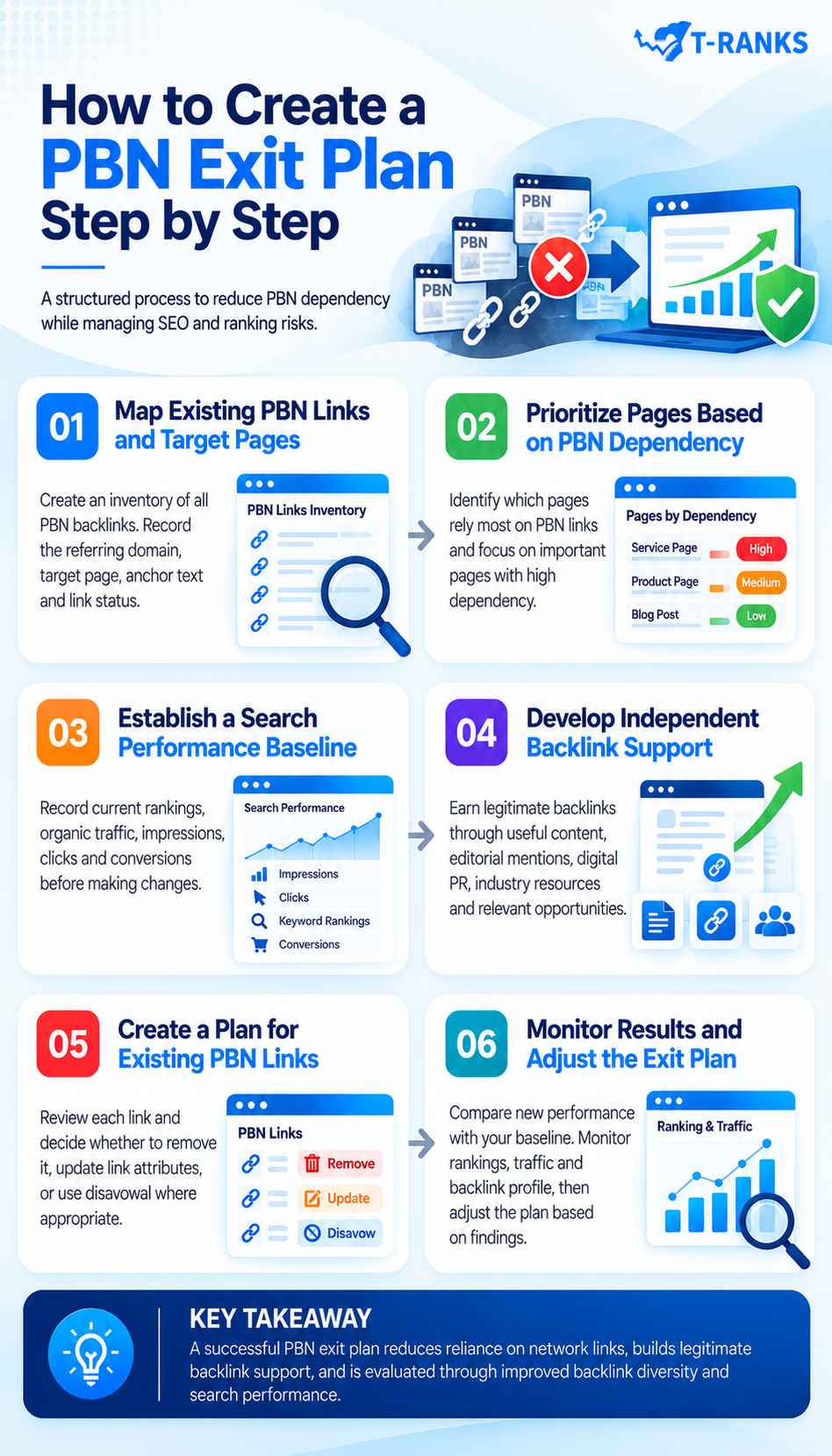
A PBN exit plan involves identifying existing network backlinks, assessing which pages depend on them, establishing performance benchmarks, developing legitimate link support, and addressing risky links. Following a structured process helps website owners reduce PBN dependency while evaluating potential SEO and ranking changes.
The six steps below provide a practical approach to planning the transition without relying on fixed removal schedules or guaranteed ranking outcomes.
Step 1: Map Existing PBN Links and Target Pages
Begin by creating an inventory of known PBN backlinks pointing to your website. Use your network records alongside Google Search Console, Ahrefs, or Semrush to identify available backlink information.
Record the following details:
- Referring domain and linking URL
- Target page receiving the backlink
- Anchor text and current link status
- Whether the placement can be edited or removed
For example, an audit may reveal that 12 network domains link to three commercial pages, with most links concentrated on one service page.
This inventory becomes the reference for deciding which links and pages require attention during the exit.
Step 2: Prioritize Pages Based on PBN Dependency
Identify which pages rely most heavily on network backlinks compared with independent referring domains.
Evaluate both backlink concentration and the importance of each page. A page generating valuable organic traffic or conversions may deserve greater attention when most of its external links come from a PBN.
For example, a service page supported by eight PBN domains and two independent domains may be more exposed to network link changes than a page supported by numerous relevant editorial sources.
Referring domain counts help identify potential dependency, but they cannot establish how Google values individual backlinks.
Step 3: Establish a Search Performance Baseline
Record search performance before making significant backlink changes.
Use Google Search Console to document impressions, clicks, search queries, and the performance of important URLs. Include keyword rankings, organic traffic, and conversion data where available.
For example, if a priority page currently receives 500 monthly organic clicks, recording that baseline provides a useful reference when evaluating later changes.
Also document major content, technical, or internal linking updates that could influence performance during the same period.
Step 4: Develop Independent Backlink Support
Identify legitimate opportunities to earn relevant backlinks for pages with substantial PBN dependency.
Useful approaches include editorial mentions, industry resources, digital public relations, original research, and content that other publications have a genuine reason to reference.
For example, a software website might earn independent citations through original research or a useful comparison tool. A local business may gain relevant mentions from genuine industry associations or community organizations.
Do not attempt to replace each PBN backlink with an identical number of new links. The objective is broader independent support, not reproducing the network’s anchor text or placement patterns.
Step 5: Create a Plan for Existing PBN Links
Review each group of network links to determine the appropriate action based on link purpose, control, and policy risk.
Where you control links created primarily to manipulate rankings, consider removing them or applying appropriate link attributes when they reflect genuine sponsored or advertising relationships.
If Google has issued an unnatural links manual action, correcting the violation becomes the immediate priority. Document removal efforts and use disavowal where appropriate under Google’s guidance.
For a voluntary exit, changes can be organized into identifiable stages to make their effects easier to investigate. However, gradual removal does not guarantee protection from ranking losses and should not delay necessary policy cleanup.
Step 6: Monitor Results and Adjust the Exit Plan
After making changes, compare search performance with the baseline recorded earlier.
Monitor important pages using Google Search Console and available backlink data. Focus on changes in rankings, impressions, organic clicks, independent referring domains, and remaining PBN links.
For example, if a service page loses search visibility after network links are removed, examine other possible causes, including indexing problems, content changes, lost legitimate backlinks, and competitor activity.
Document findings before making further significant changes. Avoid automatically restoring manipulative backlinks simply because rankings declined.
A successful PBN exit plan creates a documented transition from network dependency toward legitimate, independent backlink support. Its effectiveness should be evaluated through reduced reliance on PBN links, improved backlink diversity, and the performance of important pages rather than a predetermined removal percentage.
How Can You Replace PBN Dependency With Legitimate Backlinks?
You can reduce PBN dependency by earning relevant backlinks from independent websites through editorial mentions, original research, industry resources, and genuine partnerships. These links can diversify your backlink profile and reduce reliance on controlled network placements, although they cannot guarantee replacement of lost ranking value.
The goal is to develop a broader foundation of legitimate links that support important pages without recreating manipulative linking practices.
Earn Relevant Links From Independent Websites
Focus on attracting backlinks from websites that have a genuine reason to reference your content, products, or services.
For example, a technology website may earn editorial links by publishing original research or useful software comparisons. A local business might receive relevant mentions from industry associations, community organizations, or local publications.
These links should exist because they provide value to readers, not because their primary purpose is to influence search rankings.
Prioritize Important Pages Over Backlink Counts
Replacing PBN dependency requires improving the independent backlink support of important pages rather than matching the number of removed links.
Prioritize pages that generate meaningful organic traffic or conversions and currently depend heavily on PBN domains.
For example, earning a relevant editorial reference to a valuable service page may be more useful than acquiring numerous unrelated backlinks. However, no individual link can be assumed to replace the ranking contribution of a particular PBN link.
Evaluate opportunities based on relevance, editorial context, and the needs of the target page rather than arbitrary backlink targets.
Avoid Recreating Manipulative Anchor Text Patterns
Legitimate backlink development should not reproduce the same controlled anchor text patterns previously used across a PBN.
For example, if several network sites linked to a service page using an identical commercial keyword, do not require independent publishers to repeat that anchor. Natural editorial links may use a brand name, page title, URL, or descriptive phrase that fits the surrounding content.
The important distinction is that independent publishers should determine whether and how a link serves their readers.
A sustainable PBN exit strategy replaces reliance on controlled network links with relevant, independently earned backlinks, without assuming that any specific number of links will preserve existing rankings.
Should You Remove, Qualify, or Disavow PBN Links?

You should remove, qualify, or disavow PBN links based on why they were created, whether you control them, and whether they present a Google link spam risk. Removal eliminates a backlink, qualification signals the nature of a link, and disavowal asks Google to disregard specified links when assessing your website.
The appropriate action depends on the individual links and any existing manual action, not simply on their association with a private blog network (PBN).
When to Remove or Qualify Existing PBN Links
Removing PBN links is appropriate when they were placed primarily to manipulate search rankings and no longer serve a legitimate editorial purpose.
For example, links inserted across network blogs solely to improve a commercial page’s rankings can be removed when you control the placements.
If a link serves a genuine advertising or sponsorship purpose, use rel=”sponsored” or rel=”nofollow” as appropriate. Qualification can address how ranking credit is handled, but it does not automatically resolve other manipulative practices associated with a network.
When Google’s Disavow Tool Is Appropriate
Google recommends disavowal when a website has substantial spammy or artificial backlinks that have caused, or are likely to cause, a manual action.
If those links cannot be removed, the Disavow Links tool allows website owners to ask Google to disregard specified URLs or domains.
For example, a website receiving an unnatural links manual action may need to remove controlled PBN backlinks and disavow remaining violating links that cannot be removed.
Disavowal does not delete backlinks from referring websites. Google advises caution because incorrect use can negatively affect search performance.
Does Gradual Link Removal Reduce Ranking Risks?
Gradual PBN link removal can make ranking changes easier to monitor, but it does not guarantee protection against ranking losses.
For a voluntary exit, making documented changes in stages can help identify which pages were affected and when backlinks were removed.
For example, removing a defined group of network links and reviewing the affected pages may provide clearer information than changing numerous backlinks alongside major website updates.
However, Google does not prescribe a fixed removal schedule. When a manual action exists, resolving the violation should take priority over delaying necessary cleanup.
The most appropriate PBN exit strategy is to evaluate each link individually, address policy violations, and document changes rather than applying the same removal or disavowal method to every backlink.
What Should You Do If Rankings Drop After Removing PBN Links?
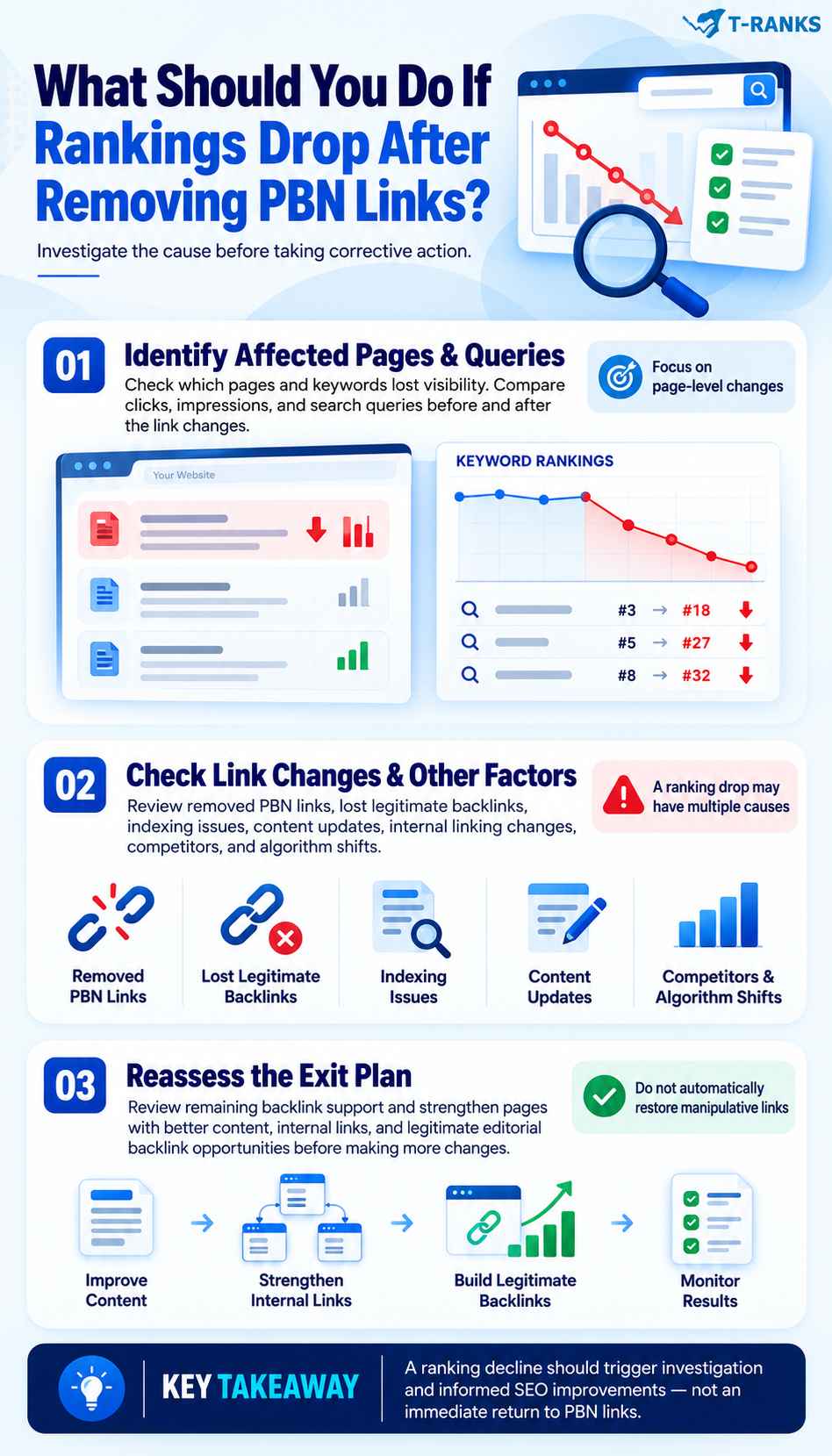
If rankings drop after removing PBN links, identify the affected pages, review recent backlink changes, and investigate other SEO factors before taking corrective action. A decline may be related to lost link signals, but it does not automatically mean that removing the private blog network (PBN) backlinks caused it.
The priority is to understand what changed and determine which actions can improve search visibility without restoring manipulative links.
Identify Affected Pages and Search Queries
Start by identifying which pages and keywords have lost visibility. Use Google Search Console to compare organic clicks, impressions, and search queries before and after the link changes.
For example, if a service page loses rankings for several important keywords while other pages remain stable, review that page’s backlink history and remaining independent support.
Focus on individual pages rather than relying only on overall website traffic, which may hide specific ranking problems.
Check Link Changes and Other Ranking Factors
Compare the timing of ranking declines with the PBN links that were removed or changed. Also check whether legitimate backlinks disappeared during the same period.
Other factors, including indexing problems, content updates, internal linking changes, competitor improvements, and Google algorithm updates, may also affect rankings.
For example, a page may lose visibility after PBN removal while also experiencing a technical indexing issue. Without investigating both, the cause can be misidentified.
Reassess Your Exit Plan Before Further Changes
If important pages continue losing visibility, review their remaining backlink support and the next planned removal actions before proceeding.
Consider whether the affected pages need stronger content, improved internal linking, or additional opportunities to earn legitimate editorial backlinks.
For example, a product page with limited independent referring domains may benefit from useful comparison content or original research that attracts relevant citations.
Avoid automatically restoring PBN links or purchasing replacement links simply to recover rankings. These actions can recreate the same risks the exit strategy is intended to address.
A ranking decline should guide further investigation and informed SEO improvements, not trigger an immediate return to manipulative backlinks.
How Do You Monitor a PBN Exit Strategy?
Monitor a PBN exit strategy by comparing remaining network backlinks, independent referring domains, keyword rankings, and organic search performance against your original baseline. This helps identify whether PBN dependency is decreasing and whether important pages are maintaining search visibility.
Use your existing backlink records, Google Search Console, and third party SEO tools to evaluate progress. Review important pages individually because overall website performance may hide declines affecting specific URLs.
Track Backlink Dependency and Independent Authority
Start by examining how your backlink profile changes as PBN links are removed or qualified. Use Ahrefs, Semrush, or similar tools alongside your network records.
Monitor these indicators:
- Remaining PBN Domains: Track which network links are active, removed, or qualified.
- Independent Referring Domains: Measure whether important pages are earning relevant backlinks from websites outside the network.
- Link Concentration: Identify pages that still receive most of their known external support from PBN domains.
- Anchor Text Distribution: Review whether commercial keyword anchors remain concentrated among network backlinks.
For example, suppose a service page initially receives links from eight PBN domains and two independent websites. Later, four network links are removed while the page earns three new editorial referring domains. This indicates lower network concentration, although it does not establish how Google values those links.
The objective is to measure reduced dependency and meaningful independent support, not reach a fixed backlink percentage.
Monitor Rankings, Traffic, and Search Visibility
Backlink changes should be evaluated alongside organic search performance to understand how important pages respond during the exit.
Use Google Search Console and website analytics to track:
- Keyword Rankings: Monitor changes in positions for important search queries.
- Search Impressions: Identify whether pages continue appearing in relevant Google searches.
- Organic Clicks: Compare search visits before and after significant backlink changes.
- Organic Traffic and Conversions: Evaluate whether priority pages continue attracting visitors who complete valuable actions.
Compare equivalent reporting periods and consider seasonality, content updates, technical problems, and Google ranking changes.
For example, if PBN dependency decreases while organic clicks and conversions remain relatively stable, the transition may be progressing as intended. However, stable rankings alone do not prove that former PBN links had no ranking value.
How to Interpret Monitoring Results
Monitoring results should inform the next decision rather than automatically trigger link removal or restoration.
| Monitoring result | What it may indicate | Recommended response |
| PBN dependency decreases and visibility remains stable | Encouraging progress | Continue evaluating independent support |
| Independent backlinks increase but rankings decline | Multiple SEO factors may be involved | Investigate affected pages and queries |
| PBN links decrease without independent link growth | Reduced network reliance but limited new external support | Improve content and pursue legitimate link opportunities |
| Organic traffic drops across unrelated pages | A broader issue may exist | Check technical changes, search demand, and ranking updates |
These outcomes are indicators, not proof of a specific cause. No backlink tool can determine exactly how much ranking value Google assigns to individual PBN links.
Effective PBN exit monitoring combines backlink dependency, independent link growth, and organic search performance. The objective is to make evidence based decisions while reducing reliance on network links without assuming ranking stability is guaranteed.
What Should Happen to PBN Sites After the Exit?
After exiting a private blog network (PBN), website owners should either maintain former network sites for legitimate independent purposes or retire those that no longer provide value. Each decision should consider the site’s content, audience, remaining backlinks, and ongoing maintenance needs.
PBN websites with original content, a genuine readership, and a clear editorial purpose may continue operating as independent publications. However, their remaining outbound links should be reviewed to ensure they are not maintained primarily to manipulate search rankings. Keeping a website solely for its backlink value does not establish a legitimate purpose.
For sites that no longer serve a useful function, review any remaining links to the main website, redirects, and operational dependencies before shutting them down. Remove manipulative placements, preserve necessary records, and decide whether to discontinue hosting or let the domain expire. Redirecting former PBN domains solely to transfer ranking signals should be avoided.
The final objective is to separate legitimate websites from unnecessary network assets and end the linking arrangements that created PBN dependency. This allows the main website to move forward without continuing to maintain the former network for SEO purposes.
How Do You Know When Your PBN Exit Is Complete?
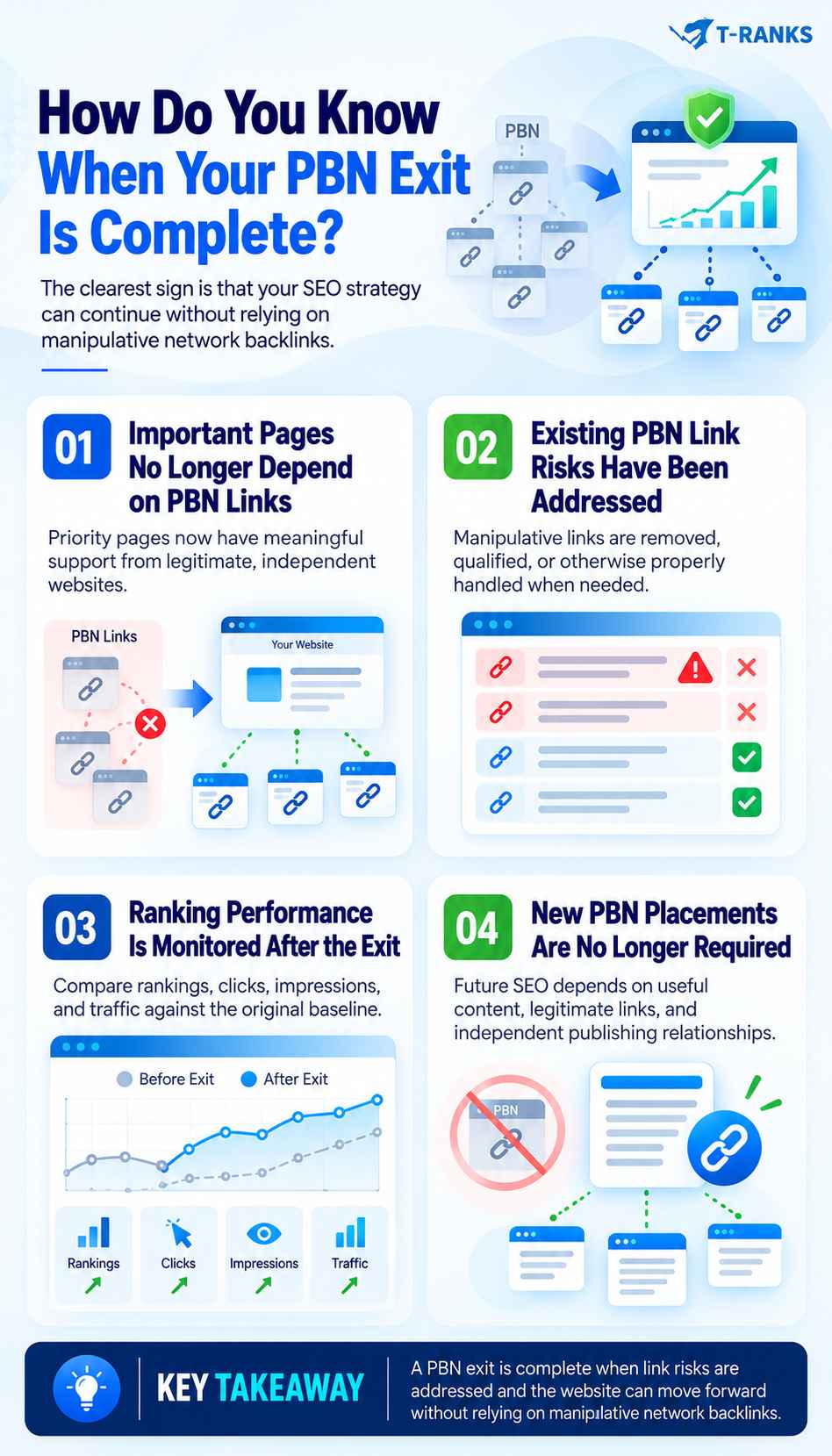
A PBN exit is complete when a website has addressed manipulative network links and no longer depends on private blog network placements for its ongoing SEO strategy. The main signs include independent backlink support, resolved link risks, and the ability to continue SEO activities without the former network.
Important Pages No Longer Depend on PBN Links
Important pages should have meaningful support from legitimate, independent websites rather than relying mainly on controlled network backlinks. There is no fixed number or percentage of referring domains that establishes independence.
Existing PBN Link Risks Have Been Addressed
Known manipulative links should be removed or appropriately qualified, with disavowal considered when Google’s conditions apply. Any confirmed unnatural links manual action should also be resolved before treating the cleanup as complete.
Ranking Performance Is Monitored After the Exit
Compare organic rankings, clicks, impressions, and traffic with the original performance baseline. Stable visibility is encouraging, but ranking fluctuations do not necessarily mean the exit is incomplete or unsuccessful.
New PBN Placements Are No Longer Required
The website should no longer purchase, create, or maintain manipulative PBN placements to support its rankings. Future SEO activities should focus on useful content, legitimate editorial links, and independent publishing relationships.
The clearest sign of a completed PBN exit is that the website can continue its SEO strategy without relying on manipulative network backlinks. Ranking stability and backlink counts alone cannot determine whether the transition is complete.
Conclusion
In conclusion, a successful PBN exit strategy focuses on reducing dependence on private blog network backlinks while managing SEO risks and potential ranking changes. The process begins with auditing existing links, identifying dependent pages, and establishing a clear performance baseline before making significant changes.
Building legitimate backlink support, addressing manipulative links, and monitoring organic search performance are essential parts of the transition. Removing or disavowing links should be based on their risks and Google’s guidance rather than arbitrary schedules. Although rankings may fluctuate, careful monitoring helps identify problems and guide further decisions.
A PBN exit is complete when existing link risks have been addressed and the website no longer relies on network placements for its ongoing SEO strategy. The objective is to establish stronger independent backlink support without assuming that ranking stability is guaranteed.
Ready to strengthen your backlink strategy? Explore T-RANKS for backlink services and guidance to help you evaluate link quality, relevance, and long term SEO risks.
Frequently Asked Questions About PBN Exit Strategy
What Is a PBN Exit Strategy?
A PBN exit strategy is a plan to reduce reliance on private blog network backlinks. It involves auditing existing links, addressing manipulative placements, building legitimate backlink support, and monitoring SEO performance.
Can You Remove PBN Links Without Losing Rankings?
Yes, rankings can remain stable after PBN link removal, but there is no guarantee. Results depend partly on whether Google valued those links and the other ranking signals supporting affected pages.
Should You Remove All PBN Links at Once?
Not necessarily. Google does not prescribe a fixed PBN link removal schedule. Staged removal can simplify monitoring, but confirmed policy violations should be addressed promptly.
Should You Build Replacement Backlinks Before Removing PBN Links?
Building legitimate backlinks first can reduce PBN dependency, but it cannot guarantee ranking stability. If an unnatural links manual action exists, correcting the violation should take priority.
Do You Need to Replace Every PBN Backlink?
No, every PBN backlink does not need an individual replacement. Focus on earning relevant editorial links from independent websites rather than matching the number of removed links.
Should You Disavow PBN Links During an Exit?
Not automatically. Google recommends disavowal only for substantial artificial or spammy backlinks that caused, or are likely to cause, a manual action. Most websites do not need the Disavow Links tool.
What Happens If Google Issues an Unnatural Links Manual Action?
An unnatural links manual action can reduce a website’s Google Search visibility. Address violating links, document removal efforts, disavow links when appropriate, and submit a reconsideration request through Google Search Console.
What Should You Do If Rankings Drop After Removing PBN Links?
Investigate affected pages, lost backlinks, indexing issues, and other SEO changes before taking action. A ranking decline after link removal does not necessarily prove that the removed links caused it.
How Long Does a PBN Exit Strategy Take?
There is no fixed timeline for completing a PBN exit strategy. The duration depends on backlink dependency, required cleanup, legitimate link acquisition, and the progress of the transition.
How Do You Know When Your PBN Exit Is Complete?
A PBN exit is complete when manipulative network links have been addressed and the website no longer relies on PBN placements for its ongoing SEO strategy. Stable rankings are encouraging but are not required to establish completion.