Have you ever compared two PBN link packages and wondered why one costs so much more than the other? Both promise powerful backlinks, high-authority domains, and better rankings. But once you look beyond the price tag, the differences can be surprising.
Comparing private blog network (PBN) link packages means looking beyond price and backlink count. You need to examine domain history, topical relevance, content quality, and link placement. For example, a package offering 20 backlinks for $300 may look more attractive than one offering five. But more links do not necessarily mean better quality or stronger SEO results.
Then there are the metrics providers love to advertise. Domain Rating (DR), Trust Flow, and organic traffic estimates can help you evaluate referring websites. However, these numbers do not guarantee that Google will value the links. Buying PBN backlinks primarily to manipulate rankings also violates Google’s link spam policies, regardless of package price.
So, how do you separate a transparent offer from one filled with empty promises? This guide breaks down PBN link package costs, quality indicators, pricing models, and common red flags. You’ll also learn how to compare providers, understand SEO risks, and verify backlink placements before deciding whether a package is worth your investment.
What Are PBN Link Packages and What Do They Include?
PBN link packages are bundles of backlinks sold at a fixed or agreed price through private blog network (PBN) websites. These packages usually offer several link placements instead of requiring buyers to purchase each backlink separately.
But not every package offers the same value. Two providers may advertise ten backlinks while offering very different referring domains, content quality, and delivery terms. That’s why understanding what a package includes matters before comparing prices.
What Does a Typical PBN Backlink Package Include?
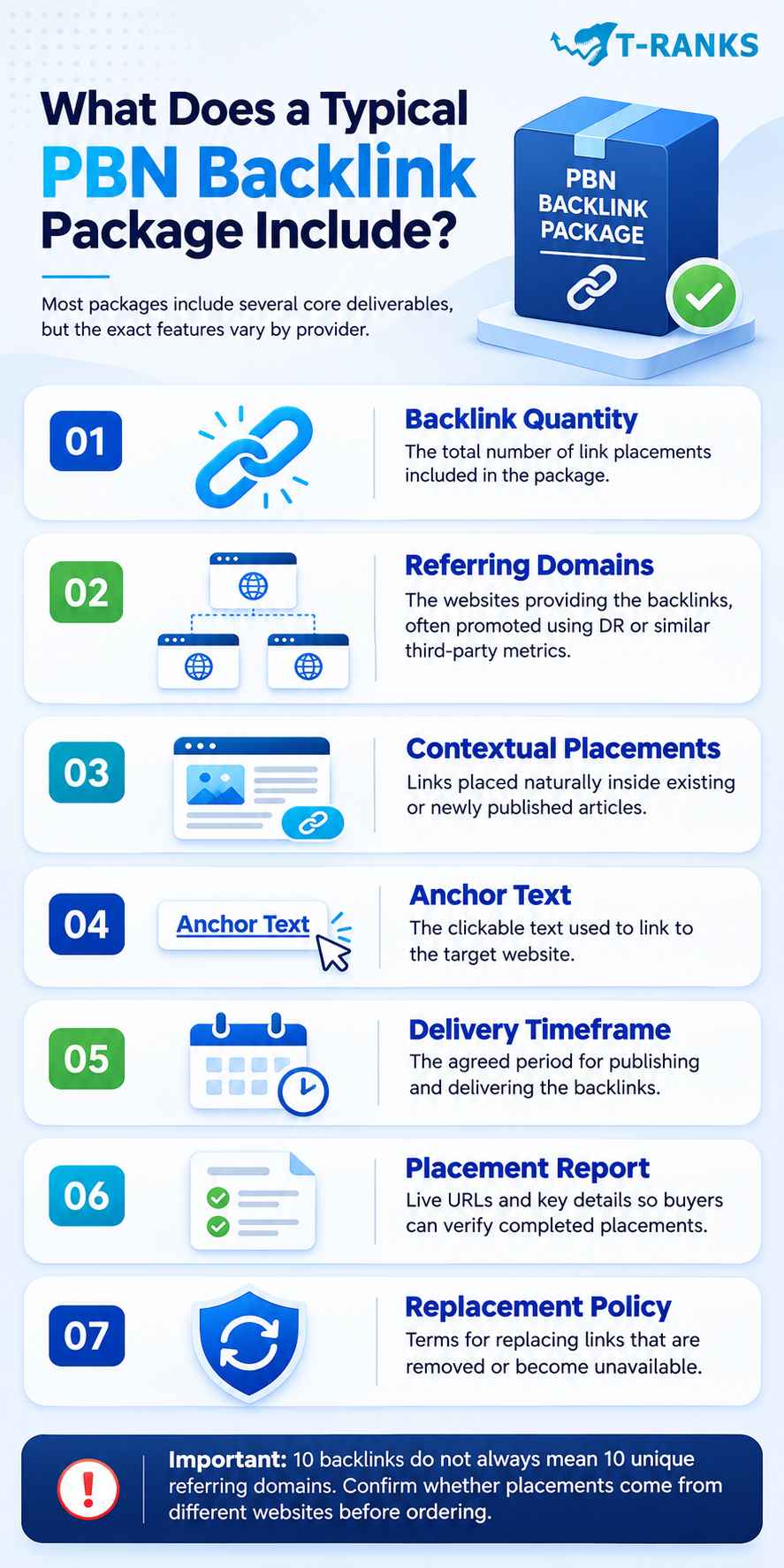
Most PBN link packages include a fixed number of backlinks, placement specifications, and a delivery timeframe. The exact features depend on the provider.
Common package components include:
- Backlink quantity: The total number of link placements included.
- Referring domains: The websites providing backlinks, often advertised using Domain Rating (DR) or other third-party metrics.
- Contextual placements: Backlinks placed within existing or newly published articles.
- Anchor text: The clickable text used to link to the target website.
- Delivery timeframe: The agreed period for publishing the backlinks.
- Placement report: Live URLs and details of completed placements.
- Replacement policy: Terms for replacing links that are removed or become unavailable.
For example, ten backlinks do not always mean ten different referring domains. Some packages may include multiple placements from the same website. Buyers should confirm this distinction before ordering.
How Are PBN Backlinks Delivered?
PBN backlinks are typically delivered through articles published on websites within a private blog network. Providers may use their own network or arrange placements through other operators.
The buyer usually provides target URLs and any agreed anchor text requirements. The provider then publishes the links within the specified delivery period.
After publication, the provider should supply live placement URLs and relevant link details. This allows buyers to verify what was delivered.
However, published backlinks do not guarantee ranking improvements. Google may disregard manipulative links, and links created primarily to influence search rankings can violate its spam policies.
Understanding these basic components helps buyers compare PBN link packages based on actual deliverables rather than advertised link counts alone.
How Much Do PBN Link Packages Cost?
PBN link packages can cost anywhere from a few dollars to several hundred dollars per backlink. The total price depends on the number of links, referring domains, niche, placement type, and services included.
For example, one provider may charge $250 for ten backlinks, while another charges more for fewer placements. Does the higher price mean better quality? Not necessarily. You need to understand what each package includes before comparing costs.
What Factors Affect PBN Link Package Pricing?
PBN backlink prices vary because providers offer different domain metrics, content standards, and delivery arrangements. A higher price may reflect additional work, but it does not guarantee better SEO results.
Several factors commonly affect package costs:
- Backlink quantity: Larger packages may offer a lower advertised price per link.
- Domain metrics: Providers may charge more for websites with higher Domain Rating (DR), Domain Authority (DA), or Trust Flow.
- Topical relevance: Packages targeting specific industries may cost more than general placements.
- Link placement: Homepage links, existing article links, and newly written contextual posts may have different prices.
- Content and reporting: Original articles, placement reports, and monitoring may increase the total cost.
- Replacement terms: Some providers include link replacements, while others charge separately.
Before comparing packages, calculate the cost per link. Then check whether those links come from unique referring domains and what the provider actually promises to deliver.
How Do Starter, Standard, and Premium Packages Differ?

Starter, Standard, and Premium are seller-defined package tiers, not universal SEO quality standards. Providers use these labels to distinguish offers by price, link quantity, advertised domain metrics, and included services.
The following table illustrates common differences. It is not a fixed market price list.
| Package tier | Typical advertised positioning | What to compare |
| Starter | Lower-cost or smaller packages | Number of links, unique domains, basic reporting |
| Standard | Mid-range packages with additional specifications | Domain history, content relevance, placement details |
| Premium | Higher-priced packages with expanded services or metrics | Evidence behind quality claims, reporting, replacement terms |
For context, one currently advertised provider lists general-niche packages at $150 for five links and $250 for ten links. Other marketplace listings range from inexpensive bulk offers to specialized packages costing much more. These are advertised prices, not verified measures of backlink quality.
A Premium label does not mean the backlinks are safer or more likely to improve rankings. Domain metrics are third-party measurements, and Google does not guarantee ranking benefits from purchased links.
The best way to compare PBN link package prices is to examine the deliverables behind each offer. A lower cost per link may look attractive, but price alone cannot establish backlink quality, long-term value, or SEO safety.
What Is the Difference Between Monthly and One-Time PBN Link Packages?

Monthly PBN link packages provide recurring backlink placements, while one-time packages deliver a fixed number of links through a single order. The main differences are payment frequency, delivery commitments, flexibility, and ongoing costs.
For example, a monthly package might include ten backlinks every month for a recurring fee. A one-time package could offer the same number of links for a single payment. Both may advertise similar domain metrics, but their service terms can differ significantly.
| Comparison factor | Monthly PBN Package | One-Time PBN Package |
| Payment | Recurring monthly fee | Single payment |
| Backlink quantity | Agreed number each month | Fixed number per order |
| Delivery | Repeated monthly placements | Placements delivered within an agreed period |
| Budget | Ongoing financial commitment | Defined upfront cost |
| Flexibility | Depends on cancellation terms | No automatic recurring purchase |
| Reporting | May include monthly placement updates | Usually includes a final delivery report |
| Replacements | Depends on the active service agreement | Depends on the stated replacement policy |
A monthly PBN package may suit buyers who want recurring deliveries and prefer to manage their spending through a regular service agreement. However, monthly retainers can increase total costs over time. Buyers should confirm cancellation conditions, the number of unique referring domains, and whether monitoring is included.
A one-time PBN package offers a more defined purchase. You pay for an agreed number of placements without automatically committing to future orders. However, link maintenance and replacement coverage may be limited after delivery.
Neither model guarantees improved rankings. Spreading paid PBN links across several months also does not make them compliant with Google’s link spam policies.
The better comparison is based on total cost, verified deliverables, contract terms, and SEO risks. Choose a purchasing model only after understanding what the provider promises and what happens if the links disappear or fail to produce measurable results.
How to Compare PBN Link Packages Before Buying
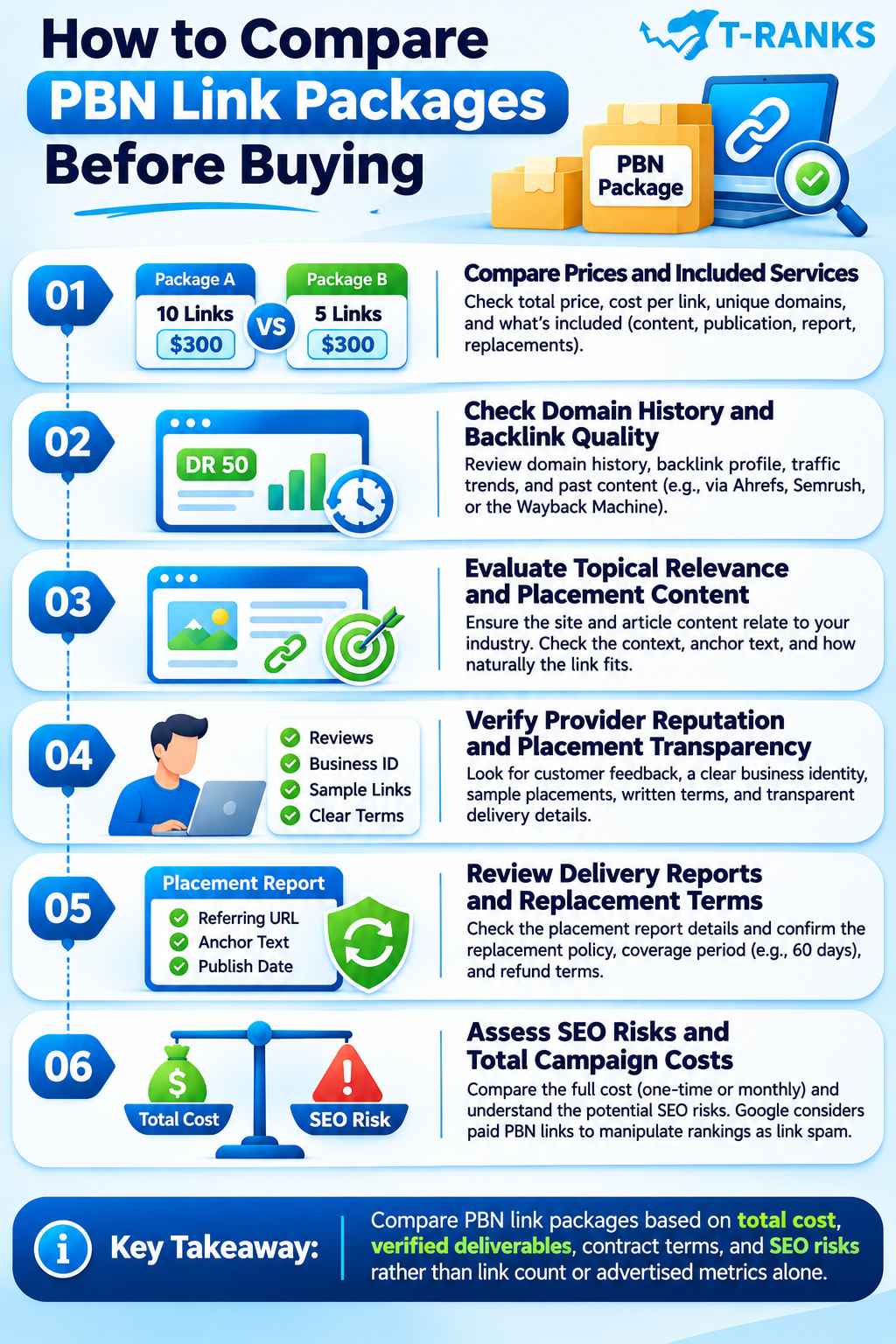
To compare PBN link packages, examine the price, referring domains, placement quality, provider credibility, delivery terms, and SEO risks. This helps you understand what each offer includes and whether its claims can be verified.
A package with more backlinks or higher Domain Rating (DR) scores is not automatically better. Before paying, compare what providers promise, what they can demonstrate, and what financial risks you would accept.
Step 1: Compare Package Prices and Included Services
Start by checking the total price and number of backlinks in each package. Calculate the cost per link, but also confirm how many unique referring domains are included. Ten backlinks from ten websites are a different deliverable from ten links on two websites.
For example, Package A offers ten links for $300, while Package B offers five for the same price. The advertised costs are $30 and $60 per link. Before deciding, check whether content writing, publication, reporting, and replacements are included or charged separately.
Step 2: Check Domain History and Backlink Quality
Review the referring domains before accepting the provider’s quality claims. Use Ahrefs or Semrush to examine backlink profiles, referring domain trends, and estimated organic traffic. The Wayback Machine can help you investigate previous website content and changes in ownership or topic.
Pay attention to sudden topic changes, unrelated inbound links, and unexplained traffic declines. A domain with DR 50 may still have a weak or irrelevant backlink profile. Remember that DR is a third-party metric, not a Google ranking score.
Step 3: Evaluate Topical Relevance and Placement Content
Examine whether the referring websites and placement articles relate to your industry. Read sample content and check how naturally the proposed backlink fits into the surrounding discussion. Also review the destination URL, anchor text, and link attributes.
For example, a budgeting article linking to a relevant finance resource has a clearer topical connection than an unrelated gardening article. However, topical relevance does not make paid links intended to manipulate rankings compliant with Google’s policies.
Step 4: Verify Provider Reputation and Placement Transparency
Look for verifiable customer feedback, a clear business identity, and a history of fulfilling orders. Ask for sample placements, written service specifications, and an explanation of how the provider handles unavailable inventory.
For example, if a seller promises ten unique referring domains, that commitment should appear in the order terms. Providers should also explain what placement information buyers will receive. Avoid relying only on testimonials, promotional screenshots, or unsupported authority claims.
Step 5: Review Delivery Reports and Replacement Terms
Check the delivery and replacement conditions before paying. A useful placement report should include the referring URL, destination URL, anchor text, publication date, and link attributes. These details allow you to verify whether the purchased service was delivered.
Also confirm which problems qualify for replacement, how long coverage lasts, and whether refunds are available. For example, a 60-day replacement policy may offer more contractual coverage than a seven-day policy. Neither guarantees that Google will value the links.
Step 6: Assess SEO Risks and Total Campaign Costs
Before making a decision, compare the complete financial commitment and potential SEO consequences. Include upfront fees, recurring charges, monitoring costs, and any possible expenses related to correcting problematic links.
For example, a $400 monthly package costs $2,400 over six months before additional charges. That amount is a known expense, while ranking benefits remain uncertain. Google considers links purchased primarily to manipulate search rankings to be link spam, regardless of package price or advertised quality.
Consider whether other investments, such as original content, digital PR, or legitimate editorial outreach, better match your website’s objectives and risk tolerance.
PBN Link Package Comparison Checklist
Use this worksheet to compare two offers before committing to either.
| Evaluation factor | Package A | Package B |
| Total price | $300 | $300 |
| Advertised backlinks | 10 | 5 |
| Cost per backlink | $30 | $60 |
| Unique referring domains | Confirm with provider | Confirm with provider |
| Domain history | Review sample domains | Review sample domains |
| Topical relevance | Examine placement examples | Examine placement examples |
| Content quality | Review sample articles | Review sample articles |
| Provider credibility | Verify reviews and terms | Verify reviews and terms |
| Delivery reporting | Confirm required fields | Confirm required fields |
| Replacement coverage | Review written policy | Review written policy |
| SEO risks | Assess before purchase | Assess before purchase |
A useful PBN package comparison considers the complete offer, not just its backlink count or price. Clear deliverables help buyers assess the service, but they cannot guarantee ranking improvements or remove the risks of manipulative linking.
What Are the Warning Signs of a Poor PBN Link Package?
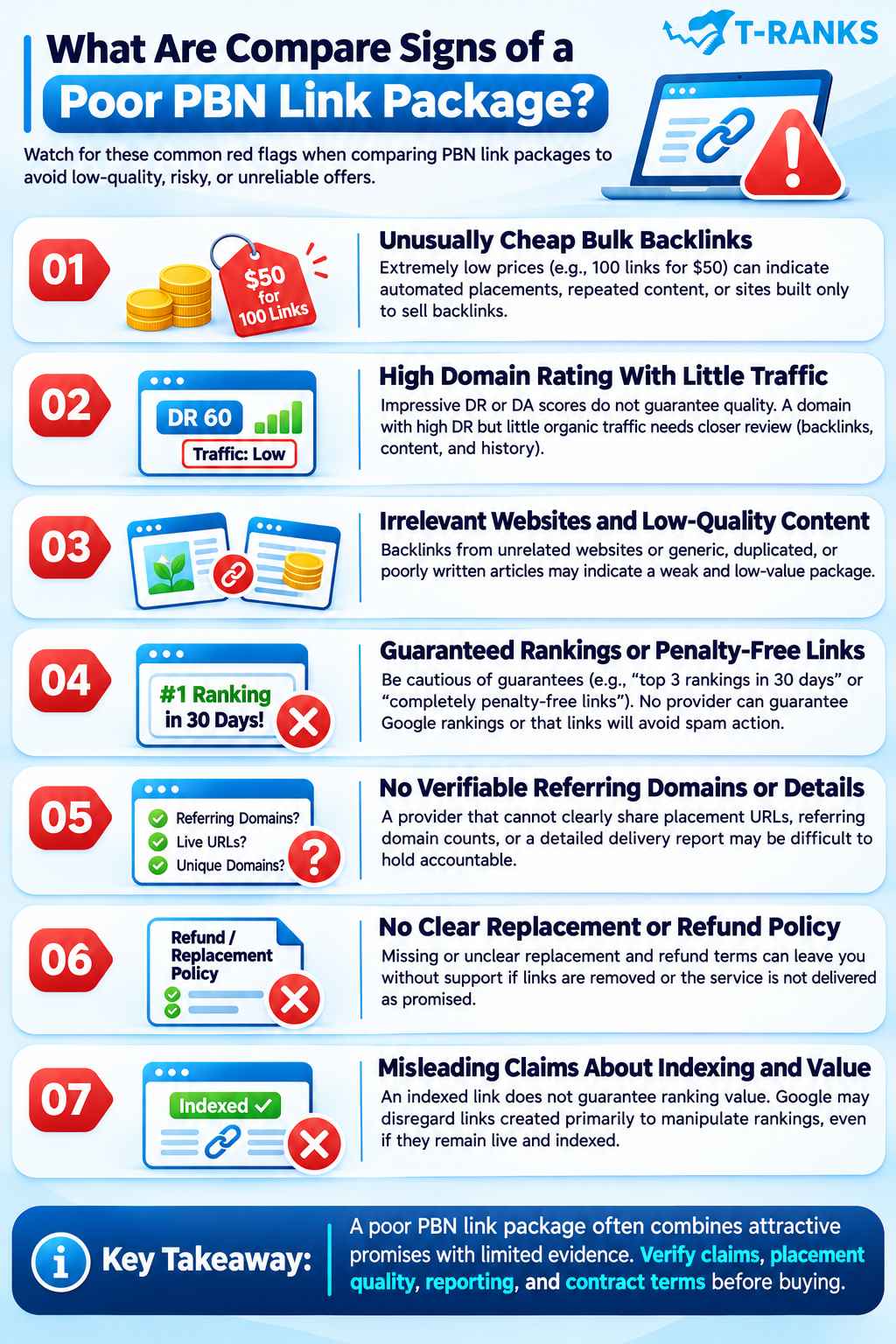
The main warning signs of a poor PBN link package include suspiciously cheap backlinks, misleading domain metrics, irrelevant content, guaranteed rankings, and unclear delivery terms. These issues may indicate unreliable providers, questionable placements, or financial risks.
A package may look attractive because of its price or advertised authority scores. However, impressive numbers mean little when the provider cannot verify what buyers will receive.
1. Unusually Cheap Bulk Backlinks
Extremely cheap PBN backlink packages deserve closer inspection, especially when sellers offer hundreds of links without explaining their sources. These offers may involve automated placements, repeated content, or websites created mainly to sell backlinks.
For example, a package offering 100 backlinks for $50 raises questions about the quality of the referring domains and placement content. The price alone does not prove poor quality, but missing delivery details are a clear warning sign.
2. High Domain Rating With Little Organic Traffic
Some providers advertise impressive Domain Rating (DR) or Domain Authority (DA) scores while offering little evidence of website quality. These are third-party SEO metrics, not Google’s own ranking scores.
For example, a domain with DR 60 but almost no estimated organic traffic deserves further investigation. Check its backlink history, content relevance, and search visibility before accepting its advertised authority. Low traffic alone does not prove that a domain is manipulative.
3. Irrelevant Websites and Low-Quality Content
A poor PBN link package may include backlinks from websites unrelated to the buyer’s industry. Placement articles may also contain generic, duplicated, or poorly written content with little value for readers.
For example, a finance website receiving backlinks from unrelated gardening articles may indicate weak topical relevance. Review the surrounding content and outbound links to understand whether the placement serves a genuine editorial purpose.
4. Guaranteed Rankings or Penalty-Free Links
Be cautious of providers promising guaranteed Google rankings or completely penalty-free PBN backlinks. No seller can guarantee that purchased links will improve search visibility or avoid spam enforcement.
For example, a package promising top-three rankings within 30 days makes a claim the provider cannot reliably support. Higher prices, aged domains, and strong authority metrics do not remove the risks associated with manipulative linking.
5. No Verifiable Referring Domains or Placement Details
A provider that cannot clearly explain its deliverables may be difficult to hold accountable. Missing placement URLs, unclear referring domain counts, and incomplete delivery reports make backlink verification harder.
For example, ten backlinks do not necessarily mean ten unique referring domains. A package may include several placements from the same website. Buyers should confirm the number of distinct domains and the evidence they will receive after delivery.
6. No Clear Replacement or Refund Policy
Missing replacement and refund terms can leave buyers without support when backlinks disappear or the provider fails to deliver the agreed service. Verbal promises are difficult to verify after payment.
Review the written policy before ordering. Confirm which problems qualify for replacement, how long coverage lasts, and whether refunds apply to incomplete orders. Replacement coverage protects specific contractual deliverables, not Google ranking performance.
7. Misleading Claims About Indexing and Backlink Value
Some providers treat indexed backlinks as proof of ranking authority. However, an indexed page does not guarantee that Google assigns ranking value to its outbound links.
Google may disregard links created primarily to manipulate rankings, even when those links remain live. Be cautious of sellers who promise guaranteed link equity or claim that indexing alone proves SEO effectiveness.
A poor PBN link package often combines attractive promises with limited evidence. Before paying, examine the provider’s claims, placement quality, reporting standards, and contract terms. Even well-documented packages cannot eliminate the SEO risks associated with manipulative backlinks.
Are PBN Link Packages Safe for SEO?
No, PBN link packages are not a risk-free SEO strategy. Backlinks purchased primarily to manipulate search rankings violate Google’s link spam policies. Google may ignore their ranking value or take action against websites involved in manipulative linking.
These risks apply regardless of package price, Domain Rating (DR), or content quality. Even a professionally managed network cannot guarantee lasting ranking benefits.
Do PBN Backlinks Violate Google’s Link Spam Policies?
Yes, PBN backlinks violate Google’s policies when their primary purpose is to manipulate search rankings. This includes buying links intended to pass ranking credit and publishing low-value content mainly to influence search results.
For example, purchasing contextual backlinks from several network websites specifically to improve keyword rankings falls under Google’s link spam rules. Relevant articles or aged domains do not change the purpose of those links.
However, paid advertising and sponsorships are permitted when the links are appropriately qualified with rel=”sponsored” or rel=”nofollow”.
Can Google Discount Links or Apply Manual Actions?
Yes, Google can neutralize spammy backlinks or issue manual actions for unnatural linking practices. These are different outcomes, and a website may experience one without the other.
Google’s automated spam systems can remove the ranking benefits of manipulative links. Those backlinks may remain published and indexed without contributing meaningful ranking value.
Manual actions involve human review. They may reduce a website’s search visibility or remove affected pages from search results. Website owners can check for these actions in Google Search Console’s Manual Actions report.
Are Expensive PBN Packages Less Risky?
No, higher-priced PBN packages are not automatically safer. Premium prices may reflect aged domains, additional content, or more extensive provider services. However, these features do not guarantee compliance with Google’s spam policies.
A package advertising DR 60 domains and carefully written articles may still contain links purchased for ranking manipulation. Google does not assign ranking value based on a provider’s package tier or advertised authority scores.
Before paying, consider the potential financial loss and the effect that link spam enforcement could have on your website. Content marketing, digital PR, and legitimate editorial links provide alternative ways to pursue search visibility.
The safety of a PBN link package cannot be established through price, domain metrics, or provider promises. The main concern is whether the backlinks violate Google’s policies and whether any claimed SEO benefits can be independently verified.
How Do You Verify a PBN Link Package After Delivery?
You can verify a PBN link package by checking the published backlinks, confirming their placement details, and monitoring their status over time. This helps determine whether the provider delivered what was promised.
But there’s an important difference between receiving backlinks and getting SEO results. A link may remain live without improving your rankings. That’s why delivery verification and performance tracking should be treated separately.
How Can You Confirm That Purchased Backlinks Are Live?
Start by opening every backlink URL provided in the delivery report. Check whether the page loads correctly and contains a working link to your website. Then compare the published placement with the original order.
Pay attention to the following details:
- Placement URL: Confirm that the referring page is accessible.
- Target URL: Check that the link points to the correct page on your website.
- Anchor text: Verify that the clickable text matches the agreed placement.
- Link attributes: Review whether the link uses nofollow, sponsored, or other attributes.
- Referring domains: Confirm the promised number of unique linking websites.
For example, a package offering ten backlinks from ten referring domains should deliver placements on ten distinct websites. If several links come from the same domain, the provider has not met that specification.
You can also use Ahrefs or Semrush to check whether backlinks appear in their databases. However, these tools may not discover every published link immediately. Direct inspection remains the clearest way to confirm delivery.
How Should You Monitor Backlink Status and Search Performance?
Monitor backlink availability, keyword rankings, and organic search performance after delivery. These checks help identify lost placements and changes in website visibility.
Use a spreadsheet or backlink monitoring tool to record each placement URL, publication date, anchor text, and current link status. Check whether links remain accessible and whether their destinations or attributes have changed.
For SEO performance, use Google Search Console to compare organic clicks, impressions, and average positions against the period before the links were published. A rank tracker can provide additional keyword-level data.
You can also review whether referring pages appear in Google Search. However, a site: search is not a reliable indexing test. Google Search Console’s URL Inspection tool provides more detailed indexing information, but only for properties you have access to.
For example, suppose organic clicks increase after a package is delivered. This shows that search traffic improved during that period. It does not prove that the purchased backlinks caused the improvement.
Also investigate other changes, such as content updates, technical SEO fixes, search algorithm updates, and competitor activity.
A verified PBN link package confirms what the provider delivered, not what Google will reward. Accurate monitoring helps identify placement issues and assess performance, while recognizing that manipulative backlinks may provide no ranking benefit.
Conclusion
In conclusion, comparing PBN link packages requires more than checking prices, backlink counts, or authority scores. Domain history, topical relevance, content quality, provider credibility, and delivery terms all deserve attention before making a purchase.
A cheaper package does not always offer better value, and a Premium label does not guarantee stronger SEO results. Metrics such as Domain Rating (DR) and Trust Flow can support your evaluation, but they cannot confirm how Google values individual backlinks. Clear placement reports and replacement policies also matter when assessing what a provider actually delivers.
Remember that purchased PBN backlinks intended to manipulate search rankings violate Google’s link spam policies. Even when every link is delivered and remains live, Google may disregard its ranking value. That’s why understanding the risks is just as important as comparing the costs.
Want to make more informed backlink decisions? Explore T-RANKS for link building resources and services. Review your options, understand the potential risks, and choose an approach that fits your SEO goals.
Frequently Asked Questions About PBN Link Packages
What Is a PBN Link Package?
A PBN link package is a bundle of backlinks sold through private blog network (PBN) websites. Packages usually include a fixed number of placements, agreed delivery terms, and a report confirming published links.
How Much Do PBN Link Packages Cost?
PBN link package prices vary by provider, backlink quantity, domain metrics, and included services. There is no standard market price, so compare the cost per link alongside unique referring domains, content quality, and delivery terms.
What Is Included in a PBN Backlink Package?
A typical PBN backlink package includes link placements, referring domains, anchor text arrangements, and a delivery timeframe. Some providers also include written content, placement reports, monitoring, and replacement coverage.
What Is the Difference Between Starter, Standard, and Premium PBN Packages?
Starter, Standard, and Premium are seller-defined package tiers. They may differ in price, backlink quantity, advertised domain metrics, content quality, and included services. These labels do not guarantee ranking value or SEO safety.
Are Monthly PBN Link Packages Better Than One-Time Orders?
Not necessarily. Monthly packages offer recurring backlink deliveries and payments, while one-time orders provide a fixed number of placements. The better contract depends on your budget, required deliverables, and cancellation terms. Neither model guarantees SEO benefits.
How Can You Check the Quality of PBN Backlinks?
Review referring domain history, topical relevance, placement content, and existing backlinks. Tools such as Ahrefs, Semrush, and the Wayback Machine can help investigate provider claims. High Domain Rating alone does not prove backlink quality.
What Are the Red Flags in a PBN Link Package?
Common red flags include unverifiable referring domains, misleading authority scores, irrelevant content, guaranteed rankings, and unclear replacement policies. Extremely cheap bulk offers also deserve closer inspection when providers cannot explain their placement sources.
How Do You Verify PBN Backlinks After Delivery?
Open each placement URL and confirm the backlink is live. Check its destination URL, anchor text, link attributes, and referring domain. Compare these details with the original order and delivery report.
Do Indexed PBN Backlinks Always Improve Google Rankings?
No, indexed PBN backlinks do not guarantee ranking improvements. Google may disregard manipulative links even when the referring pages remain indexed. Indexing confirms a page’s presence in Google’s index, not the ranking value of its outbound links.
Are PBN Link Packages Safe for SEO?
No, PBN link packages intended to manipulate search rankings are not a risk-free SEO strategy. Google’s spam policies prohibit buying links for ranking manipulation. Such links may lose their ranking value or contribute to manual actions.