A PBN backlink’s position within an article affects how readers encounter it and understand its relevance. Yet many website owners focus on domain metrics while overlooking where the link actually appears. Even a backlink from a high-authority website may offer little value to readers if it is placed in an unrelated paragraph or surrounded by poor-quality content.
PBN link placement strategy involves evaluating where a Private Blog Network (PBN) backlink appears, how well it fits the surrounding content, and whether its anchor text accurately describes the linked page. For example, a relevant contextual link may help readers more than an unrelated footer link. However, natural-looking placement does not make manipulative PBN backlinks compliant with Google’s spam policies.
This guide explains how to assess link positions, contextual relevance, anchor text, and outbound links. You will also learn how to identify poor placements, audit backlinks step by step, and understand the SEO risks associated with PBN linking.
What Is PBN Link Placement Strategy?

PBN link placement strategy is the process of deciding where and how backlinks appear within content published on Private Blog Network (PBN) websites. It considers link position, surrounding content, anchor text, and the relevance of the destination page.
For example, a backlink placed within a paragraph discussing SEO tools has a clearer contextual connection when it points to a relevant SEO resource. The same backlink placed in an unrelated paragraph may feel forced and provide little value to readers.
A well-evaluated placement should be visible, relevant to the discussion, and supported by useful content. However, these qualities do not guarantee ranking benefits or make PBN links created to manipulate search results compliant with Google’s spam policies.
What Factors Determine the Quality of a PBN Link Placement?
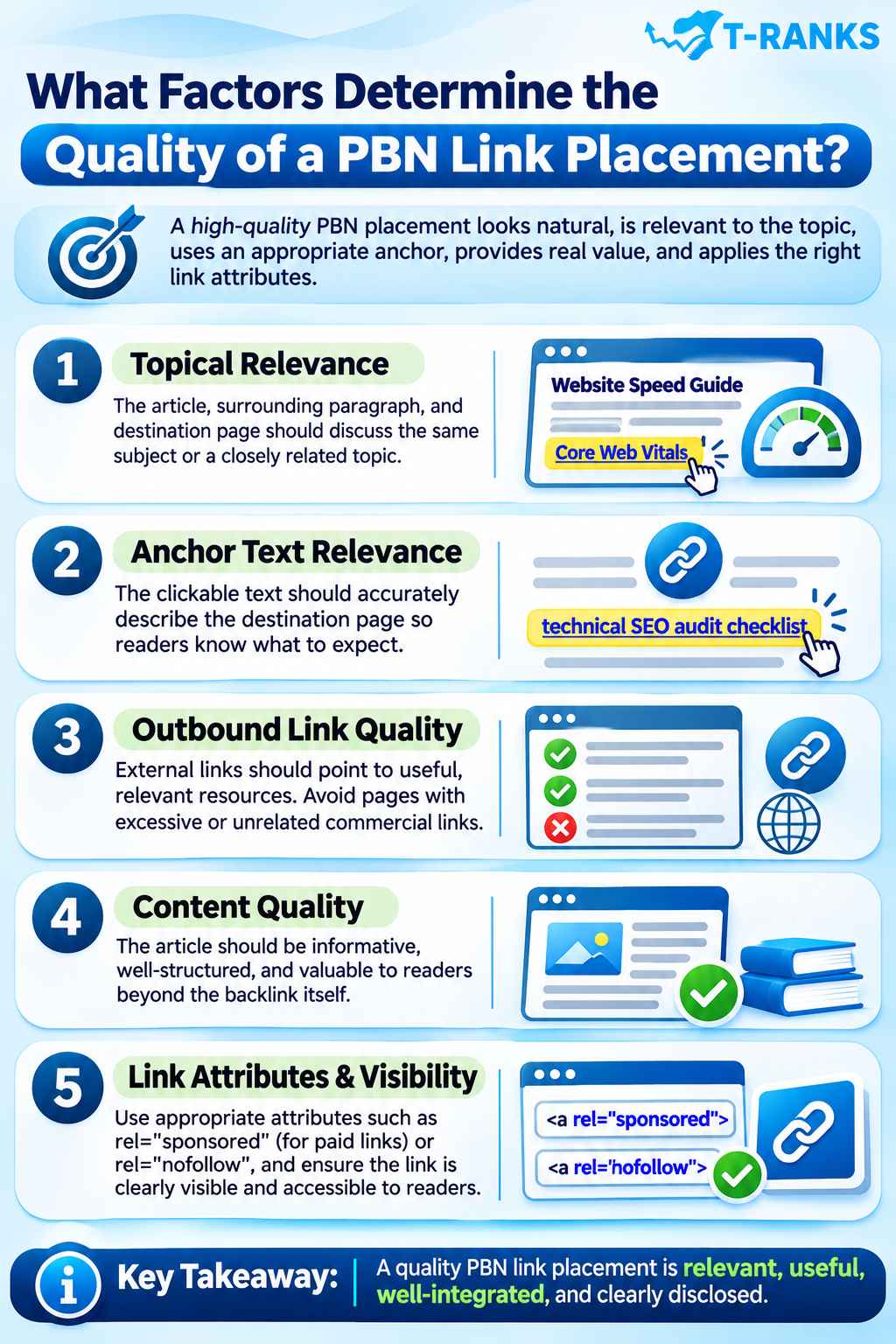
The quality of a PBN link placement depends on its contextual relevance, visibility, anchor text, and surrounding content. Each factor helps determine whether the link serves a meaningful purpose within the article.
The main factors include:
- Link position: Where the backlink appears, such as the introduction, main content, conclusion, or sidebar.
- Contextual relevance: How closely the surrounding paragraph relates to the linked page.
- Anchor text: Whether the clickable text accurately describes the destination.
- Content quality: Whether the article provides useful information beyond the backlink.
- Outbound links: Whether other links on the page are relevant and serve clear purposes.
- Link attributes: Whether attributes such as rel=”sponsored” or rel=”nofollow” correctly describe the linking arrangement.
These factors provide a starting point for reviewing a published backlink. They help distinguish meaningful editorial references from placements inserted mainly for promotional or ranking purposes.
Why Does Link Placement Matter for PBN Backlink Quality?
Link placement matters because it affects a backlink’s visibility, contextual relevance, and usefulness to readers. A link placed naturally within relevant content is easier to understand than one inserted into an unrelated paragraph or hidden in a less visible section.
However, placement quality is not the same as ranking value. A backlink can be relevant and useful to readers without necessarily passing ranking credit in Google Search.
How Does Link Position Affect Visibility and Context?
A backlink’s position determines where readers encounter it and how much surrounding information helps explain its purpose. Links within the main article body often have more immediate context than links in footers or sidebars.
For example, a link to a technical SEO guide within a paragraph about website crawling gives readers a clear reason to visit that resource. The same link in an unrelated sidebar may be harder to interpret.
Still, no specific paragraph position guarantees greater link equity. A link near the introduction can be appropriate when it supports the opening discussion, just as a link near the conclusion can support a final recommendation.
Why Does Editorial Relevance Matter More Than Placement Alone?

Editorial relevance matters because a useful backlink should support the article’s subject and direct readers to related information. Simply placing a link in the middle of an article does not make it relevant or valuable.
Consider an article explaining website security. A contextual link to a detailed guide about SSL certificates provides a logical next step for readers. In contrast, a link to an unrelated insurance sales page may appear promotional, even when placed within the main content.
This distinction is important when evaluating PBN backlinks. Relevant placement improves the reader experience, but it does not remove the SEO risks of links created primarily to manipulate search rankings.
Where Can PBN Backlinks Appear Within an Article?

PBN backlinks can appear in the introduction, middle paragraphs, conclusion, or supporting areas such as footers, sidebars, and author bios. Each position provides a different level of visibility and surrounding context.
However, no single position guarantees better rankings. When evaluating a backlink, consider whether its location makes sense for the reader and whether the surrounding content supports the linked resource.
Links in the Introduction
Links in the introduction appear near the beginning of an article, often within the first few sentences or paragraphs. They can be useful when readers need immediate access to a definition, original source, or supporting resource.
For example, an article introducing Google’s link spam policies may link directly to Google’s official documentation in its opening paragraph. That placement serves a clear informational purpose. A promotional backlink inserted without a relevant explanation, however, may feel forced.
An introductory link is not automatically unnatural. Its relevance depends on why the link appears and what readers gain from following it.
Links in the Middle of the Article
Links in the middle of an article appear within the main discussion, where writers typically explain concepts, provide examples, and reference supporting information. These placements often have enough surrounding content to establish why a resource is relevant.
For example, a guide discussing technical SEO audits might link to a detailed resource about crawling errors while explaining how to identify them. The backlink supports the topic rather than interrupting it.
When evaluating a middle-of-article placement, examine the paragraph containing the link and the discussion around it. Being positioned in the middle does not automatically make a backlink valuable or compliant with Google’s policies.
Links Near the Conclusion
Links near the conclusion appear toward the end of an article. They commonly direct readers to additional resources, related guides, or useful next steps after the main discussion.
For example, an article about website migration might conclude with a link to a practical migration checklist. The placement is relevant because it helps readers apply what they have learned.
A concluding link becomes questionable when it introduces an unrelated topic or exists mainly to promote a particular website. Evaluate its purpose rather than assuming that links near the end are weaker.
Links in Footers, Sidebars, and Author Bios
Footer, sidebar, and author bio links appear outside the main article body. They often serve navigation, attribution, or author identification purposes rather than supporting a particular paragraph.
For example, an author’s personal website link in a genuine biography may provide useful background. Likewise, a footer link to a company’s contact page can serve a legitimate navigational purpose.
However, repeated keyword-rich links to unrelated commercial websites across multiple footers or sidebars deserve closer inspection. Google specifically identifies widely distributed links in website footers or templates as a potential form of link spam.
Comparison of PBN Link Positions
| Link position | Typical purpose | Main evaluation point |
| Introduction | Introduce sources or background information | Does the link support the opening discussion? |
| Middle of article | Support explanations, examples, or references | Is the surrounding content relevant to the destination? |
| Conclusion | Provide related resources or next steps | Does the link follow logically from the discussion? |
| Footer | Navigation, attribution, or site information | Is the link relevant and appropriately used? |
| Sidebar | Navigation or supplementary resources | Does the link serve a useful purpose? |
| Author bio | Author identification or professional background | Is the destination genuinely associated with the author? |
The best way to evaluate link position is to examine its purpose, visibility, and surrounding context. A well-placed reference should help readers understand the content, while its position alone cannot establish SEO value or eliminate PBN-related risks.
What Factors Determine the Quality of a PBN Link Placement?
The main factors that determine PBN link placement quality are topical relevance, anchor text, outbound links, content quality, and link attributes. Together, they help explain whether a backlink serves readers or appears to exist mainly for SEO manipulation.
A placement may look natural without providing ranking value. Therefore, evaluate its editorial usefulness separately from its potential SEO impact.
Topical Relevance of the Surrounding Content
Topical relevance measures how closely the referring article, surrounding paragraph, and destination page relate to one another. All three should support the same subject or a logically connected topic.
For example, an article about website speed can naturally reference a guide to Core Web Vitals. However, a backlink to an unrelated insurance service would lack a clear connection, even if it appeared within the main content.
Anchor Text and Destination Page Relevance
Anchor text quality depends on how accurately the clickable words describe the destination page. Readers should understand what they will find before opening the link.
For example, “technical SEO audit checklist” is descriptive when linking to a checklist about technical SEO. An exact-match keyword inserted into an unrelated sentence may feel forced. There is no universal safe percentage for exact-match anchors.
Outbound Link Quality and Quantity
Outbound links should connect readers to useful, relevant resources rather than simply promote unrelated websites. A page containing numerous commercial links with little supporting content deserves closer inspection.
The total number of links is not enough to judge quality. A detailed research article may legitimately cite many external sources, while a short promotional article with only a few links may still lack editorial value.
Content Quality and Editorial Integration
A backlink should support an article that provides useful information independently of the link itself. The content should have a clear purpose, accurate explanations, and a logical structure.
Check whether the linked resource genuinely expands the discussion. If an article exists mainly to introduce a promotional backlink, its editorial quality is questionable regardless of where the link appears.
Link Attributes and Placement Visibility
Link attributes identify certain linking relationships, while visibility determines whether readers can easily find and use a backlink. Both are important when evaluating the placement.
Google recommends rel=”sponsored” for paid placements and also accepts rel=”nofollow”. A link should also be accessible and displayed in a way that readers can recognize.
However, proper formatting and visible placement do not guarantee ranking benefits or make manipulative backlinks compliant with Google’s spam policies.
These five factors provide the foundation for evaluating placement quality. The next step is to apply them systematically when reviewing a published PBN backlink.
How to Evaluate PBN Link Placement Quality Step by Step
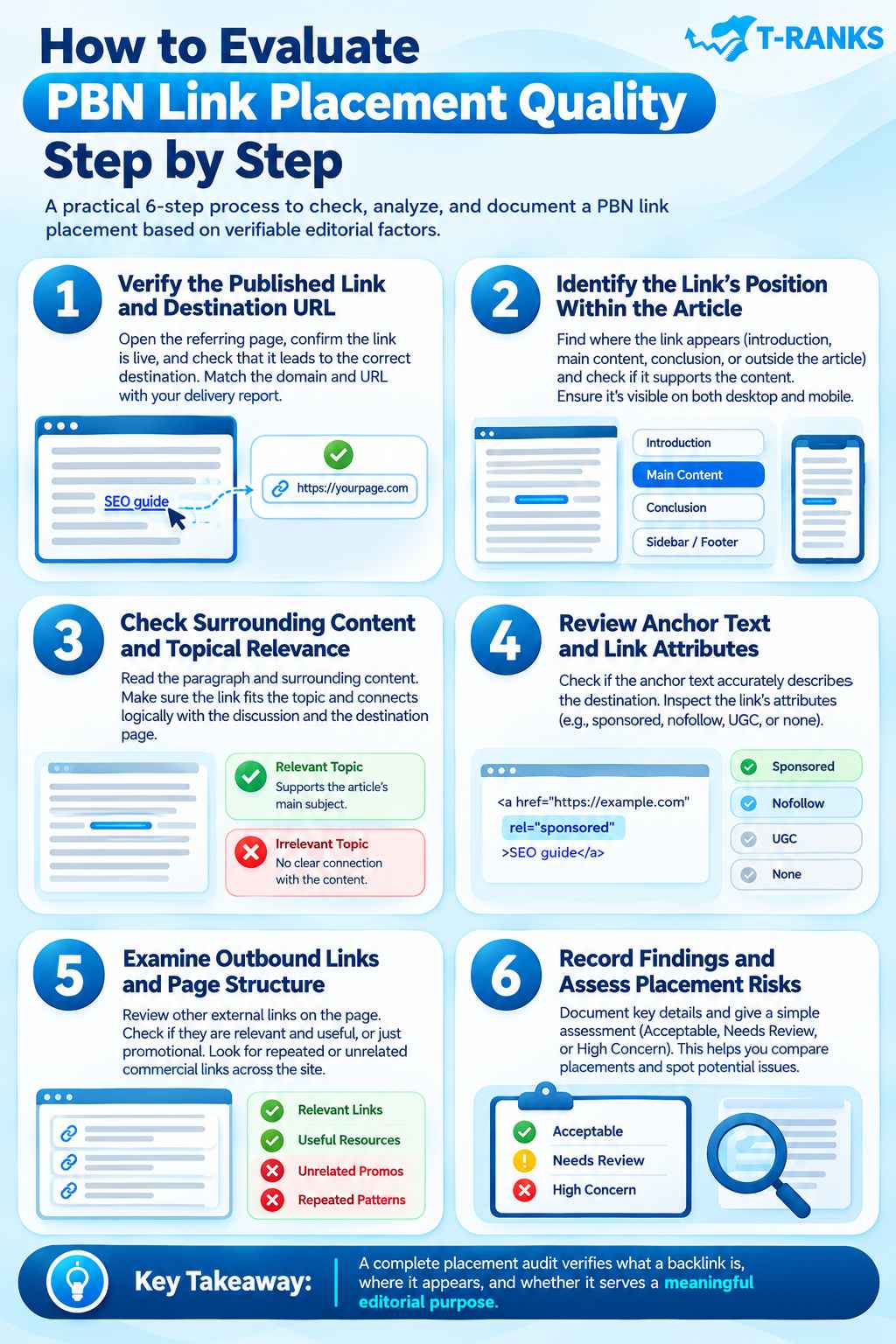
To evaluate PBN link placement quality, verify the published backlink, inspect its position, assess contextual relevance, review anchor text, examine outbound links, and document potential SEO risks. This six-step process helps you distinguish verifiable editorial characteristics from unsupported claims about ranking value.
You do not need to rely solely on a provider’s backlink report. By combining manual inspection with basic SEO tools, you can evaluate what actually appears on the referring page.
Step 1: Verify the Published Link and Destination URL
Start by opening the referring page in your browser. Confirm that the article is publicly accessible and that the backlink appears where the provider reported it.
Click the link and check its destination. It should lead to the agreed page rather than an unexpected redirect, broken URL, or unrelated website. Also confirm that the referring domain and placement URL match the delivery report.
For example, if you purchased a backlink pointing to a technical SEO guide, verify that it opens the correct guide rather than your homepage or another service page.
You can use a browser, Screaming Frog SEO Spider, or a backlink checker to inspect URLs. Remember that a live backlink confirms publication, not whether Google assigns it ranking value.
Step 2: Identify the Link’s Position Within the Article
Next, locate the backlink and examine how readers encounter it. Determine whether it appears in the introduction, main discussion, conclusion, or an area outside the article.
Ask yourself whether the link supports the content at that location. An early reference may help explain an unfamiliar concept, while a link near the conclusion may provide additional resources.
Also check whether the backlink is clearly visible on desktop and mobile devices. Links hidden behind unexpected elements or difficult to distinguish from surrounding text can weaken usability.
Do not judge placement quality by paragraph number alone. Google does not publish a universal rule requiring backlinks to appear after a specific word count.
Step 3: Check Surrounding Content and Topical Relevance
Read the paragraph containing the backlink, along with the surrounding discussion. Identify the article’s main subject and compare it with the destination page.
A useful contextual placement should connect these topics logically. The linked resource should explain, support, or expand something readers are already learning.
For example, a website migration article might reference a guide to 301 redirects while explaining how to preserve important URLs. That connection is meaningful because the destination addresses a specific part of the discussion.
Now compare that with a backlink to an unrelated insurance page inserted into the same paragraph. The link may be clickable, but its editorial purpose would be questionable.
Step 4: Review Anchor Text and Link Attributes
Inspect the clickable text and determine whether it describes the destination accurately. Branded, partial-match, exact-match, and generic anchors can all appear in legitimate content, depending on the context.
For example, “Google Search Console setup guide” is descriptive when linking to an actual setup guide. In contrast, repeatedly inserting an unrelated commercial keyword may indicate that the wording was chosen primarily for search rankings.
Next, inspect the link’s HTML or use a browser extension to identify its rel attributes.
Check whether the backlink is marked as:
- Sponsored: Identifies advertising or paid placements.
- Nofollow: Indicates that the publisher does not want to endorse or associate its site with the destination for ranking purposes.
- UGC: Identifies links in user-generated content, such as comments or forum posts.
- Unqualified: Has none of these attributes and is treated as a regular link.
Google prefers rel=”sponsored” for advertising links and also accepts rel=”nofollow”. An unqualified link is not automatically spam, but paid ranking links require particular scrutiny.
Step 5: Examine Outbound Links and Page Structure
Review the other links appearing on the referring page. Separate internal navigation links from external references and commercial placements.
Open a sample of the external links to see whether they support the article’s subject. Multiple unrelated promotional links, repeated keyword-rich anchors, or outbound links inserted without useful context may indicate weak editorial standards.
You should also look beyond the individual paragraph. Check whether the same commercial links appear repeatedly in sidebars, footers, or other pages across the website.
For example, a detailed cybersecurity article linking to relevant documentation and research sources has a clearer editorial purpose than a thin article containing unrelated links to gambling, loans, and online shopping websites.
There is no fixed outbound link count that guarantees safety. Assess the purpose and relevance of the links rather than applying an arbitrary numerical limit.
Step 6: Record Findings and Assess Placement Risks
Finally, document what you discovered. Recording consistent observations makes it easier to compare placements, identify missing deliverables, and review changes later.
Your evaluation record should include the referring URL, destination URL, anchor text, link position, topical relevance, link attributes, and any problems identified.
Use a simple assessment such as Acceptable, Needs Review, or High Concern for the placement’s editorial characteristics. These are internal review labels, not Google-approved safety ratings.
For example, a visible backlink in a relevant article may receive an acceptable editorial-quality assessment. However, if the link was purchased primarily to manipulate rankings, it still carries a separate Google policy risk.
If you identify questionable links, document the evidence and determine whether the issue concerns a delivery failure, poor editorial placement, or potential link spam.
PBN Link Placement Audit Worksheet
Use this worksheet to record the results of your review.
| Evaluation check | What to verify |
| Published backlink | Link is accessible and matches the delivery report |
| Destination URL | Correct page opens without unexpected redirects |
| Link position | Placement serves a clear purpose within the article |
| Contextual relevance | Surrounding content relates to the destination |
| Anchor text | Clickable wording accurately describes the linked page |
| Link attributes | Relationship is correctly identified |
| Outbound links | Other external references have relevant purposes |
| Content quality | Article provides value independently of the backlink |
| Placement patterns | No unexplained repetition or unrelated promotional links |
| SEO policy risks | Paid or manipulative linking concerns are documented |
A complete placement audit verifies what a backlink is, where it appears, and whether it serves a meaningful editorial purpose. It does not guarantee that Google will count the link or that the backlink will improve search rankings.
What Are the Warning Signs of Poor PBN Link Placement?

The main warning signs of poor PBN link placement include irrelevant content, forced anchor text, hidden links, excessive promotional linking, and repeated placement patterns. These issues can indicate weak editorial quality or backlinks created mainly to manipulate search rankings.
A backlink may appear inside a well-written article and still be questionable. The important question is whether the link genuinely supports the content or exists primarily for SEO purposes.
1. Links Placed in Irrelevant Paragraphs
A backlink becomes questionable when the surrounding paragraph has little connection to the linked page. Simply inserting a link into the main content does not make it contextually relevant.
For example, a backlink to a cryptocurrency exchange inside an article about home gardening lacks a clear editorial connection. Such placements deserve closer examination, especially when the article provides no reason for the reference.
2. Forced or Overoptimized Anchor Text
Keyword-rich anchor text can be a warning sign when it feels unnatural or does not accurately describe the destination page. Repeated exact-match anchors across unrelated articles may also suggest a ranking-focused linking pattern.
For example, inserting “best emergency plumber London” into a paragraph that does not discuss plumbing creates an obvious mismatch. Descriptive anchors should help readers understand the linked resource rather than simply repeat target keywords.
3. Hidden or Difficult-to-Access Backlinks
Backlinks that are concealed, visually obscured, or difficult for readers to identify deserve investigation. These may include links styled to blend into the background or placed inside elements that readers cannot reasonably access.
However, not every collapsed menu or less prominent link is suspicious. The concern is whether the placement intentionally hides a link or prevents users from recognizing its purpose.
4. Excessive Unrelated Promotional Links
An article containing numerous unrelated commercial links may have been created mainly to distribute backlinks rather than inform readers. The warning sign is the lack of editorial purpose, not a specific number of outbound links.
For example, a short article about website security that suddenly promotes loans, casino websites, and unrelated shopping services raises questions about its content quality and linking practices.
5. Repeated Sitewide or Template-Based Links
Identical commercial links appearing across many footers, sidebars, or page templates can indicate a pattern of non-editorial linking. Google specifically identifies widely distributed links in footers or templates as an example of potential link spam.
Ordinary navigation and attribution links are not automatically problematic. Review whether the repeated links serve legitimate website functions or appear designed primarily to influence rankings.
6. Misleading Link Attributes or Placement Claims
A backlink may be advertised as an editorial recommendation even though it was purchased specifically to influence search rankings. Such claims deserve scrutiny, particularly when the linking arrangement is not appropriately disclosed.
For paid advertisements and sponsorships, Google recommends rel=”sponsored” and also accepts rel=”nofollow”. A provider’s promise of a regular link that passes ranking authority does not guarantee SEO value.
Poor PBN link placement is often recognizable through weak relevance, unnatural wording, hidden presentation, or misleading linking practices. These warning signs help identify questionable placements, but their absence does not establish that a PBN backlink is safe under Google’s spam policies.
Can Proper PBN Link Placement Reduce SEO Risks?
Proper PBN link placement can improve contextual relevance and readability, but it cannot eliminate SEO risks. Even a backlink placed naturally within high-quality content may violate Google’s spam policies if its primary purpose is to manipulate search rankings.
Understanding this distinction is important. A placement can meet editorial quality standards without guaranteeing ranking benefits or protection from Google enforcement.
Can Google Ignore or Penalize Manipulative PBN Backlinks?
Yes, Google can disregard manipulative PBN backlinks or take manual action against websites involved in link spam. The outcome depends on how Google evaluates the linking practices, not simply where a backlink appears.
Google’s automated spam systems may neutralize the ranking effects of suspicious links. These backlinks can remain live while providing no ranking benefit.
Manual actions are different. They involve human review and can reduce a website’s visibility in Google Search. Website owners can check reported actions through Google Search Console.
For example, a paid backlink placed within a relevant article may still be considered link spam if it was purchased primarily to influence rankings.
Does Natural-Looking Placement Make PBN Links Safe?
No, natural-looking placement does not make manipulative PBN backlinks safe or compliant with Google’s policies. Relevant paragraphs, descriptive anchor text, and professional article formatting cannot change the underlying purpose of a purchased ranking link.
For example, placing a backlink in the middle of an informative article does not guarantee that Google will recognize or reward its ranking value. There is no officially approved paragraph position, anchor text percentage, or outbound link count that makes PBN links penalty-free.
However, legitimate advertising and sponsored placements are allowed when links are appropriately qualified. Google recommends rel=”sponsored” for paid links and also accepts rel=”nofollow”.
The most effective way to reduce PBN-related SEO risk is to address the linking arrangement itself, not merely adjust the link’s position. Editorial relevance improves content usefulness, while compliance depends on whether the linking practice follows Google’s policies.
PBN Link Placement Evaluation Checklist
A PBN link placement checklist helps you assess a backlink’s position, contextual relevance, anchor text, link attributes, and potential SEO risks. Use it to identify placement problems and confirm whether a published backlink meets the agreed requirements.
The checklist below focuses on verifiable characteristics rather than unsupported promises about ranking improvements.
| Evaluation factor | What to check |
| Link position | Does the backlink appear in a location that makes sense within the article? |
| Contextual relevance | Does the surrounding paragraph relate directly to the destination page? |
| Anchor text | Does the clickable text accurately describe the linked content? |
| Content quality | Does the article provide useful information beyond the backlink? |
| Outbound links | Are other external links relevant rather than unrelated promotions? |
| Placement visibility | Can readers easily identify and access the backlink? |
| Destination URL | Does the backlink point to the correct page without unexpected redirects? |
| Link attributes | Are paid links appropriately qualified with sponsored or nofollow? |
| Sitewide patterns | Are repeated commercial links or template-based placements present? |
| SEO risks | Was the backlink created primarily to manipulate search rankings? |
How to Interpret Your Checklist Results
A placement that meets the editorial checks may be relevant and useful to readers. If several checks reveal problems, investigate the referring page and document the issues before accepting the placement.
However, passing every checklist item does not guarantee that Google will value the backlink. Links purchased primarily to manipulate rankings remain a link spam concern, even when their placement appears natural.
Conclusion
In conclusion, an effective PBN link placement strategy requires evaluating more than where a backlink appears within an article. Contextual relevance, anchor text, content quality, outbound links, and placement visibility all help determine whether a link serves a meaningful editorial purpose.
A backlink in the middle of an article is not automatically better than one in the introduction or conclusion. What matters is whether the surrounding content supports the linked page and gives readers a genuine reason to follow the reference. A structured placement audit can help identify forced anchors, irrelevant links, and other quality concerns.
However, good placement does not guarantee better Google rankings or eliminate SEO risks. PBN backlinks purchased primarily to manipulate search results violate Google’s link spam policies, even when they appear naturally within relevant content.
Want to make more informed backlink decisions? Explore T-RANKS for SEO resources and link building insights. Learn how to evaluate backlink quality, understand potential risks, and develop a more informed link building strategy.
Frequently Asked Questions About PBN Link Placement Strategy
What Is PBN Link Placement Strategy?
PBN link placement strategy involves deciding where backlinks appear within private blog network (PBN) content. It considers link position, contextual relevance, anchor text, and how naturally the link fits the article.
Where Is the Best Place to Put a PBN Link in an Article?
There is no universally best position for a PBN link. A relevant link within the main article body can provide useful context, but its placement does not guarantee greater ranking value.
Should PBN Links Appear in the First Paragraph?
Yes, a PBN link can appear in the first paragraph when it supports the opening discussion. Google does not publish a rule prohibiting introductory links, but placement alone cannot make manipulative backlinks compliant.
Do Contextual PBN Backlinks Pass More Link Equity?
Not necessarily. Contextual backlinks may offer clearer topical relevance, but Google does not guarantee that they pass more ranking value. Links created primarily to manipulate rankings may be disregarded entirely.
How Many Outbound Links Should a PBN Post Have?
There is no fixed safe number of outbound links per PBN post. Evaluate each link’s relevance and editorial purpose instead of following an arbitrary limit.
What Anchor Text Should You Use for PBN Links?
Use anchor text that accurately describes the destination page and fits the surrounding sentence. Branded, descriptive, and keyword-based anchors can all be appropriate, but no anchor ratio makes manipulative PBN linking safe.
Are Footer and Sidebar PBN Links Bad for SEO?
Not automatically. Footer and sidebar links can serve legitimate navigation or attribution purposes. However, widely distributed links created primarily to manipulate rankings violate Google’s link spam policies.
Can Google Detect Unnatural PBN Link Placements?
Yes, Google uses automated systems and human reviews to identify manipulative linking practices. Unnatural placement patterns may raise concerns, but Google does not disclose a complete list of detection signals.
How Can You Check Whether a PBN Link Is Properly Placed?
Open the referring page and check the link’s position, surrounding content, anchor text, destination URL, and link attributes. Confirm that the placement is visible, relevant, and accurately represented in the delivery report.
Can Natural-Looking PBN Links Still Cause Google Penalties?
Yes, natural-looking PBN links can still violate Google’s spam policies if created primarily to manipulate rankings. Google may neutralize their ranking benefits or issue manual actions against affected websites.