Choosing the right PBN link can decide whether your rankings grow or your site gets into trouble. Many beginners buy PBN links without knowing what makes a link safe, strong, or risky. This leads to penalties, wasted money, and unstable SEO. It does not have to be this way.
PBN link quality describes how safe, relevant, and trustworthy a Private Blog Network link is before you use it. A weak or unsafe link can create footprints that Google can detect. A strong link comes from a clean domain, unique hosting, real content, and a website that fits your niche.
This guide gives you a simple, clear PBN quality checklist. You will learn how to inspect a site, what to avoid, and how to choose links that support long term, stable rankings.

.
Why Checking PBN Link Quality Matters Before Buying

Checking PBN link quality matters because Google looks for unnatural link patterns, and weak PBNs leave the clearest signals. Poor networks reuse hosting, publish thin content, or link to unrelated niches. These patterns are easy for algorithms to detect. When you buy links from unsafe PBNs, you risk losing rankings, wasting money, and damaging your domain for the long term.
Google Targets Weak Networks
Low quality PBNs share hosting providers, use identical IP ranges, or follow the same DNS setup. These footprints make detection simple for automated systems.
Thin Content Weakens Trust
Blogs filled with generic articles, spun paragraphs, or irrelevant topics fail to index well. When the PBN lacks authority, your link loses power.
Irrelevant Outbound Links Cause Algorithmic Flags
If a PBN links to unrelated niches or risky categories, Google treats the site as low trust. Your backlink becomes part of that pattern.
Slow Indexing Shows Weak Authority
A weak PBN often takes weeks to index new content. When your link appears on such a page, its impact becomes slow and unstable.
Weak Domains Collapse During Updates
Google updates target link manipulation. Unsafe networks lose many indexed pages at once. Buyers who rely on these networks face sudden drops.
Quality Checks Reveal Real Authority
A strong PBN has a clean domain history, diverse hosting, and real content. These signals show stability. They also show that the link will continue to pass value over time.
Quality Checks Protect Your Budget
Evaluating metrics and risk before buying helps you avoid spending on links that disappear, lose indexation, or become nofollow later.
Quality Checks Keep Your Rankings Stable
Safe PBNs behave like real websites. They link naturally, publish consistently, and maintain topic focus. These traits support steady ranking growth.
Quality Checks Build a Safe Link Profile
When you choose high quality PBNs, your backlink profile grows slowly and safely. Each link appears natural. This reduces long term detection risk.
By reviewing link quality before you buy, you protect your investment, avoid risky networks, and build a link profile that can survive future algorithm updates
Step-by-Step PBN Quality Checklist
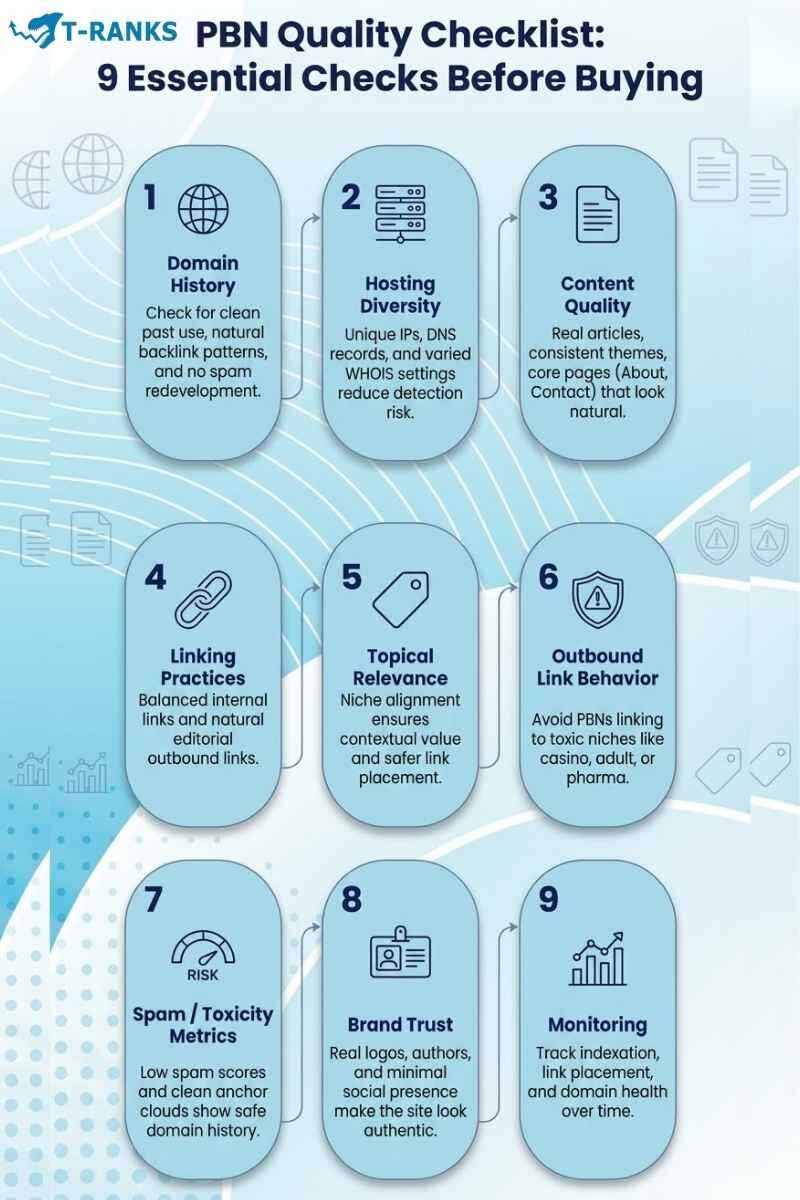
A PBN quality checklist helps you decide if a PBN link is safe, relevant, and worth your investment. When you follow a structured review, you understand how the domain was used, how the site behaves today, and whether the link can support long-term rankings. Each step gives you a clear buyer action so you know exactly what to check before making a final decision.
Below are the nine checks every buyer should complete before purchasing a PBN link.
1. Domain and Backlink History
Start by checking the domain’s past because a clean history is the foundation of a safe PBN link. Open the Wayback Machine and scroll through several snapshots. Look for normal layouts, readable articles, and stable activity. If you see foreign spam, thin autogenerated pages, or long periods of deindexation, the domain is unsafe.
Next, review its backlink profile in Ahrefs or Majestic. Focus on Trust Flow, Domain Rating, and Citation Flow. These metrics show how trusted and balanced the domain is. A safe starting point is TF above fifteen and DR above twenty five.
Study the anchor cloud. Natural anchors include brand names, URLs, and long phrases. Spam anchors often include pills, gambling terms, and foreign characters.
Look at the timeline of backlinks. Healthy domains grow slowly. Redirect-heavy histories or sudden spikes show manipulation.
When the history feels clean and consistent, you can trust the domain to pass strong authority.
2. Hosting and Server-Level Diversity
A safe PBN uses hosting that hides footprints and makes every site look independent. Check whether the site sits on a unique C class IP. Sites sharing the same IP range across a network become easy for Google to map.
Premium hosting with varied providers lowers this risk.
Look at WHOIS details. They should be private, but not identical across many PBNs.
Check DNS records, nameservers, and MX entries. Small variations create natural separation between sites.
If multiple PBNs share the same registrar, same hosting plan, and same nameserver pattern, this becomes a detectable footprint.
Strong server diversity protects the entire network and ensures your purchased link remains safe, stable, and hidden.
3. On-Site Content and Structure
Look closely at the content because it shows whether the PBN behaves like a real website. Read several articles on the site. The writing should feel natural, relevant, and created for real users. Avoid blogs filled with generic filler text or posts that sound heavily automated.
A genuine PBN maintains a clear theme. Its categories and tags make sense. Its pages follow a logical structure.
Check for About, Contact, and Privacy pages. Real websites include these elements because they reflect responsibility and ownership. Their absence often signals rushed or low-effort setups.
Review the layout. Themes and plugins should not match across different PBNs from the same seller. Identical builds create patterns that Google can eventually detect.
When content feels authentic and the structure looks intentional, the PBN becomes safer for long-term link placement.
4. Internal and External Linking Practices
A safe PBN shows balanced linking behavior, both inside the site and to the outside web. Start by reviewing external links on a few posts. They should point to trusted and relevant sources, not only to clients or unrelated commercial pages.
A natural site references authority domains often. A link farm does not.
Check anchor text. A healthy pattern includes branded anchors, generic anchors, and long phrases. If every outbound link uses a keyword-focused anchor, the site is being used purely for ranking manipulation.
Evaluate internal links. They should guide readers to related articles, not follow the exact same structure on every page.
Avoid PBNs that interlink multiple sites within the same network. This creates an obvious footprint.
When linking behavior feels organic and editorial, your purchased link will look more natural and less risky.
5. Relevance and Topical Context
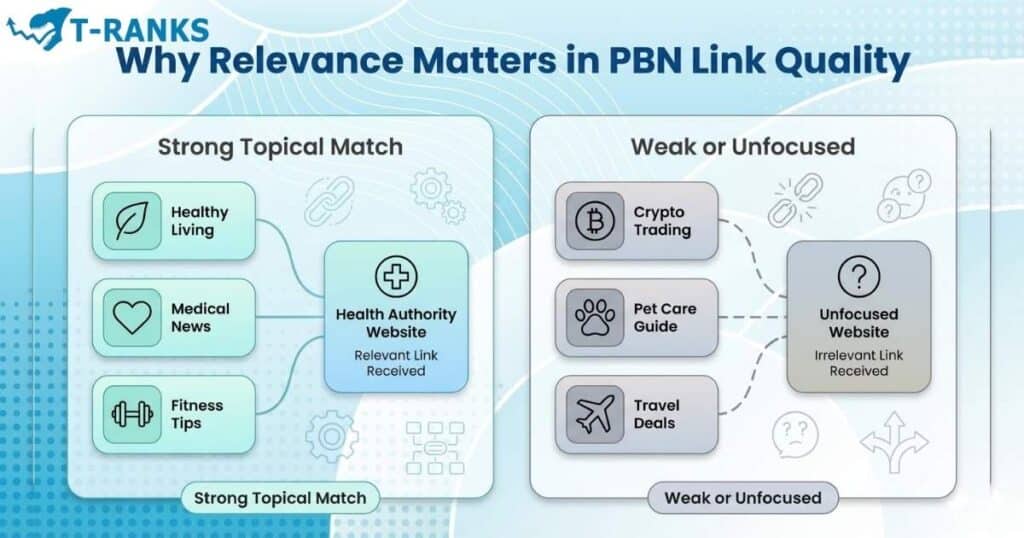
Relevance is one of the strongest signals that a PBN link will help rather than harm your rankings. Look at the main theme of the site. Its categories, tags, and overall content direction should align with your niche or a closely related topic. A health PBN should publish health content. A finance PBN should stay within finance.
When the theme matches your target page, Google sees the link as contextually meaningful.
Check the writing for semantic clues. Strong PBNs use vocabulary, entities, and examples connected to their niche. Weak or unfocused PBNs mix topics like travel, crypto, and pets in one place, which reduces trust and relevance.
Review outbound links as well. If the PBN links to websites within the same niche, it strengthens its topical identity.
A relevant PBN does more than pass authority. It reinforces your topical map and supports long-term rankings.
6. Outbound Link Behavior and Network Patterns

Outbound link behavior shows how responsibly the seller manages the PBN. Use Ahrefs or Screaming Frog to see every domain the site links to. If you find links to adult, casino, or pharma pages, avoid the network immediately. These niches attract algorithmic scrutiny.
Count how many commercial links appear on the homepage and inside posts. Too many promotional links make the site look like a link farm. A natural website mixes authority citations, informational sources, and occasional commercial references.
Check link placement. The safest PBN links appear inside paragraphs, not inside footers, sidebars, or author boxes. Google rewards contextual placement because it resembles editorial behavior.
Look for consistency. If you find repetitive link patterns across many posts, the seller may be automating placements.
A PBN that keeps outbound behavior balanced and clean is far more likely to stay indexed and pass long-term value.
7. Spam Score and Toxicity Indicators

Spam signals help you understand risks that are not visible on the surface. Start by checking Moz Spam Score. A clean domain usually sits in the low range. If the score climbs above thirty, the domain may carry past abuse or low-quality backlinks.
Use Majestic to compare Trust Flow and Citation Flow. When CF is much higher than TF, it often means the domain collected many weak or spammy links.
Check the SEMrush toxicity report to confirm patterns. Look at referring countries, referring networks, and anchor text origins. If most backlinks come from irrelevant regions or suspicious blogs, avoid the site.
Review the anchor cloud carefully. Anchors containing pills, gambling terms, or foreign characters show the domain was previously misused.
A low-toxicity domain gives your PBN link a better chance of staying safe through future Google updates.
8. Branding, Trust, and Social Presence

Branding helps a PBN look like a real website instead of a controlled link asset. Start by checking the logo, author names, and About page. These elements tell you whether the seller puts effort into making the site believable.
A strong PBN includes unique personas, not reused identities across multiple sites.
Look at writing style. If posts follow a consistent voice and cover related topics, the site feels more authentic.
Check social presence. Even basic profiles on X, Facebook, or LinkedIn improve trust. The goal is not high activity but simple confirmation that the brand exists outside the website.
Brand signals make a PBN harder to detect and increase the safety of your purchased link.
9. Post-Purchase Monitoring and Link Maintenance

Your work does not end once the link is placed. Ongoing monitoring ensures the link continues to deliver value. Start by checking indexation through Google Search Console. If the linking page disappears from the index, the link loses all SEO power.
Use Ahrefs to confirm the link remains live, dofollow, and placed in the correct section of the article.
Watch the domain’s Trust Flow, Domain Rating, and traffic trends over time. A slow, natural decline is normal. A sharp drop suggests the PBN may be weakening or attracting penalties.
Record each link in a private tracking sheet. Include the date of placement, anchor text, the page URL, and the seller’s details. This helps you evaluate link performance and vendor reliability.
If a link gets removed, changes to nofollow, or loses indexation, request a replacement quickly.
Consistent monitoring protects your budget and helps you build a reliable network of PBN vendors for long-term SEO growth.
Common Red Flags When Buying PBN Links

Common red flags help you quickly identify unsafe PBNs before buying a link. These warning signs show patterns that Google can detect easily. If you notice any of the points below, avoid the network or request more evidence from the seller.
Reused Themes and Layouts
Identical site designs, repeated themes, or matching plugin setups across multiple PBNs show automation and create strong footprints.
Thin or Repetitive Content
Posts that share the same structure, tone, or filler topics indicate low-quality AI or spun writing that does not build trust.
Unnatural Anchor Usage
A pattern of exact-match anchors on most outbound links signals aggressive link selling and increases detection risk.
Irrelevant Outbound Links
Links to unrelated niches, especially casino, adult, or pharma, show poor editorial control and attract algorithmic scrutiny.
Excessive Commercial Links
Pages with many promotional outbound links behave like link farms, not real websites with balanced citations.
Hosting Footprints

Multiple sites using the same hosting provider, same IP range, or matching nameservers create a clear, trackable pattern.
Manipulated Domain Histories
Redirect-heavy backlink profiles, sudden DR jumps, or spam-filled anchor clouds show expired-domain abuse.
Lack of Transparency
Sellers who refuse to share basic sample URLs, hosting information, or link placement details often hide unsafe practices.
Too Good To Be True Offers
Very cheap PBN links or promises of guaranteed rankings show poor network quality and unrealistic expectations.
Quantity Over Quality Mindset
Vendors who push large link packages instead of relevance and safety prioritize volume, not results.
No Real Strategy
Sellers who position PBNs as the only solution without considering niche, competition, or your site’s stage are not providing responsible guidance.
How to Build a Sustainable PBN Strategy
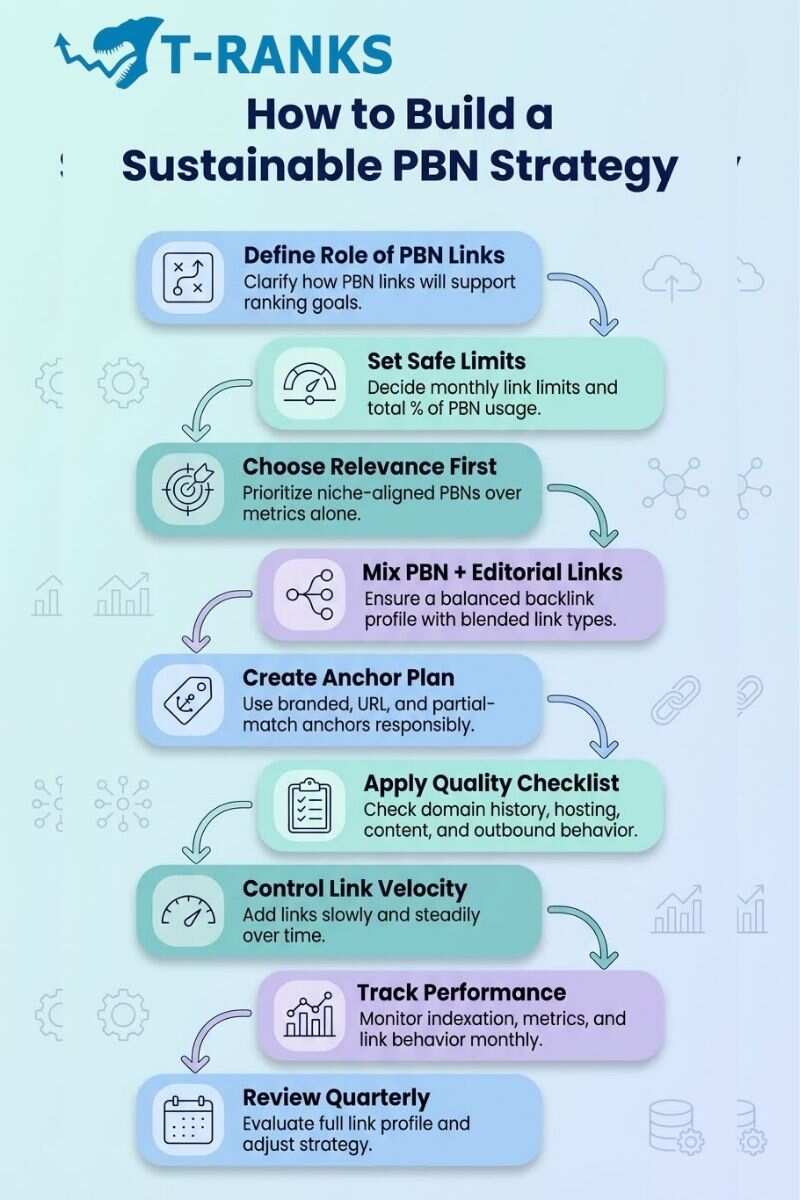
A sustainable PBN strategy is a step-by-step plan that tells you when to use PBN links, how many to build, and how to keep your backlink profile safe for the long term. You avoid random link buying. You follow a controlled process. This protects your rankings, your budget, and your entire domain from future Google updates.
Below is the practical method that experienced SEOs use.
Step 1: Define the role of PBN links in your SEO plan
Decide exactly what PBN links should help you achieve. You may use them to start rankings on new pages or to strengthen inner pages in competitive clusters. You may use them to support slow moving keywords or to create steady authority flow.
When the purpose is clear, you avoid using PBNs on every page without direction.
For example, many SEOs only use PBNs on inner pages and never on the homepage. This one decision keeps the strategy stable.
Step 2: Set safe limits for how many PBN links you will use
Decide how many PBN links you will allow in your overall link profile. A safe range is often ten to twenty percent of your total referring domains. Anything higher can create unnatural patterns.
Set a monthly limit as well. A new site may use one or two PBN links per month. An aged site can handle slightly more.
Limits stop you from building too fast and protect you from sudden spikes that Google may question.
Step 3: Choose relevance before metrics
Decide what relevance means for your niche. Make a small list of categories and themes your content covers. Only consider PBNs that publish within those topics.
If two PBNs share similar metrics, always choose the one with stronger topical alignment. A DR twenty five link from a relevant site is safer and stronger than a DR forty link from a random theme.
Relevance improves indexing, anchor strength, and natural trust.
Step 4: Mix PBN links with safer link types
Plan how PBN links will sit beside your other backlinks. Add guest posts, niche edits, citations, and natural mentions. This creates a balanced pattern that looks real.
A simple ratio is one PBN link for every two or three non PBN links. This mix prevents your entire strategy from collapsing if one PBN loses value.
Diversification is the key to long term stability.
Step 5: Create an anchor plan before ordering any links
Write a small anchor map. Decide how many branded anchors, URL anchors, generic anchors, and partial match anchors you will use. Keep exact match anchors low.
Assign anchors to specific URLs before you order the links. This removes emotion from your decisions. Many beginners repeat the same keyword anchor because they want fast wins. A plan prevents this mistake.
A balanced anchor plan protects your link profile from patterns.
Step 6: Use the PBN quality checklist on every site you consider
Apply the checklist you built earlier to each PBN before you buy. Look at domain history, hosting diversity, content, outbound links, spam score, and branding.
Treat the checklist as a pass and fail test. If a site fails on two or more points, move on.
This step protects you from risky networks and stops you from paying for unsafe links.
Step 7: Control link velocity and timing
Plan when each PBN link will be added. Start slowly for new sites. One or two PBN links in the first month is usually enough.
As your site grows and earns natural links, you can increase the pace slightly.
Avoid adding many PBN links at once after months of no activity. Steady growth looks natural to search engines and users.
Step 8: Track performance and remove weak links
Create a simple tracking sheet. Record each PBN domain, anchor, target URL, placement date, metric values, and index checks.
Review the sheet monthly. If a PBN loses traffic, gains toxic outbound links, or drops in trust, consider it unsafe. You can ask for a replacement or disavow it.
Over time, this process helps you build a list of reliable PBN vendors and strong PBN domains.
Step 9: Review your PBN usage every quarter
Every few months, review your full link profile. Count how many new links came from PBNs and how many came from natural or editorial sources.
If PBNs begin to dominate your profile, slow them down. Increase safer link types to keep your ratio balanced.
This step keeps your long term strategy consistent and protects your domain from dependency risks.
When you follow this method, PBN links stop being a risky gamble. They become a controlled and predictable part of your wider SEO strategy. You understand why each link exists, how it was selected, and how it will be maintained over time.
Conclusion: Build Safer, Smarter PBN Investments
In conclusion, checking PBN link quality before buying protects your rankings, your budget, and your long term SEO stability. Strong PBN links come from clean domains, real content, diverse hosting, and natural link patterns. Weak links come from footprints, thin content, and expired domain abuse. When you follow a clear checklist and a sustainable strategy, you avoid unsafe networks and choose PBN links that stay indexed and deliver consistent value.
A careful review helps you understand which links offer real authority and which links only create short term gains. It also keeps your backlink profile balanced and protects you from algorithm updates. Safe PBN investments come from patience, relevance, strong metrics, and responsible link velocity.
If you want manually vetted PBN links with clean histories, diverse hosting, and strong topical relevance, T-RANKS offers premium PBN link packages designed for long term safety and performance.
FAQS On PBN Quality Checklist
Do PBN links still work in 2026?
Yes, PBN links still work in 2026 when they come from clean domains with real content, diverse hosting, and natural anchors. Safe networks continue to pass authority and support rankings.
Can Google detect PBN links?
Yes, Google can detect PBN links that leave clear footprints such as shared IPs, repeated themes, or identical anchors. Private networks with unique hosting and relevant content are harder to identify.
Are PBNs against Google’s guidelines?
Yes, Google discourages manipulative link building, including PBNs. High quality networks with real content, unique branding, and natural context can still operate safely when maintained correctly.
What is the safest way to use PBN links?
The safest way is to use niche relevant PBNs with genuine content, unique IPs, and balanced anchors. Avoid interlinking PBNs and review metrics before buying.
Can SpamBrain detect private PBNs?
SpamBrain detects PBNs with spam anchors, low quality content, or repeated link patterns. Clean aged domains with unique WHOIS and strong topical focus are harder for SpamBrain to flag.
How many PBN links are safe to use?
Start with three to five high quality PBN links and increase slowly as your site gains authority. Safe growth protects your profile from unnatural link spikes.
What happens if Google penalizes a PBN link?
A penalized PBN link can cause ranking drops or page deindexation. Disavow the bad link, strengthen clean backlinks, and remove any visible footprints.
Do PBN links help build topical authority?
Yes, PBN links help build topical authority when placed inside relevant content that matches your niche. They support your entity signals but should not replace editorial links.
What tools can help maintain a safe PBN profile?
Ahrefs, Screaming Frog, and Majestic help track link status, anchor patterns, and indexation. Regular audits keep your PBN links clean and safe.
Where can I buy safe, vetted PBN links?
You can buy safe PBN links from T RANKS, where each domain is manually vetted, aged, and hosted on diverse IPs. Every link includes safety checks and performance tracking.
Can Google detect PBN links in 2026?
Yes, Google can detect networks with shared hosting, duplicate content, or anchor repetition. Diverse hosting and unique content reduce detection risk.
How can I compare PBN link pricing across vendors?
Compare DR, traffic, content quality, and indexation rates in a simple spreadsheet. Focus on value and safety rather than the lowest price.
What happens if a PBN link gets deindexed?
A deindexed PBN link loses all SEO value. Replace it quickly or disavow the domain to protect rankings.
How do I calculate ROI from PBN links?
Measure ranking gains and traffic improvements after the link goes live, then compare that growth to your spending. ROI becomes clear over several months.