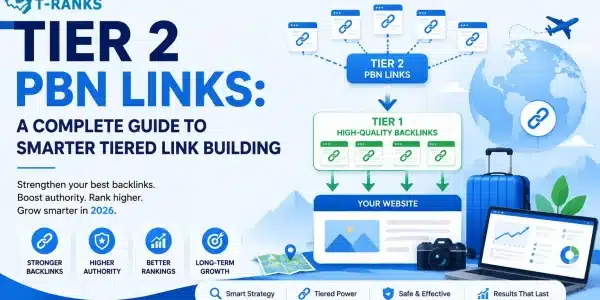
What if you could get more value from the backlinks you already have instead of constantly building new ones? That’s exactly why many SEO professionals use a tiered link-building strategy. Rather than focusing only on new backlinks, they also strengthen their best existing backlinks to improve their overall SEO performance.
Tier 2 PBN Links are part of this strategy. They help reinforce valuable Tier 1 backlinks, allowing those backlinks to contribute more effectively to your website’s authority and create a stronger, more balanced backlink profile.
Many website owners understand how to build backlinks but aren’t sure when a Tier 2 strategy is the right choice. Questions like which backlinks should receive Tier 2 support, how this approach differs from direct PBN links, and whether it’s still effective often create confusion.
In this guide, you’ll learn what Tier 2 PBN Links are, how they work, which backlinks they should support, how they compare with direct PBN links, the benefits they offer, the mistakes to avoid, how to choose a quality provider, and what factors influence pricing.
By the end of this guide, you’ll have a clear understanding of how Tier 2 PBN Links fit into a modern SEO strategy and how to decide whether they’re the right choice for your website.
What Are Tier 2 PBN Links?
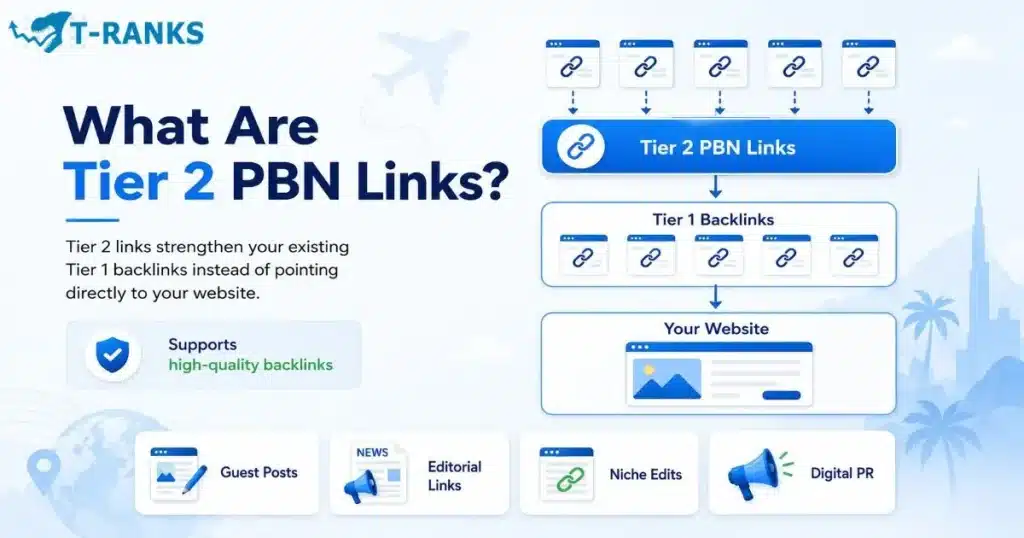
A Tier 2 PBN Link is a Private Blog Network backlink that points to one of your existing backlinks instead of directly to your website. Its purpose is to strengthen valuable Tier 1 backlinks as part of a tiered link-building strategy.
Unlike Tier 1 PBN links, which point directly to your money site, Tier 2 PBN Links support the backlinks that already link to your website. This extra layer is designed to reinforce existing authority rather than create another direct connection to the final destination.
Tier 2 PBN Links are commonly used to strengthen high-quality backlinks such as guest posts, editorial links, niche edits, digital PR placements, and resource page links. Instead of replacing these backlinks, they are used to add more support to the pages that already contribute to your SEO strategy.
Although the concept is straightforward, Tier 2 PBN Links are not intended for every backlink. They work best when they are used selectively as part of a well-planned link-building campaign rather than being added to every link you own.
Understanding what Tier 2 PBN Links are makes it much easier to understand how they fit into a tiered backlink strategy. The next step is learning how they work and how authority moves from one tier to another.
How Do Tier 2 PBN Links Work?
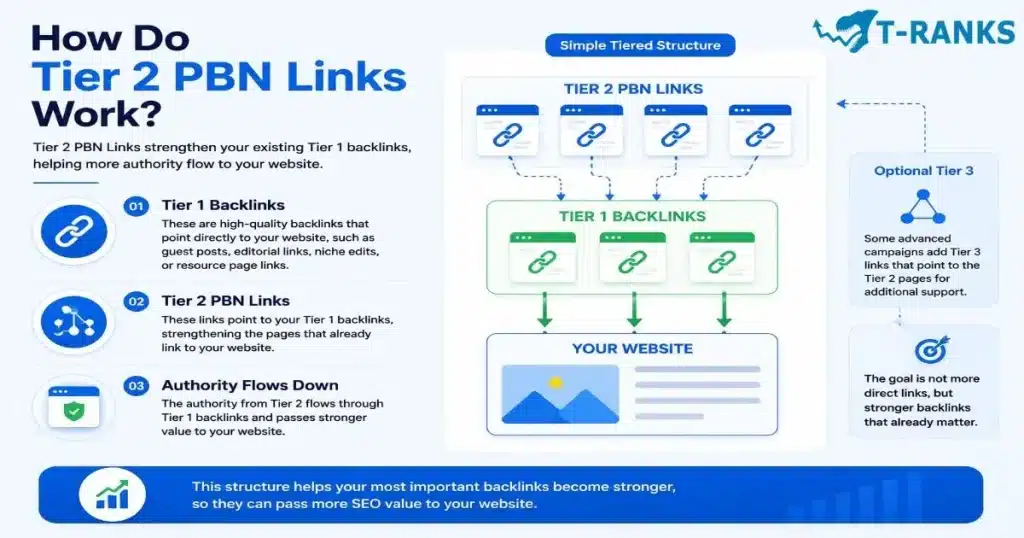
Tier 2 PBN Links work by strengthening your existing Tier 1 backlinks instead of linking directly to your website. As those Tier 1 backlinks gain more authority, they can pass stronger SEO value to the pages they already point to.
A tiered link-building strategy starts with Tier 1 backlinks. These are the backlinks that point directly to your website, such as guest posts, editorial links, niche edits, or resource page links. Because they have a direct connection to your website, they are usually the most valuable backlinks in the campaign.
Tier 2 PBN Links are then built to support those Tier 1 backlinks. Rather than creating another direct backlink to your website, they strengthen the pages that already link to it. This allows the authority gained by the Tier 2 links to flow through the Tier 1 backlinks before reaching your website.
A simple tiered structure looks like this:
Tier 2 PBN Links
↓
Tier 1 Backlinks
↓
Your Website
Some advanced SEO campaigns also add a third tier of backlinks that points to the Tier 2 pages. This creates another layer of support, but it isn’t necessary for every website. Many successful campaigns rely only on Tier 1 and Tier 2 PBN Links to build authority and strengthen valuable backlinks.
The purpose of this structure isn’t to build more direct backlinks. It’s to strengthen the backlinks that already matter, helping them contribute more effectively to your overall link-building strategy.
Now that you understand how Tier 2 PBN Links work, the next step is learning which Tier 1 backlinks are worth strengthening with Tier 2 support.
Which Backlinks Should Receive Tier 2 PBN Links?
Backlinks should receive Tier 2 PBN Links only if they are relevant, trustworthy, and already contribute to your SEO strategy. Instead of supporting every backlink in your profile, focus on the Tier 1 backlinks that already provide value and have the greatest potential to influence your search visibility.
The purpose of Tier 2 PBN Links is to reinforce your strongest backlinks, not increase the total number of links pointing to your website. Choosing the right Tier 1 backlinks is one of the most important decisions in a successful tiered link-building strategy.
Tier 1 Backlinks That Benefit Most from Tier 2 PBN Links
| Tier 1 Backlink Type | Recommended | Reason |
| Guest Posts | Yes | Contextual backlinks published on relevant websites that often become important authority links. |
| Editorial Backlinks | Yes | Trusted backlinks that are difficult to earn and worth strengthening. |
| Niche Edits | Yes | Existing authoritative pages can benefit from additional support. |
| Digital PR Links | Yes | Media backlinks from reputable publications can become stronger Tier 1 assets. |
| Resource Page Links | Yes | Relevant resource pages often provide lasting SEO value. |
| Low-Quality Directory Links | Usually No | These backlinks often provide limited value and rarely justify additional support. |
| Spammy or Irrelevant Backlinks | No | Strengthening poor-quality backlinks can reduce the effectiveness of your overall strategy. |
Guest Posts
Guest posts are one of the best candidates for Tier 2 PBN Links because they usually contain contextual backlinks published within relevant content. Supporting these backlinks can help reinforce pages that already play an important role in your SEO campaign.
Editorial Backlinks
Editorial backlinks are earned when another website naturally references your content. Because these backlinks are often difficult to acquire, they are good candidates for carefully planned Tier 2 support.
Niche Edits
Niche edits place backlinks into existing pages that already have authority, content, and search visibility. When those pages are relevant to your niche, they can become strong Tier 1 backlinks that benefit from additional support.
Digital PR Links
Digital PR campaigns often secure backlinks from established publications and industry websites. These backlinks can become valuable long-term assets, making them suitable candidates for Tier 2 PBN Links.
Resource Page Links
Resource pages recommend useful websites and references within a specific topic. If the page is relevant, well maintained, and trusted, strengthening that backlink with Tier 2 support can improve its contribution to your overall backlink profile.
Before building Tier 2 PBN Links, evaluate every Tier 1 backlink individually. Ask whether the backlink is relevant to your niche, comes from a trustworthy website, and already contributes to your SEO goals. Prioritizing your strongest backlinks will usually produce better long-term results than trying to strengthen every link equally.
Now that you know which backlinks should receive Tier 2 PBN Links, the next step is understanding when direct PBN links are the better choice and when a Tier 2 strategy is the smarter option.
Direct PBN Links vs. Tier 2 PBN Links
Direct PBN Links and Tier 2 PBN Links serve different purposes within a link-building strategy. Direct PBN Links point to your website to build authority directly, while Tier 2 PBN Links point to your existing backlinks to strengthen the authority they already pass to your website.
Neither strategy is automatically better than the other. The right choice depends on your backlink profile, SEO goals, and the stage of your campaign. In many cases, experienced SEO professionals use both approaches together rather than treating them as competing strategies.
Direct PBN Links vs. Tier 2 PBN Links
| Feature | Direct PBN Links | Tier 2 PBN Links |
| Link Target | Point directly to your website | Point to your existing Tier 1 backlinks |
| Primary Purpose | Build authority for your website | Strengthen valuable Tier 1 backlinks |
| Best Used When | Building new authority or supporting important pages | Reinforcing strong backlinks that already exist |
| Focus | Direct authority building | Authority amplification through Tier 1 backlinks |
| Typical Strategy | Create new direct backlinks | Support existing high-quality backlinks |
Direct PBN Links are often used when a website needs additional authority for important landing pages or content. Since these links point directly to your website, they become part of your primary backlink profile and should be planned carefully.
Tier 2 PBN Links are used when you already have valuable Tier 1 backlinks that deserve additional support. Instead of creating another direct backlink, they help reinforce the authority of backlinks that are already contributing to your SEO performance.
Many successful SEO campaigns combine both approaches. Direct PBN Links help establish authority for important pages, while Tier 2 PBN Links strengthen the backlinks that support those pages. Together, they create a more structured and balanced tiered link-building strategy.
Choosing between these strategies isn’t about finding a single winner. It’s about understanding your existing backlink profile and selecting the approach that best supports your long-term SEO objectives.
Now that you understand the difference between Direct PBN Links and Tier 2 PBN Links, the next step is exploring the specific benefits that Tier 2 PBN Links can bring to a long-term SEO strategy.
What Are the Benefits of Tier 2 PBN Links?
Tier 2 PBN Links help you get more value from the high-quality backlinks you already own. Instead of focusing only on building new direct backlinks, they strengthen existing Tier 1 backlinks so those links can continue supporting your long-term SEO strategy.
The biggest advantage of Tier 2 PBN Links is that they build on your existing link-building efforts. Rather than replacing valuable backlinks, they reinforce the pages that already contribute to your website’s authority and search visibility.
Benefits of Using Tier 2 PBN Links
| Benefit | How It Helps |
| Strengthens Tier 1 Backlinks | Reinforces the backlinks that already support your website. |
| Gets More Value from Existing Backlinks | Helps maximize the impact of backlinks you’ve already earned or built. |
| Supports a Stronger Backlink Profile | Focuses on improving the quality and balance of your backlink profile. |
| Contributes to Long-Term SEO Growth | Strengthens important backlink assets that continue supporting future rankings. |
Strengthening Valuable Tier 1 Backlinks
One of the biggest advantages of Tier 2 PBN Links is their ability to support high-quality Tier 1 backlinks. Instead of constantly building new direct backlinks, you can improve the value of the backlinks that already play an important role in your SEO strategy.
Supporting a Stronger Backlink Profile
A successful backlink profile is built on quality, relevance, and consistency. By strengthening valuable Tier 1 backlinks, Tier 2 PBN Links help create a more balanced backlink profile that supports sustainable SEO growth over time.
Contributing to Long-Term SEO Growth
Tier 2 PBN Links are not just about improving short-term rankings. They strengthen backlink assets that can continue supporting your website as your SEO campaign grows. This makes them a useful addition to a long-term authority-building strategy when applied thoughtfully.
The greatest benefit of Tier 2 PBN Links comes from using them strategically rather than applying them to every backlink. Focusing on your strongest Tier 1 backlinks allows you to build on work you’ve already completed while creating a stronger foundation for future SEO growth.
Now that you understand the benefits of Tier 2 PBN Links, the next step is learning how to use anchor text naturally so your Tier 2 link-building strategy remains balanced and effective.
Anchor Text Best Practices for Tier 2 PBN Links

Anchor text for Tier 2 PBN Links should look natural and support your overall backlink profile. Instead of repeating the same keyword, use a variety of anchor types that match the context of the page and the purpose of the backlink.
A natural anchor profile helps your Tier 2 links blend with the rest of your link-building strategy. The goal is to support valuable Tier 1 backlinks without creating repetitive or overly optimized linking patterns.
Common Anchor Types for Tier 2 PBN Links
| Anchor Type | Example | Best Used For |
| Branded | T-RANKS | Brand mentions and natural references |
| Partial Match | Tiered link building guide | Supporting relevant keywords naturally |
| Generic | Learn more, Read this guide | Creating a varied backlink profile |
| Naked URL | https://t-ranks.com/ | Natural citations and references |
| Contextual | This SEO resource | Editorial-style links within relevant content |
Building a Natural Anchor Text Profile
A healthy anchor text profile includes a mix of branded, partial-match, generic, naked URL, and contextual anchors. Using different anchor types makes your backlink profile look more natural and reduces unnecessary repetition across multiple backlinks.
When choosing anchor text, focus on relevance instead of forcing keywords into every link. The anchor should fit naturally within the surrounding content and accurately describe the page it points to.
Anchor Text Mistakes to Avoid
One of the most common mistakes is using the same keyword repeatedly across multiple Tier 2 backlinks. Repetitive anchor text can make a backlink profile look unnatural and reduce the overall quality of a tiered link-building strategy.
Another mistake is using anchor text that has little connection to the content or the destination page. Every anchor should provide clear context for readers while supporting the relevance of the backlink.
There is no single anchor text formula that works for every website. The best approach is to maintain variety, keep anchors relevant to the content, and build a backlink profile that grows naturally over time.
Now that you understand how to use anchor text for Tier 2 PBN Links, the next step is learning which common mistakes can reduce the effectiveness of a Tier 2 link-building strategy and how to avoid them.
Common Mistakes to Avoid with Tier 2 PBN Links
Most problems with Tier 2 PBN Links come from poor planning rather than the links themselves. Supporting the wrong backlinks, ignoring relevance, or relying too heavily on automation can reduce the effectiveness of your tiered link-building strategy.
A successful Tier 2 campaign focuses on quality instead of quantity. Avoiding a few common mistakes helps you get better value from your Tier 1 backlinks while maintaining a stronger and more natural backlink profile.
Common Mistakes and Better Approaches
| Common Mistake | Better Approach |
| Supporting weak or low-quality backlinks | Strengthen Tier 1 backlinks that already provide value to your SEO strategy. |
| Ignoring topical relevance | Build Tier 2 links from websites and content that are closely related to your niche. |
| Building too many Tier 2 links too quickly | Grow your backlink profile gradually instead of creating large spikes in link activity. |
| Using repetitive anchor text | Use a natural mix of branded, partial-match, generic, and contextual anchors. |
| Relying entirely on automation | Review every campaign manually to maintain quality, relevance, and consistency. |
Not every mistake has the same impact on your SEO results. Supporting weak Tier 1 backlinks or building links without considering relevance can limit the value of your entire tiered link-building strategy. Taking time to evaluate each backlink before adding Tier 2 support usually produces better long-term results.
How to Identify a High-Quality Tier 2 PBN Service
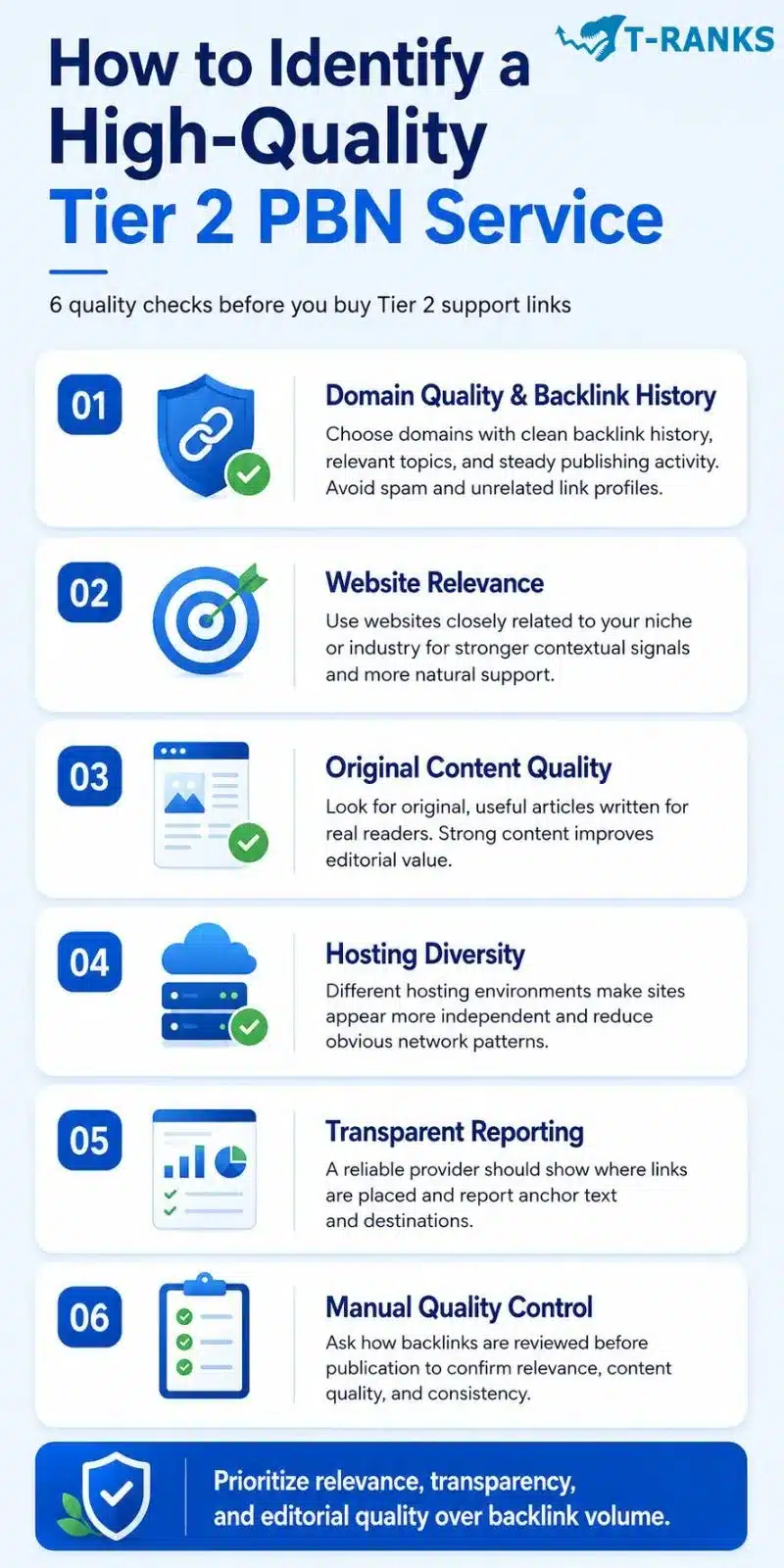
A high-quality Tier 2 PBN service is built on relevant websites, quality content, careful domain selection, and transparent link-building practices. Reviewing these factors before you buy helps you choose a provider that supports long-term SEO growth instead of simply selling large numbers of backlinks.
Before choosing a Tier 2 PBN service, review the following quality checks:
- Domain quality and backlink history
- Website relevance
- Original content quality
- Hosting diversity
- Transparent reporting
- Manual quality control
Domain Quality and Backlink History
Start by reviewing the domains included in the service. Look for websites with a clean backlink history, relevant topics, and consistent publishing activity. Domains with spam, frequent ownership changes, or unrelated backlink profiles are less likely to provide long-term SEO value.
A strong domain creates a stronger foundation for every Tier 2 backlink. When the domain has trust, relevance, and a natural history, it becomes a better platform for supporting your Tier 1 backlinks.
Website Relevance
Check whether the websites are closely related to your niche or industry. Relevant websites create stronger contextual signals and help Tier 2 backlinks support your Tier 1 backlinks more naturally.
Websites that publish unrelated topics across multiple niches often provide less topical value than websites with a clear editorial focus.
Original Content Quality
Read several articles published on the websites. The content should be original, informative, and written for real readers instead of being created only to place backlinks.
High-quality content helps supporting backlinks blend naturally into the website and improves the overall editorial value of the placement.
Hosting Diversity
Review how the websites are hosted. Different hosting environments help each website appear independent and reduce obvious network patterns.
Hosting diversity is one of several technical signals that contribute to a more natural-looking Private Blog Network.
Transparent Reporting
A reliable provider should clearly explain where your backlinks are placed and provide a report after the campaign is completed. This allows you to verify the placement, anchor text, and destination of every Tier 2 backlink.
Transparent reporting also makes it easier to monitor your backlink profile and evaluate campaign performance over time.
Manual Quality Control
Finally, ask how every backlink is reviewed before publication. Manual quality checks help confirm that each placement meets the required standards for relevance, content quality, and consistency.
Providers that invest in quality control are generally more focused on sustainable SEO than simply delivering larger numbers of backlinks.
Choosing a Tier 2 PBN service is about evaluating the quality of the entire process rather than comparing backlink counts alone. Providers that prioritize relevance, transparency, and editorial quality are more likely to support long-term SEO success.
Now that you know how to identify a high-quality Tier 2 PBN service, the next step is understanding what factors influence the cost of Tier 2 PBN Links and why pricing varies between providers.
How Much Do Tier 2 PBN Links Cost?
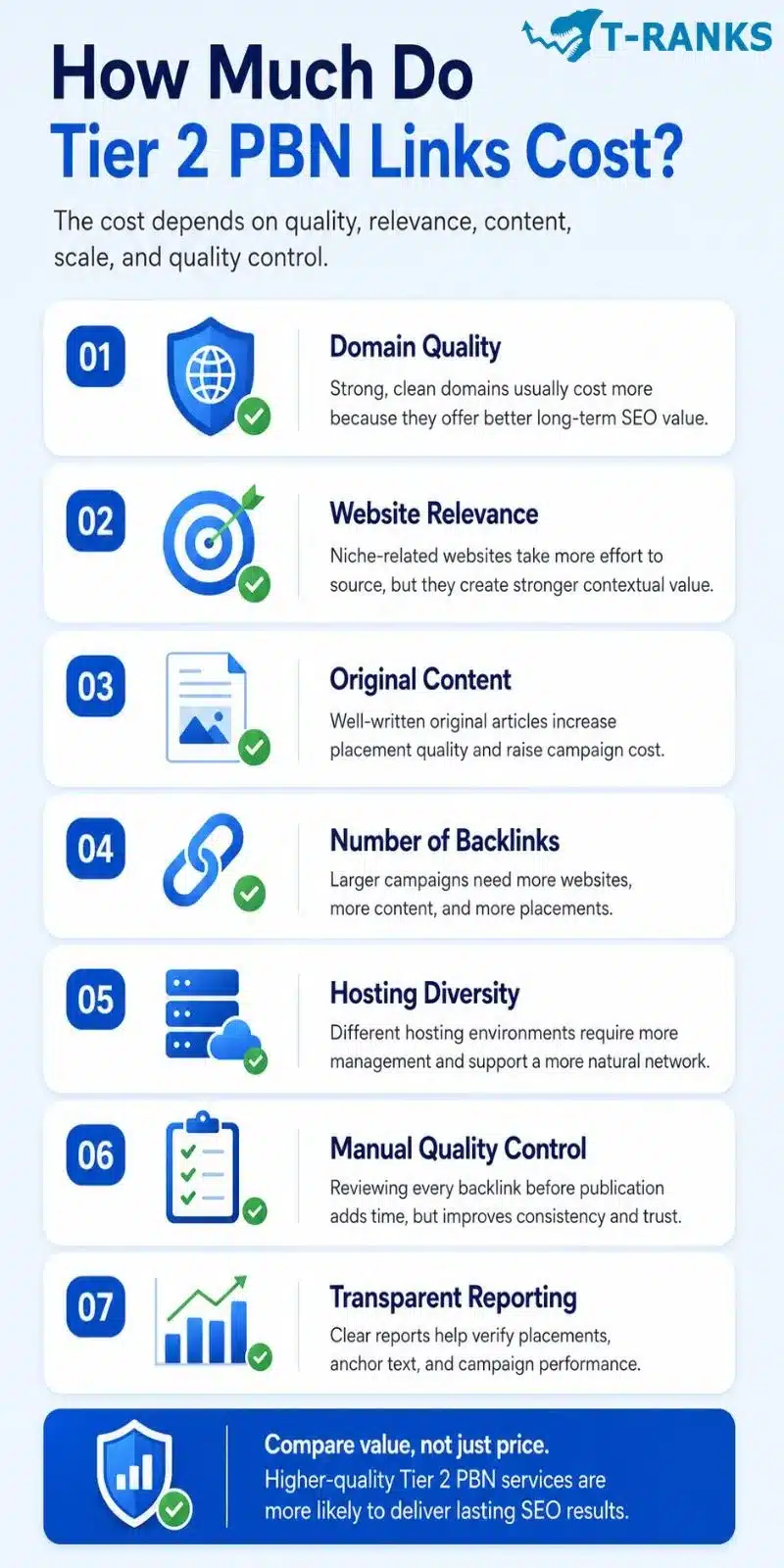
The cost of Tier 2 PBN Links depends on the quality of the websites, the content created, the number of backlinks, and the level of quality control included in the campaign. Before comparing providers, it’s important to understand what you’re paying for because these factors have a direct impact on the overall value of the service.
Every Tier 2 PBN service is priced differently. Some providers focus on building larger numbers of backlinks, while others invest more in domain quality, original content, relevant websites, and manual quality checks. Understanding these differences helps you compare services based on value rather than price alone.
The following factors have the greatest influence on the cost of Tier 2 PBN Links:
- Domain quality
- Website relevance
- Original content
- Number of backlinks
- Hosting diversity
- Manual quality control
- Transparent reporting
Domain Quality
Start by reviewing the quality of the domains included in the service. Websites with stronger backlink profiles, clean histories, and relevant topics usually require more investment to acquire and maintain, making them one of the biggest factors affecting the overall cost.
Higher-quality domains often provide stronger long-term SEO value than low-cost networks built around weaker or less relevant websites.
Website Relevance
Relevant websites usually require more effort to source than general-purpose websites. A provider that builds Tier 2 PBN Links on niche-related websites is often investing more time in finding placements that strengthen topical relevance.
Greater relevance improves the quality of the supporting backlinks and contributes to a more natural link-building strategy.
Original Content
Content quality is another major pricing factor. Original, well-written articles require more time and resources than reused or low-quality content, but they also create stronger editorial placements for Tier 2 backlinks.
Supporting backlinks published within useful content are generally more valuable than backlinks placed on thin or poorly written pages.
Number of Backlinks
The size of the campaign also influences the overall cost. Larger campaigns require more websites, more content, and additional link placements, increasing the time and resources needed to complete the work.
The number of backlinks should always be considered alongside their quality rather than as the only measure of value.
Hosting Diversity
Maintaining websites across different hosting environments requires additional management and infrastructure. Providers that invest in hosting diversity often incur higher operating costs while creating a more natural network structure.
Hosting quality supports the long-term stability of the backlink network rather than simply increasing the number of websites.
Manual Quality Control and Reporting
Quality assurance also affects pricing. Reviewing every backlink before publication and providing transparent reports takes additional time, but it gives buyers confidence that the campaign follows consistent quality standards.
Clear reporting makes it easier to verify backlink placements and monitor the performance of your Tier 2 campaign over time.
The cost of Tier 2 PBN Links should always be evaluated alongside the quality of the service you receive. Choosing a provider based only on the lowest price can lead to weaker domains, lower-quality content, and less effective supporting backlinks. A service built around relevance, transparency, and editorial quality is more likely to provide lasting SEO value than one focused only on delivering more links.
Are Tier 2 PBN Links Right for Your SEO Strategy?
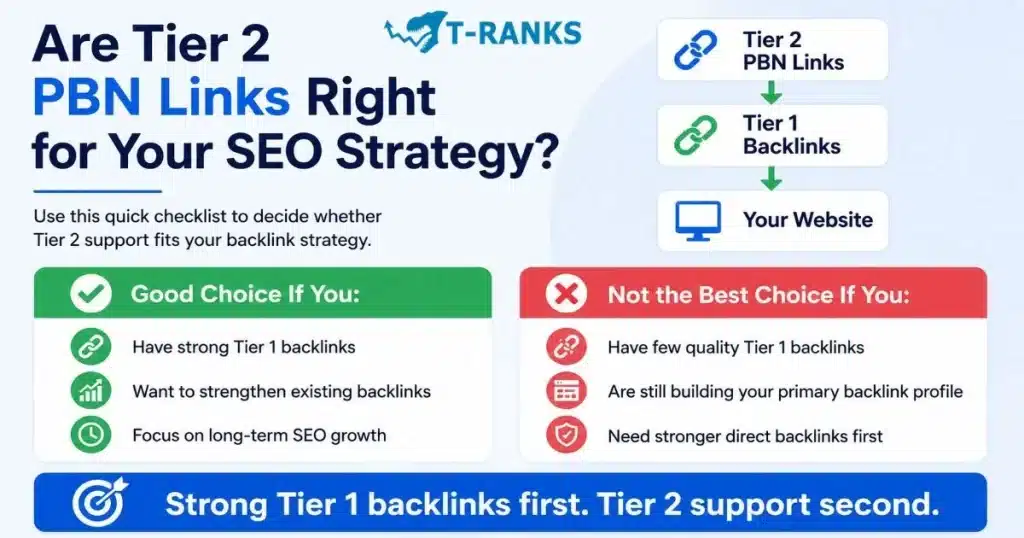
Tier 2 PBN Links are the right choice for websites that already have valuable Tier 1 backlinks worth strengthening. They work best as part of a long-term SEO strategy that builds on existing authority instead of relying only on new direct backlinks.
Whether this strategy is the right fit depends on the strength of your existing backlink profile, your SEO objectives, and the quality of the Tier 1 backlinks you already own. Reviewing these factors helps you decide whether adding a second layer of backlinks will provide meaningful value for your website.
Before adding Tier 2 PBN Links to your SEO strategy, review the following checklist:
Tier 2 PBN Links Are a Good Choice If You:
- Already have high-quality Tier 1 backlinks.
- Want to strengthen existing backlinks instead of relying only on new direct backlinks.
- Focus on long-term SEO growth rather than short-term ranking improvements.
- Prioritize backlink quality over backlink quantity.
- Follow a structured tiered link-building strategy.
Tier 2 PBN Links May Not Be the Best Choice If You:
- Have very few high-quality Tier 1 backlinks.
- Are still building your primary backlink profile.
- Need stronger direct backlinks before adding supporting links.
- Plan to strengthen weak or irrelevant backlinks.
- Choose link-building services based mainly on low cost instead of quality.
Choosing the right strategy is more important than simply building more backlinks. If your website already has strong Tier 1 backlinks, a carefully planned Tier 2 strategy can help you get more value from those existing assets. If your backlink profile is still developing, focusing on high-quality Tier 1 backlinks first is usually the better long-term investment.
Why Choose T-RANKS for Tier 2 PBN Links?
Choosing a Tier 2 PBN provider is about more than buying backlinks. It’s about working with a team that follows proven SEO practices, prioritizes quality, and builds supporting backlinks that contribute to long-term organic growth. At T-RANKS, we apply the same standards and best practices explained throughout this guide to every Tier 2 campaign we deliver.
Every campaign is planned around relevance, transparency, and editorial quality rather than backlink volume alone. Instead of taking shortcuts, we focus on building supporting backlinks that strengthen valuable Tier 1 assets while maintaining a natural and sustainable link-building strategy.
What You Can Expect from T-RANKS
- Relevant, niche-focused websites selected to support your Tier 1 backlinks.
- Original, editorial-quality content written for every backlink placement.
- Manual quality control before every campaign goes live.
- Transparent reporting that shows where your backlinks are placed.
- Natural link placement designed to strengthen existing authority.
- Long-term SEO strategies focused on sustainable organic growth instead of short-term gains.
Our goal is not simply to build more backlinks. We focus on building the right supporting backlinks through relevant websites, quality content, and transparent processes that align with long-term SEO best practices. This approach helps clients strengthen existing authority while maintaining a natural and trustworthy backlink profile.
FAQs About Tier 2 PBN Links
What are Tier 2 PBN Links?
Tier 2 PBN Links are Private Blog Network backlinks that point to your Tier 1 backlinks instead of directly to your website. They strengthen existing Tier 1 backlinks so they can pass more authority to your website within a tiered link-building strategy.
Do Tier 2 PBN Links improve SEO?
Yes, Tier 2 PBN Links can improve SEO when they strengthen relevant, high-quality Tier 1 backlinks. Their effectiveness depends on backlink quality, topical relevance, and natural placement rather than link quantity.
Which backlinks should receive Tier 2 PBN Links?
Tier 2 PBN Links should support your strongest Tier 1 backlinks. Guest posts, editorial backlinks, niche edits, Digital PR links, and authoritative resource pages are typically the best candidates.
Should Tier 2 PBN Links point directly to my website?
No, Tier 2 PBN Links are designed to point to Tier 1 backlinks, not directly to your website. Their role is to strengthen existing backlinks within a structured tiered link-building strategy.
Are Tier 2 PBN Links safe?
Tier 2 PBN Links can be used responsibly, but no link-building method is completely risk-free. Using relevant websites, original content, natural anchor text, and careful quality control helps reduce unnecessary risk.
What anchor text should Tier 2 PBN Links use?
Tier 2 PBN Links should use a natural mix of branded, partial-match, generic, contextual, and naked URL anchors. A diverse anchor profile supports a more natural backlink strategy than repeatedly using keyword-rich anchors.
How many Tier 2 PBN Links should I build?
There is no fixed number of Tier 2 PBN Links that works for every website. The ideal quantity depends on the strength of your Tier 1 backlinks, your backlink profile, and your overall SEO strategy.
How do I choose a Tier 2 PBN service?
Choose a Tier 2 PBN service by evaluating domain quality, website relevance, original content, transparency, and manual quality control. A reliable provider should clearly explain its process and provide reporting for completed campaigns.
Can Tier 2 PBN Links replace direct link building?
No, Tier 2 PBN Links are designed to support direct backlinks, not replace them. A balanced SEO strategy combines strong Tier 1 backlinks with carefully planned Tier 2 support where appropriate.
Are Tier 2 PBN Links worth using?
Yes, Tier 2 PBN Links can be worthwhile if your website already has valuable Tier 1 backlinks. They provide the greatest value when used strategically to strengthen existing authority as part of a long-term SEO strategy.