A website can have well-written content but still raise questions if visitors cannot identify who runs it, who writes its articles, or how to make contact. Author bios, About pages, Contact information, and Privacy Policies help answer these questions. Together, these PBN site trust pages create a clearer picture of the website’s identity and credibility.
However, simply adding these pages does not make a private blog network (PBN) trustworthy. Generic About pages, fabricated author profiles, inactive contact forms, and inaccurate privacy information can weaken credibility rather than improve it.
Trust pages can also reveal connections between websites. Repeated author identities, profile images, contact details, and distinctive page content may create recognizable PBN footprints. Still, common website layouts or standard policy wording alone do not establish a network connection.
This guide explores how PBN site trust pages support transparency, what Google says about authorship and trust, how identity patterns create SEO risks, and how to audit these pages for accuracy and consistency.
What Are PBN Site Trust Pages, and Why Do They Matter?

PBN site trust pages are supporting pages that explain a website’s identity, purpose, authorship, contact information, and relevant policies. They help visitors understand who operates the site, what information it provides, and how the publisher can be contacted.
These pages form the public identity of a private blog network (PBN) website. Their importance comes from providing useful information about the publication rather than simply making the website appear established.
Common Trust Pages and Their Functions
Different trust pages serve different purposes, but together they help visitors understand how a website operates.
- About Page: Explains the website’s purpose, main topics, publishing background, and responsible organization or individual where relevant.
- Contact Page: Provides a working method for visitors to contact the website owner, publisher, or editorial team.
- Author Bios: Identify content contributors and describe their relevant experience, expertise, or areas of knowledge.
- Privacy Policy: Explains how the website collects, uses, and handles personal information where applicable.
- Terms and Disclaimers: Clarify website usage conditions, content limitations, and relevant legal or commercial information.
Not every PBN site requires the same combination of pages. For example, a small informational blog may provide an About page and contact email, while a publication that collects visitor information or displays advertising may need additional privacy disclosures.
The appropriate pages depend on the website’s actual content, functionality, and responsibilities.
Why Trust Pages Matter for Website Credibility
Trust pages matter because they help visitors evaluate the identity, transparency, and accountability of a website. When the information is accurate and consistent, readers can better understand the publication and the people responsible for its content.
For example, an About page can explain why a website publishes home improvement guides, while an author profile can identify the contributor responsible for technical articles. A working Contact page gives visitors a way to ask questions, report errors, or request clarification.
Trust pages also help connect information across the website. The publisher named on the About page should align with relevant Contact and Privacy Policy details. Similarly, author information should accurately reflect the contributors associated with published articles.
A website does not become credible simply by adding these pages. Generic descriptions, false credentials, outdated contact information, or policies that do not reflect actual practices can leave visitors with unanswered questions.
For PBN site trust pages, the essential requirement is that each page serves a clear purpose and provides accurate information about the individual website.
How Author Bios Influence PBN Site Credibility
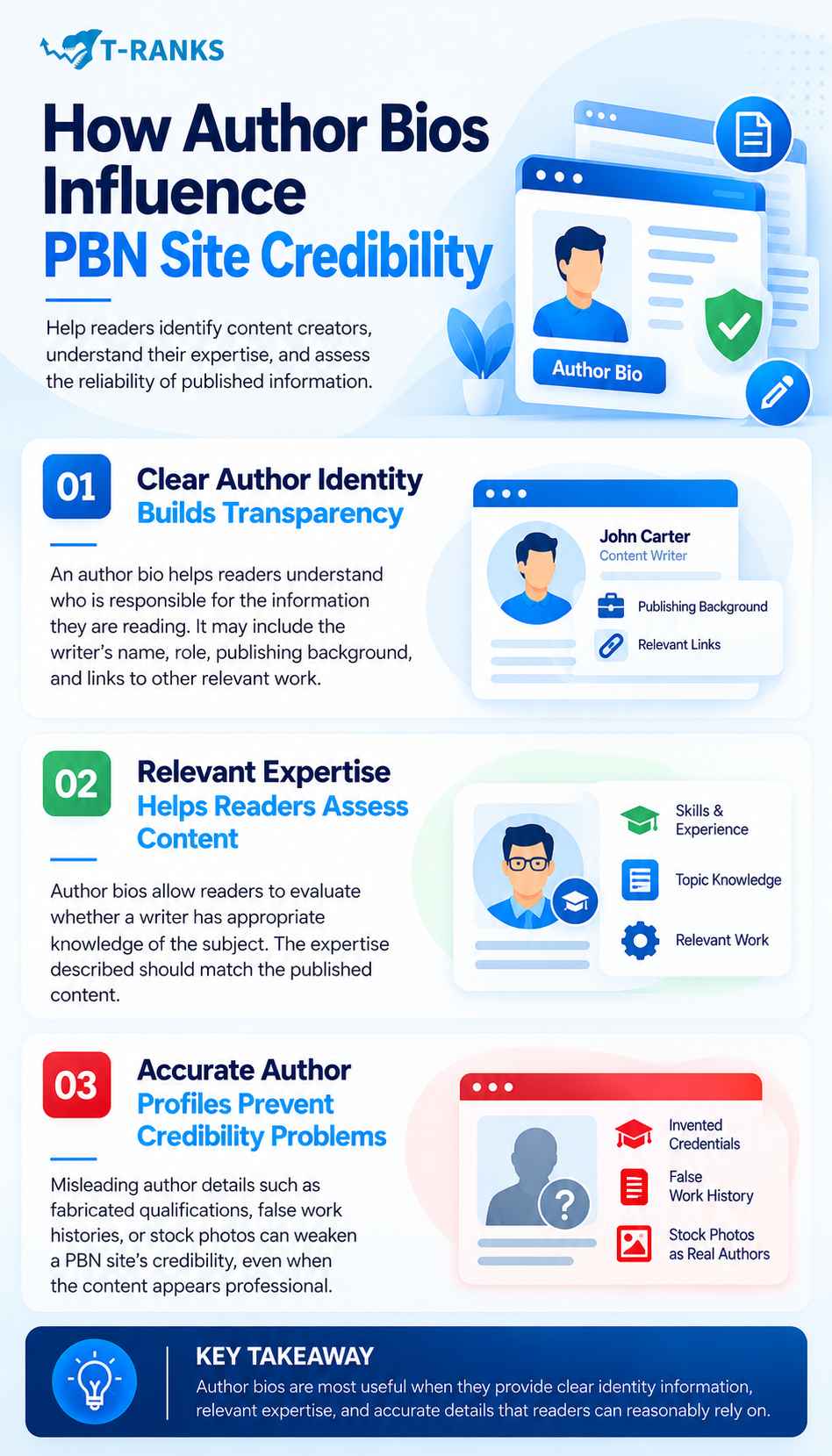
Author bios influence PBN site credibility by helping readers identify content creators, understand their expertise, and assess the reliability of published information. A clear author profile provides useful background about the person responsible for an article.
However, the presence of an author bio alone does not establish credibility. Its value depends on whether the information is relevant, accurate, and consistent with the content being published.
Clear Author Identity Builds Transparency
An author bio helps readers understand who is responsible for the information they are reading. It may include the writer’s name, role, publishing background, and links to other relevant work.
For example, an educational website that identifies its article contributors provides more transparency than one that publishes anonymous content without explaining its editorial responsibility.
The purpose is to establish clear authorship rather than simply display a name beneath an article.
Relevant Expertise Helps Readers Assess Content
Author bios can help readers evaluate whether a writer has appropriate knowledge of the subject.
For example, a technology writer with software development experience may provide useful background for programming articles. Similarly, an experienced gardener may have relevant practical knowledge for plant care guides.
The expertise described should match the published content. Generic claims such as “leading industry expert” provide little value without supporting information.
Accurate Author Profiles Prevent Credibility Problems
Misleading author details can weaken a PBN site’s credibility, even when its content appears professional.
For example, fabricated qualifications, false employment histories, or stock photographs presented as real authors can misrepresent who created the content.
Using a genuine pen name is not inherently misleading, but the identity should not be supported by invented credentials.
For PBN site trust pages, author bios are most useful when they provide clear identity information, relevant expertise, and accurate details that readers can reasonably rely on.
What Makes an About Page Trustworthy on a PBN Site?
A trustworthy PBN About page clearly explains the website’s purpose, publishing background, and the people or organization responsible for its content. It helps visitors understand what the website represents and whether its stated identity matches the information published elsewhere.
An About page becomes useful when it provides accurate details about the individual website. Generic descriptions, exaggerated claims, or invented business information may create an appearance of credibility without providing genuine transparency.
Clear Site Purpose and Editorial Identity
An About page should explain what the website covers, who its intended audience is, and who manages its content where relevant.
For example, a home improvement blog may describe its focus on property maintenance, repairs, and renovation advice. A technology publication may explain that it covers software guides, product comparisons, and industry developments.
The description should reflect the website’s actual content. If a site claims to specialize in technology but regularly publishes unrelated material, visitors may question its stated editorial identity.
Accurate Information Builds Credibility
A trustworthy About page should contain information that readers can reasonably verify or understand from the rest of the website.
For example, a publication may identify its editorial team, explain its publishing approach, or provide background about its contributors. These details can help visitors assess the website’s accountability.
However, fabricated company histories, invented team members, unsupported awards, or misleading professional claims can weaken credibility. Simply copying an About page from another website and changing the domain name also provides little meaningful information.
For PBN site trust pages, a credible About page should accurately represent the individual website rather than rely on generic statements or manufactured authority.
Do Contact Pages and Working Forms Improve Transparency?

Contact pages and working forms improve PBN site transparency by giving visitors a reliable way to communicate with the website’s publisher or editorial team. They allow readers to ask questions, report content errors, or request information about the website.
However, a Contact page provides little value if its information is inaccurate or its communication methods do not work. The contact options should reflect how the individual website actually operates.
Appropriate Contact Information Supports Transparency
A Contact page should provide communication methods that match the website’s purpose and publishing model.
For example, a small informational blog may only need an active email address or contact form. A business website may also provide a phone number, physical address, and operating hours when those details genuinely apply.
Including unnecessary business information does not increase credibility. False addresses, unrelated phone numbers, or invented company details can mislead visitors about the website’s identity.
Working Contact Forms Improve Accessibility
A functional contact form gives visitors a practical way to communicate without requiring them to use external platforms.
For example, readers may use a form to report incorrect information, request corrections, or contact the publisher about an article. The form should submit messages successfully and direct inquiries to an active communication channel.
Forms that fail to deliver messages or lead to abandoned inboxes do not provide meaningful accessibility. They may also create uncertainty about whether anyone maintains the website.
For PBN site trust pages, effective Contact pages depend on accurate information and reliable communication methods rather than the number of contact options displayed.
Privacy Policies, Terms, and Disclosures on PBN Websites
Privacy Policies, Terms, and disclosures help PBN websites explain how they handle visitor information, define website usage conditions, and communicate relevant legal or commercial relationships. These pages support transparency when their information accurately reflects the website’s actual operations.
However, simply publishing legal pages does not establish credibility. Their usefulness depends on whether the information is relevant, accurate, and consistent with the services and features available on the website.
When Privacy and Legal Pages Are Relevant
The need for Privacy Policies, Terms, and disclosures depends on the website’s activities, data practices, and applicable requirements.
For example, a PBN site that collects names and email addresses through a contact form may need to explain how that information is used. A website using analytics, advertising cookies, or third party services may require additional privacy disclosures.
Terms of Use can explain website usage rules, while disclaimers and commercial disclosures may be relevant when a site publishes affiliate recommendations, sponsored content, or specialized advice.
Not every website needs the same legal pages. Each document should serve a purpose that matches how the individual site operates.
Accurate Policies Support Website Credibility
A Privacy Policy or Terms page is more useful when it describes the website’s real practices rather than relying on generic statements.
For example, a website using contact forms and analytics should explain the relevant data practices instead of publishing a policy that discusses unrelated services. Similarly, a site displaying affiliate links should provide appropriate commercial disclosures where required.
Copied policies may contain outdated contact information, incorrect domain names, or references to features the website does not offer. These errors can confuse visitors and weaken transparency.
Standard legal wording is not inherently problematic. The important consideration is whether the final document accurately represents the individual website.
For PBN site trust pages, relevant and accurate policies provide more meaningful transparency than lengthy documents copied simply to make a website appear established.
Can PBN Trust Pages Improve Google Rankings?
PBN site trust pages do not directly guarantee higher Google rankings, but accurate authorship and website information can support transparency and content credibility. Google evaluates content using multiple signals rather than rewarding websites simply for having About, Contact, or Privacy pages.
These pages can help readers understand a website’s identity, but their presence does not establish that its content or backlinks deserve higher rankings.
What Google’s E-E-A-T Guidance Actually Says
Google’s Experience, Expertise, Authoritativeness, and Trustworthiness (E-E-A-T) framework helps explain the qualities associated with reliable content. However, Google states that E-E-A-T itself is not a specific ranking factor.
Google’s guidance encourages clear authorship information when readers would reasonably expect it. For example, an article about financial planning may benefit from identifying the contributor’s relevant background, while an educational publication may explain who creates or reviews its content.
Author bios and About pages can provide this context, but adding them does not automatically improve search rankings. The quality, accuracy, and usefulness of the main content remain essential.
Why Trust Pages Cannot Eliminate PBN Link Risks
Professional trust pages do not protect a PBN website from Google’s link spam policies.
Google considers links created primarily to manipulate search rankings a form of link spam. A website may have detailed author profiles, a legitimate Contact page, and accurate policies while still participating in manipulative linking practices.
For example, adding an About page to a network website does not make paid links that pass ranking credit compliant with Google’s guidelines. Similarly, creating author biographies cannot compensate for low value content published mainly to influence backlink signals.
Google may ignore unnatural links or apply manual actions when its policies are violated.
The SEO value of PBN site trust pages should not be confused with ranking guarantees. These pages can provide useful transparency, but they cannot replace quality content or eliminate risks associated with manipulative backlinks.
How Trust Pages Can Reveal PBN Network Footprints
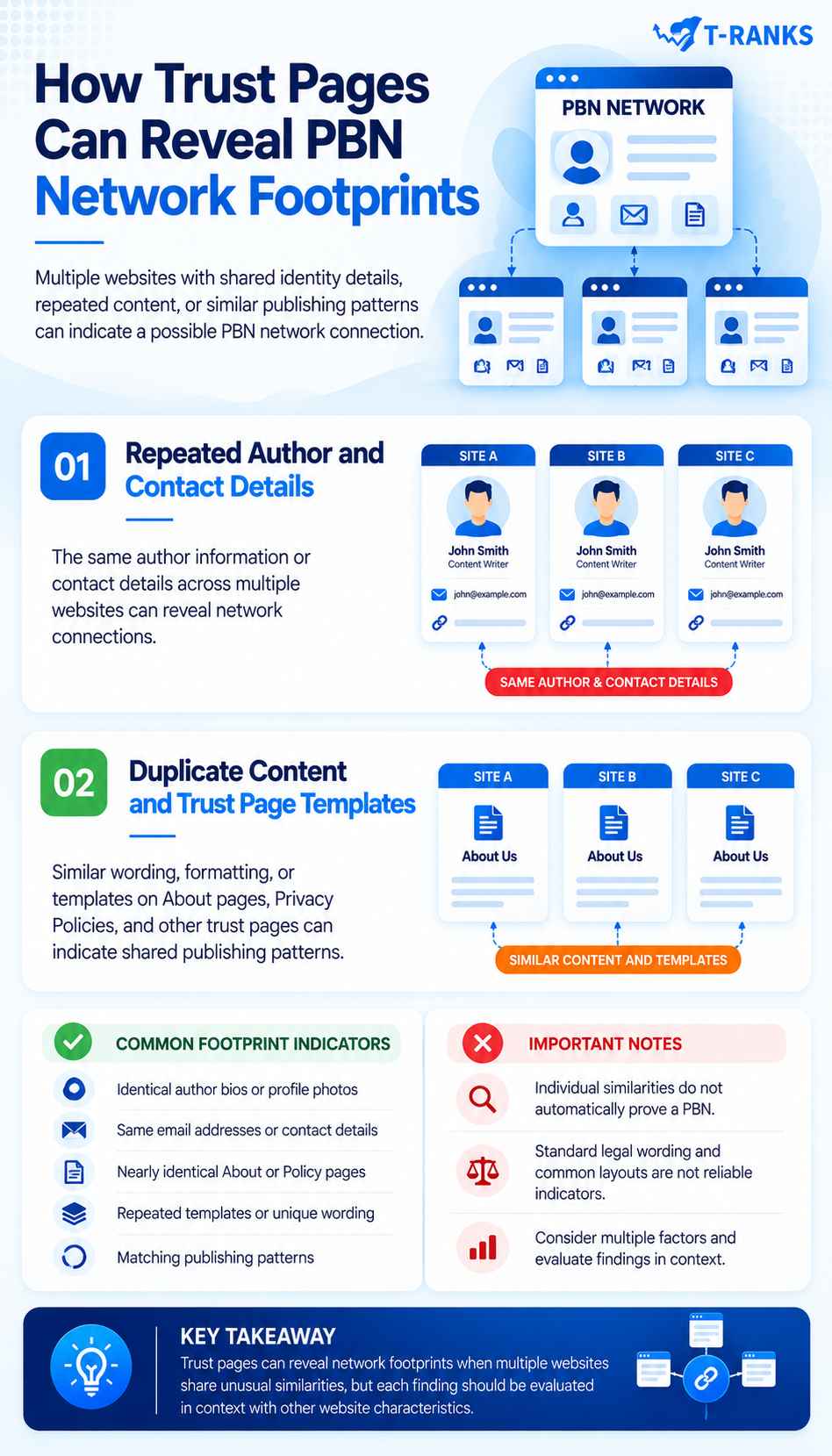
PBN site trust pages can reveal network footprints when multiple websites share distinctive identity details, repeated content, or similar publishing patterns. These connections may indicate common ownership or management, especially when several unusual similarities appear across the same group of domains.
However, individual similarities do not automatically establish a PBN connection. Shared information becomes more meaningful when multiple identifying details consistently overlap.
Repeated Author and Contact Details
Author bios and Contact pages can reveal possible network connections when the same identifying information appears across multiple websites.
For example, several unrelated blogs may use identical author biographies, display the same profile photograph under different names, or list the same contact email address.
A genuine author may contribute to multiple publications, and businesses may operate several websites. Therefore, repeated identity details should be evaluated alongside other website characteristics rather than treated as conclusive evidence.
Duplicate Content and Trust Page Templates
About pages, Privacy Policies, and other supporting pages can reveal shared publishing patterns through repeated wording, formatting, or site specific details.
For example, multiple websites may publish nearly identical About pages with only their domain names changed. Their Privacy Policies might also contain matching contact information, outdated references, or identical placeholder text.
Standard legal terminology and common page layouts are not reliable network indicators by themselves. Unusual wording, repeated errors, and matching identity information provide more useful evidence of a shared publishing process.
Combined Identity Signals Across Multiple Sites
Network footprints become more meaningful when several distinctive trust page characteristics repeatedly appear together.
For example, three websites sharing the same author photograph may have a legitimate connection. However, if those websites also contain matching biographies, identical contact details, and unusually similar About page descriptions, the combined pattern provides stronger evidence of common management.
Even when shared ownership is established, it does not automatically mean the websites participate in manipulative link building. Their linking relationships and publishing practices must also be considered.
The main concern with PBN site trust pages is not ordinary similarity but the repeated combination of distinctive details that can connect multiple websites.
How to Audit PBN Site Trust Pages for Credibility and Consistency
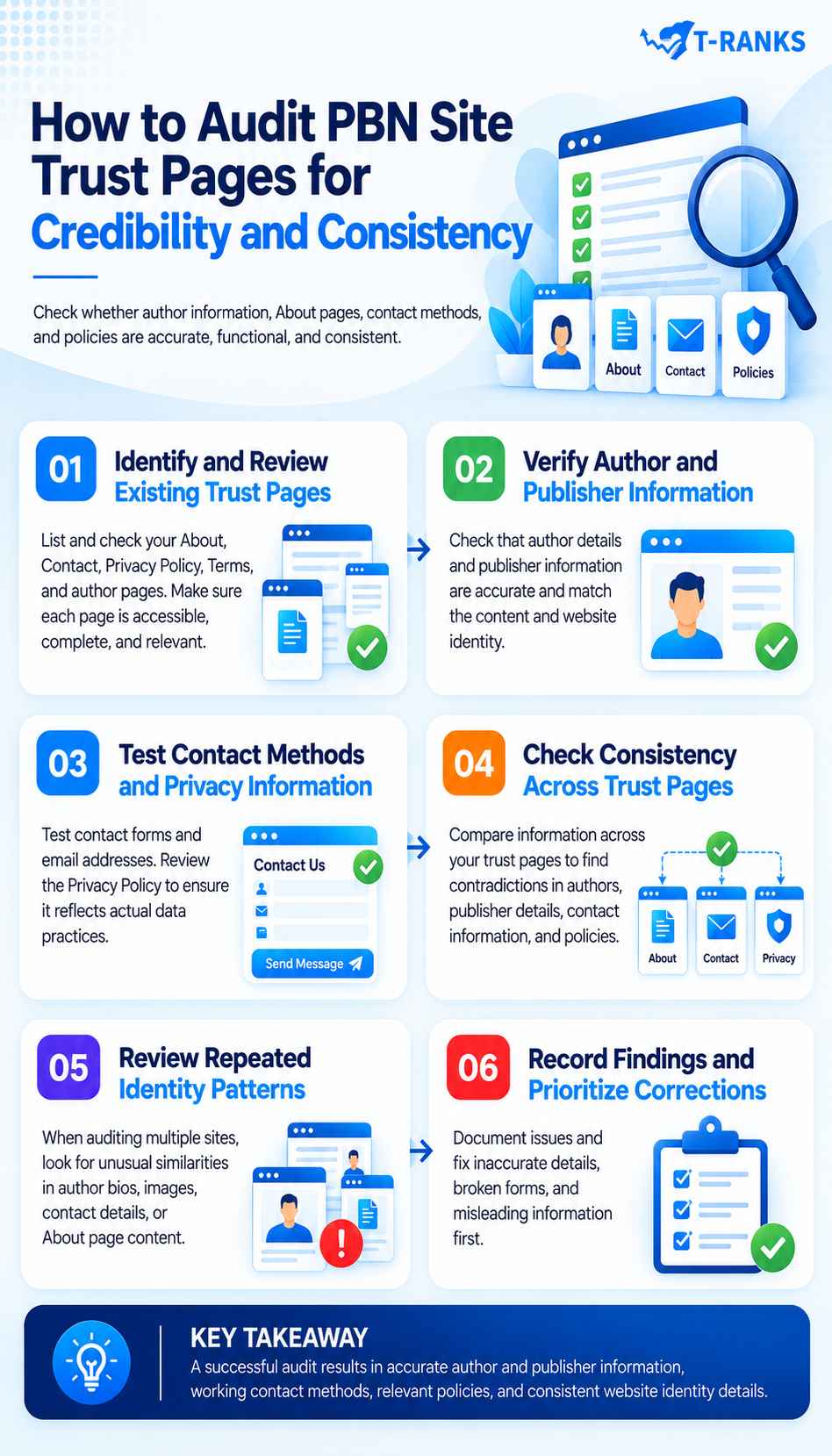
A PBN site trust page audit checks whether author information, About pages, contact methods, and policies are accurate, functional, and consistent with the website’s actual identity. It helps identify misleading details, outdated information, and contradictions that may weaken credibility.
The audit should begin with individual pages, followed by a review of consistency across the website and any related domains.
Step 1: Identify and Review Existing Trust Pages
Start by listing the website’s available trust pages, including About, Contact, Privacy Policy, Terms, disclaimers, and author profiles where applicable.
Check whether each page is accessible, complete, and relevant to the website’s activities.
For example, an About page containing placeholder text or a Privacy Policy referencing an old domain requires attention. Missing pages should be evaluated according to the site’s actual needs rather than a fixed checklist.
Step 2: Verify Author and Publisher Information
Review author biographies and About page details to confirm that they accurately identify the people or organizations responsible for published content.
Check whether:
- Author names and qualifications are accurate.
- Author expertise matches the subjects covered.
- Publisher information agrees with the About page.
- Profile photographs represent the identities presented.
For example, an author described as a licensed professional should have accurate, supportable credentials. Unsupported claims should be corrected or removed.
Step 3: Test Contact Methods and Privacy Information
Examine the Contact page to confirm that visitors can reach the publisher through the methods provided.
Test contact forms, check email addresses, and verify any business details displayed.
Next, review whether the Privacy Policy reflects the website’s actual data practices, including contact forms, analytics, cookies, and relevant third party services.
For example, if a website collects visitor email addresses, its privacy information should accurately explain the relevant collection and use of that data where required.
Step 4: Check Consistency Across Trust Pages
Compare information across the website to identify contradictions involving authors, publishers, contact details, and policies.
Pay particular attention to:
- Different publisher names on About and Contact pages.
- Conflicting author credentials or biographies.
- Outdated email addresses or domain references.
- Privacy Policies describing services the site does not use.
For example, if the About page identifies one organization while the Privacy Policy names an unrelated publisher, the inconsistency should be investigated and corrected.
The goal is to ensure that all trust pages accurately describe the same website.
Step 5: Review Repeated Identity Patterns Across Sites
When auditing multiple PBN websites, compare relevant identity information to identify unusual similarities.
Look for repeated author biographies, profile photographs, contact information, distinctive About page wording, and matching policy errors.
For example, several websites using the same photograph under different author names, along with identical biographies and contact details, may indicate a shared publishing process or inaccurate identity information.
However, common legal wording and standard page structures are not sufficient evidence of a PBN connection. Each finding should be evaluated in context.
Step 6: Record Findings and Prioritize Corrections
Complete the audit by documenting problems and identifying the corrections needed.
A simple review table can help organize the findings:
| Trust Element | Common Issue | Recommended Action |
| Author Bio | Unsupported credentials | Verify or correct claims |
| About Page | Outdated publisher details | Update website identity |
| Contact Page | Broken contact form | Repair and test submissions |
| Privacy Policy | Incorrect data practices | Update relevant disclosures |
| Cross Site Identity | Conflicting author information | Investigate and correct inconsistencies |
Prioritize inaccurate identity claims, broken communication methods, and misleading privacy information before addressing minor formatting differences.
A successful PBN site trust page audit produces accurate author and publisher information, working contact methods, relevant policies, and consistent website identity details. It improves transparency without treating trust pages as a guarantee of search rankings or protection from Google’s link spam policies.
Best Practices for Maintaining Credible PBN Trust Pages
Maintaining credible PBN site trust pages requires accurate information, consistent website details, and regular updates that reflect how each site actually operates. Author bios, About pages, contact information, and policies should remain useful to visitors rather than exist simply to make a website appear established.
The goal is to maintain a reliable public identity through genuine information and ongoing website management.
Prioritize Accurate and Site Specific Information
Each trust page should provide information that reflects the individual website’s purpose, content, and publishing practices.
For example, an About page should explain the site’s actual editorial focus, while author bios should describe genuine experience relevant to published articles. Contact details and Privacy Policies should also reflect the website’s real communication methods and data practices.
Avoid fabricated qualifications, invented business information, and generic descriptions that provide little meaningful context. Templates may help organize pages, but factual details should be reviewed for accuracy before publication.
Maintain Consistency and Update Outdated Details
Trust pages should be reviewed when website information, contributors, or operational practices change.
For example, changing a publisher’s contact email may require updates to the Contact page, Privacy Policy, and other relevant sections. Similarly, introducing analytics tools, advertising, or new contact forms may require reviewing existing privacy disclosures.
Author profiles should also be updated when contributors change roles or when their published information becomes outdated.
Regular maintenance helps prevent conflicting identities, broken communication methods, and policies that no longer describe the website accurately.
For PBN site trust pages, long term credibility depends on maintaining accurate, relevant, and consistent information rather than adding more pages or relying on artificial trust signals.
Final Verdict: Are PBN Site Trust Pages Worth Having?
In conclusion, PBN site trust pages help establish website credibility when they provide accurate authorship, clear publisher information, working contact methods, and relevant policies. These elements support transparency and give visitors a better understanding of the website’s identity and purpose.
However, fabricated author profiles, inconsistent details, and copied policies can weaken credibility. Repeated identity information across multiple PBN sites may also reveal network footprints. While well maintained trust pages support a more reliable website experience, they do not guarantee higher Google rankings or eliminate the risks of manipulative backlinks.
The best approach is to maintain genuine, consistent information and review trust pages as the website evolves.
Want to build a more informed backlink strategy? Explore T-RANKS to learn about backlink placement options and how relevance, website quality, and transparency fit into your SEO decisions.
Frequently Asked Questions About PBN Site Trust Pages
What Are PBN Site Trust Pages?
PBN site trust pages are supporting pages that explain a website’s identity, authorship, contact methods, and relevant policies. Common examples include About pages, Contact pages, author bios, Privacy Policies, and Terms pages.
Do PBN Sites Need About and Contact Pages?
About and Contact pages are useful but not universal Google ranking requirements. They help visitors understand a PBN site’s purpose, identify its publisher, and find appropriate contact information.
Do Author Bios Improve PBN Site Credibility?
Yes, accurate author bios can improve perceived credibility by identifying content creators and explaining their relevant expertise. However, fabricated credentials or misleading author identities can undermine trust.
Does Google Require Author Bios on Every Website?
No, Google does not require author bios on every website. Its guidance encourages accurate authorship information when readers would reasonably expect it, particularly for content requiring expertise.
Can PBN Sites Use Pen Names for Authors?
Yes, PBN sites can use legitimate pen names or established publishing identities. However, invented qualifications, false professional histories, and misleading claims about an author’s expertise should be avoided.
Do Privacy Policies Help PBN Sites Rank Higher?
No, adding a Privacy Policy does not automatically improve Google rankings. Privacy Policies explain relevant data collection and handling practices, with requirements depending on the website’s activities and applicable laws.
Can Google Identify PBNs Through Trust Pages?
Trust pages can reveal similarities that may help identify relationships between PBN websites, but they do not prove Google has detected a network. Repeated author identities, contact details, and distinctive content may indicate shared management.
Are Identical Privacy Policies a PBN Footprint?
Identical Privacy Policies are not necessarily evidence of a PBN. Standard legal wording is common, while repeated contact details, unusual errors, and identical site specific information may provide stronger indications of shared management.
Can Trust Pages Prevent Google Penalties?
No, trust pages cannot prevent Google penalties for manipulative link practices. Accurate author information and legal policies do not make backlinks created primarily to manipulate rankings compliant with Google’s spam policies.
How Often Should PBN Trust Pages Be Updated?
PBN site trust pages should be reviewed periodically and whenever important website details change. Updates to authorship, contact information, data collection, or publishing practices may require corresponding revisions to relevant pages.